


Listen to the article
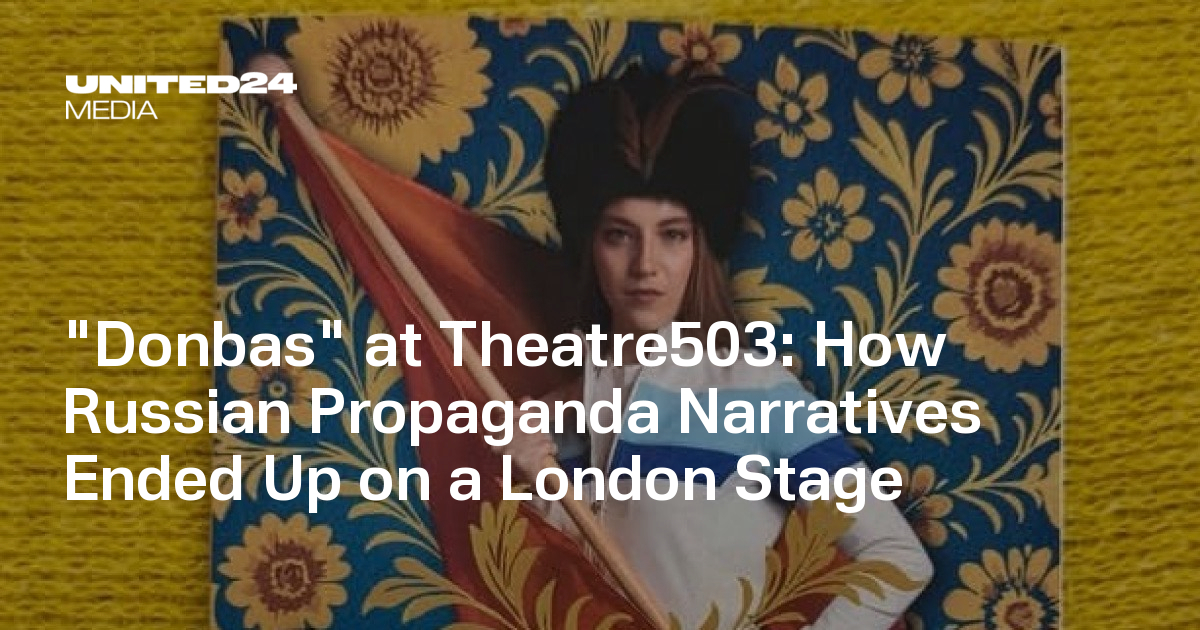
The controversial play “Donbas” currently running at London’s Theatre 503 has sparked criticism over concerns it may distort perceptions of Russia’s war against Ukraine. The production, which premiered on February 5 and runs until March 7, has sold out shows but faces serious questions about its narrative framing and the background of its playwright.
Written by Olha Braga, who identifies herself as Ukrainian, the play features Ukrainian actress Sasha Sizonenko and is directed by Anthony Simpson-Pike. However, stand-up comedian Iryna Hil has raised significant concerns about both the play’s content and Braga’s background.
According to Hil’s investigation, Braga was previously known as Olha Nikora before 2022. Her profile on the Vertical Line Theatre website states she was born in “Transnistria, a region in the former USSR” before emigrating to New Zealand as a teenager. She later moved to the United Kingdom, where she now works at the National Theatre and writes commissioned plays for the Royal Shakespeare Company.
Hil’s research revealed that the first reference to Braga as a “Ukrainian playwright” appeared on March 25, 2022 – shortly after Russia’s full-scale invasion of Ukraine began. At that time, Braga’s earlier play “Return to Sender” was suddenly categorized among works that “Ukrainian authors write and urgently translate almost under bombs.” Hil also pointed out that Braga continues to follow Russian accounts on Instagram, raising questions about her claimed Ukrainian identity.
British theater publications have largely praised the production. The Art Desk describes the Donbas town where the play is set as a place where “ethnic Ukrainians and ethnic Russians who once played together in the streets, now shoot across them.” Theatre Vibe suggests the performance leads the audience to realize that “people are not as clear cut as either Russian or Ukrainian as all these separate countries were once part of the USSR.”
London Pub Theatres’ review states that war is “a pointless, meaningless hell” and praises Braga for not “taking the easy route of simply lionising heroic little Ukraine. Instead it shows us the heartbreaking squalor of living in the midst of a war.”
These reviews have drawn sharp criticism from Hil, who contends they miss the political realities of Russia’s aggression against Ukraine. “Donbas was extended for a month due to sold-out performances. Foreigners are writing enthusiastic reviews while the play blurs the line between aggressor and victim, humanizes occupiers alongside Ukrainians. It presents resistance as irrational. It ignores Russia’s crimes,” she stated on social media.
The controversy highlights ongoing concerns about cultural narratives surrounding the war in Ukraine. Critics argue that framing the conflict as a civil war or ethnic dispute rather than acknowledging it as Russia’s military aggression against a sovereign nation serves to legitimize the Kremlin’s propaganda.
This incident follows other recent controversies in European cultural spaces. British singer Charli XCX faced criticism after attending a Berlinale afterparty hosted by Anastasia Shevtsova, whose mother Zhanna Shevtsova is connected to a foundation operating in Russian-occupied areas of Ukraine and collaborating with Kremlin-supported initiatives.
As the conflict in Ukraine enters its third year, cultural representations of the war have become increasingly contested terrain. The reception of “Donbas” in London demonstrates how artistic productions can become battlegrounds for competing narratives about the nature and causes of the ongoing conflict.
For Ukrainians and their supporters, productions that fail to clearly distinguish between aggressor and victim or that present Russian military actions as part of a more complex ethnic or civil conflict rather than an invasion are seen as undermining Ukraine’s struggle for sovereignty and territorial integrity.
Fact Checker
Verify the accuracy of this article using The Disinformation Commission analysis and real-time sources.

6 Comments
While artistic expression should be protected, we must be vigilant against attempts to distort the truth, especially when it comes to an ongoing war. Fact-checking is essential in these situations.
This seems like a concerning case of potential Russian propaganda being presented as Ukrainian art. I hope the investigation uncovers the full truth behind the play’s origins and messaging.
This is a complex issue that deserves careful examination. I’m curious to learn more about the playwright’s connections and whether the play’s narrative aligns with the facts on the ground in Ukraine.
This is a troubling development that underscores the need for heightened scrutiny of artistic works related to the war in Ukraine. Transparency and accountability must be the top priorities.
It’s important to scrutinize the backgrounds and motivations of those involved in creating works related to the Ukraine conflict. Transparency and accountability are key to avoiding the spread of disinformation.
The revelation that the playwright’s background may be more complicated than initially presented raises serious concerns. I hope the investigation can shed light on the full context surrounding this production.