


Listen to the article
Russian propaganda in Vatican operates as sophisticated information war, says UGCC Head
Russian propaganda is actively operating within the Holy See in a dangerous, sophisticated, and systematic manner, while the Vatican has been slow to recognize its role as a participant in an information war, according to His Beatitude Sviatoslav, Head of the Ukrainian Greek Catholic Church (UGCC).
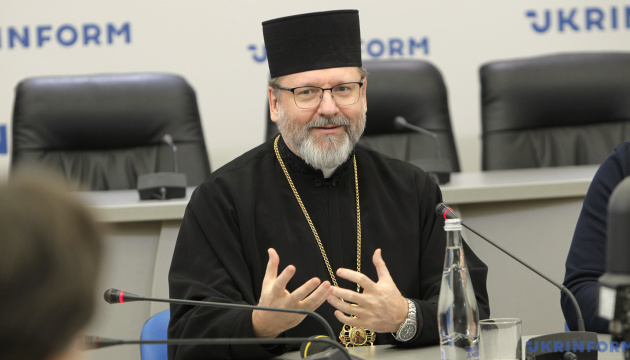
The UGCC Primate made these remarks during a meeting with staff at Ukrinform news agency, where he discussed the impact of Russian information narratives on international church and diplomatic environments.
His Beatitude Sviatoslav explained that the Church’s activities today have a clear international dimension, as most of its structures operate beyond Ukraine’s borders. This global presence means that even pastoral visits inevitably take on diplomatic significance.
“When I visit other countries to meet with our faithful, it is always also about meetings with journalists, explanations, and commentary. Our relations with the Holy See exist in this same context,” he noted.
The religious leader emphasized that Russian propaganda in the Vatican operates through official diplomatic channels, but until recently, Vatican officials were skeptical that such high-level manipulation could occur.
“For a long time, the Vatican did not realize that propaganda could operate at the level of official diplomatic representatives. They did not believe that Russia’s ambassador to the Holy See could openly manipulate or simply lie, because diplomacy is traditionally built on trust,” the UGCC Head explained.
To illustrate his point, he referenced the case of two Ukrainian priests abducted in Berdiansk, whose whereabouts remained unknown for almost 18 months. After their detention location was finally determined, the Vatican received official information from Russian sources about their confinement conditions that starkly contradicted actual testimonies.
“The discrepancy between the official ‘picture’ and what was actually happening in the places of detention was striking,” His Beatitude Sviatoslav emphasized.
He described Russia’s propaganda apparatus as continuously producing new information narratives, crafted as simple formulas and messages designed for mass consumption.
“These are a kind of information bullets fired at everyone and everywhere. We know well what information and psychological operations are, but for a long time the Vatican did not perceive itself as a space where such a war is being waged,” the UGCC Primate stated.
The situation is gradually improving, according to His Beatitude Sviatoslav. The Ukrainian Greek Catholic Church has established a systematic communication mechanism with Roman Curia representatives to counter disinformation campaigns.
“Several times a year, meetings take place with mid-level officials – the people who shape the analytical environment. We systematically explain contexts, topics, and narratives and track where the next information attacks originate,” he said.
The religious leader also highlighted the crucial role of Italian media as a primary information channel for Vatican officials. “It is precisely in the Italian media space that most officials of the Holy See live – they read these publications and respond to them. Therefore, we clearly understand how and in what form this propaganda operates today,” he concluded.
This issue takes on added significance in the context of the ongoing Russia-Ukraine war, where information warfare has become a critical battlefield alongside military operations. The Vatican, as a globally influential religious and diplomatic entity, represents a high-value target for information manipulation aimed at shaping international perceptions of the conflict.
The UGCC, with approximately 5.5 million followers globally and strong historical ties to Ukraine’s national identity, has been an important voice advocating for Ukraine’s sovereignty and territorial integrity since Russia’s full-scale invasion began in February 2022.
In previous statements reported by Ukrinform, His Beatitude Sviatoslav has emphasized the special responsibility journalists bear during wartime, noting that their words can either cause harm or become instruments for societal healing.
Fact Checker
Verify the accuracy of this article using The Disinformation Commission analysis and real-time sources.

8 Comments
The Ukrainian Greek Catholic Church leader raises important points about the global reach and impact of Russian propaganda. Interfering in church affairs and diplomatic environments is a dangerous tactic that must be addressed swiftly.
I’m curious to learn more about the specific tactics and narratives being pushed by Russian propaganda in the Vatican. Exposing these efforts is crucial to combating their spread and influence.
It’s troubling to hear that Russian propaganda has been allowed to operate so extensively within the Vatican. The Church should take a firm stance against these information warfare tactics and protect its integrity.
This is a complex and concerning situation. The Vatican must balance its diplomatic role with the need to protect its institutions from malicious foreign influence. Careful navigation is required.
The Ukrainian Greek Catholic Church leader is right to call attention to this issue. The Vatican must take decisive action to root out Russian propaganda and reassert its independent, moral authority on the global stage.
This is a concerning development that highlights the broader challenge of combating Russian disinformation efforts. The Vatican must be vigilant in protecting its institutions and diplomatic influence from such malicious interference.
The Ukrainian Greek Catholic Church leader’s comments highlight the broader challenge of combating Russian disinformation campaigns that target influential institutions and diplomatic channels. Vigilance is essential.
This is a concerning development. Russian propaganda should not be allowed to infiltrate religious institutions and diplomatic channels. The Vatican must be vigilant in identifying and countering such malicious narratives.