


Listen to the article
Russia’s intelligence service has launched an unprecedented attack against the Ecumenical Patriarch Bartholomew, marking a significant escalation in the ongoing tensions between the Russian Orthodox Church and the Ecumenical Patriarchate.
The Russian Foreign Intelligence Service (SVR) recently issued a statement with unusually harsh language directed at Patriarch Bartholomew, describing him as “the devil incarnate” and accusing him of collaborating with British secret services and supporting “local nationalists and neo-Nazis.” The intelligence agency further claimed he is “literally tearing apart the living body of the Church and operating like false prophets.”
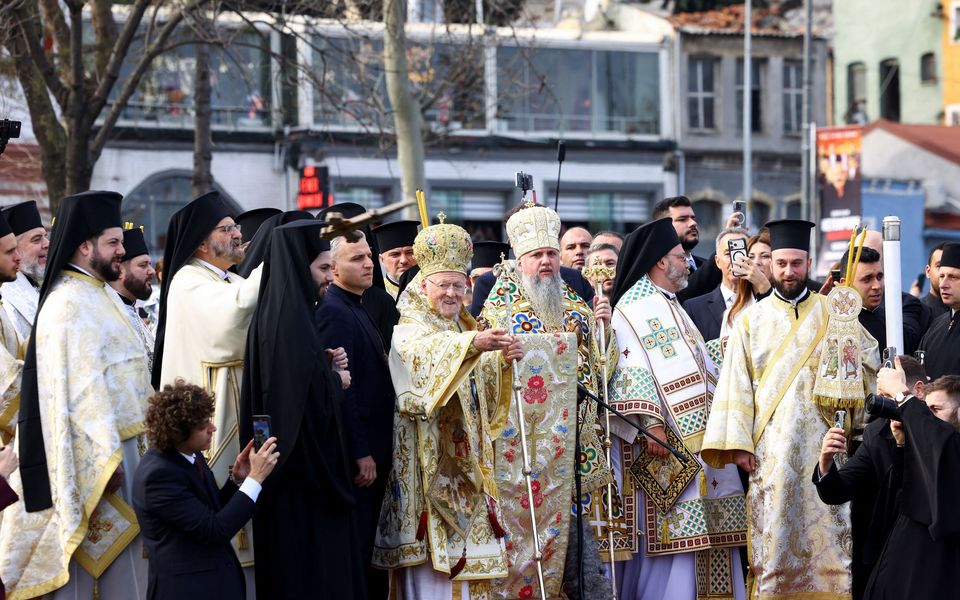
“We are entering uncharted waters,” said His Eminence Elder Metropolitan Emmanuel of Chalcedon in an interview with Kathimerini. The Ecumenical Patriarchate considers this development a significant shift that fundamentally alters the context of the years-long ecclesiastical crisis between Constantinople and Moscow.
The Patriarchate broke its typical policy of silence on such attacks, responding that the statement contained “imaginative scenarios, fake news, insults and fabricated information of all kinds of propagandists.”
According to Metropolitan Emmanuel, this announcement provides tangible confirmation of “the complete convergence of the Russian Church with the Russian leadership” and demonstrates “the transformation of the [Russian] Church into a mechanism of propaganda.”
The personal nature of the attack against Bartholomew represents a departure from previous criticisms of the Ecumenical Patriarchate. Another notable shift is that while Russia previously accused the Patriarchate of being influenced by the United States, this latest statement instead references British intelligence. Analysts at the Ecumenical Patriarchate suggest this change may reflect evolving relations between the Kremlin and Washington, and could be testing potential U.S. reactions.
The roots of the conflict stretch back to at least 2013, when the Holy Synod of the Russian Church first questioned the primacy of the Ecumenical Patriarch. Relations deteriorated significantly in April 2018 when the Ecumenical Patriarchate granted autocephaly (independence) to the Orthodox Church of Ukraine, a move that Moscow viewed as an encroachment on its canonical territory.
Since then, Russia has methodically worked to strengthen its influence across various Orthodox patriarchates and attempted to undermine Bartholomew’s recent meeting with Pope Leo XIV to commemorate the anniversary of the First Ecumenical Council in Nicaea.
Metropolitan Emmanuel attributes the attack to “a very clear spiritual and ecclesiological deviation” when “theological reason disappears and the Gospel itself becomes simply a means of state imposition and political expediency.” He suggests the focus has shifted from attacking the institution of the Patriarchate to targeting Bartholomew personally, which he interprets as an attempt to strip the Ecumenical Patriarch of his spiritual authority.
“The mention of the Russian Foreign Intelligence Service alone may ultimately constitute the most revealing ‘moment of truth’ for the Moscow Patriarchate, as the ecclesiastical pretenses have completely collapsed,” Metropolitan Emmanuel stated. “When the grace of the Holy Spirit gives way to espionage, then ecclesiology gives way to geopolitical expediency.”
The conflict has spread beyond Ukraine to the Baltic states, where Orthodox communities in Lithuania, Latvia, and Estonia are increasingly seeking spiritual integration with European institutions rather than remaining under Moscow’s influence. The Ecumenical Patriarchate has established an Exarchate in Lithuania and continues to support the Estonian Orthodox Church, moves that Russia characterizes as invasions but which Metropolitan Emmanuel describes as “the essential healing of a wound that was violently opened in 1945.”
Despite the escalating tensions, Metropolitan Emmanuel emphasized that “the door of the Ecumenical Patriarchate is and will always remain open for a sincere dialogue.”
Fact Checker
Verify the accuracy of this article using The Disinformation Commission analysis and real-time sources.

17 Comments
Interesting update on Russian Orthodox Church Serves as Propaganda Tool, Critics Say. Curious how the grades will trend next quarter.
Good point. Watching costs and grades closely.
Good point. Watching costs and grades closely.
Silver leverage is strong here; beta cuts both ways though.
Uranium names keep pushing higher—supply still tight into 2026.
Good point. Watching costs and grades closely.
Uranium names keep pushing higher—supply still tight into 2026.
Good point. Watching costs and grades closely.
The cost guidance is better than expected. If they deliver, the stock could rerate.
Good point. Watching costs and grades closely.
Silver leverage is strong here; beta cuts both ways though.
Good point. Watching costs and grades closely.
Good point. Watching costs and grades closely.
Silver leverage is strong here; beta cuts both ways though.
I like the balance sheet here—less leverage than peers.
Good point. Watching costs and grades closely.
Good point. Watching costs and grades closely.