


Listen to the article
Russia to Revise School History Textbooks Amid Widespread Criticism
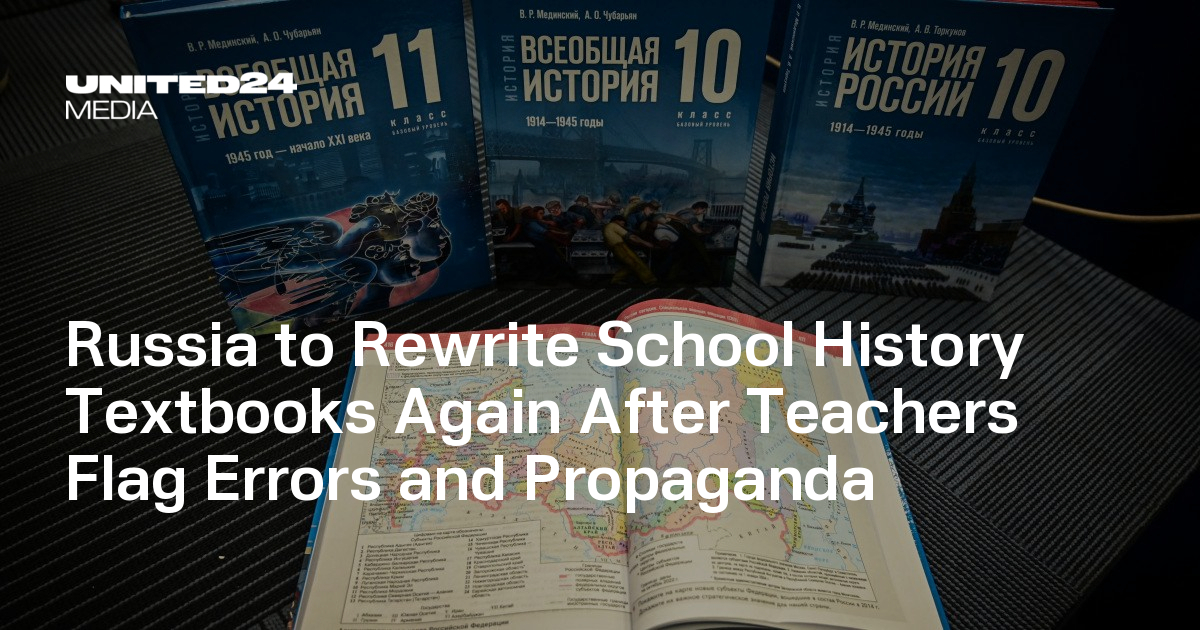
Russia is preparing once again to overhaul its state-approved school history textbooks following significant criticism from educators, according to a February 2 report from Ukraine’s Foreign Intelligence Service (SZRU). Teachers have highlighted numerous factual errors, internal contradictions, and ideological distortions in the current editions.
The revised textbooks are scheduled for release in 2026, with a second edition planned for grades 5-9 and a third edition for upper secondary schools. According to intelligence sources, the volume of feedback from teachers has been unprecedented, with some educators submitting dozens of pages of detailed comments on individual textbooks.
Vladimir Medinsky, head of the Russian Military Historical Society and an aide to President Vladimir Putin, has downplayed concerns by describing the repeated revisions as a “normal process,” characterizing history as a “living organism.” The SZRU notes that this rhetoric reflects a familiar pattern in Russia’s approach to historical education, which often prioritizes emotional narratives over scholarly rigor.
The forthcoming editions are expected to expand sections explaining the causes of Russia’s so-called “special military operation” in Ukraine. Additionally, the modern history curriculum will be extended to include reference to a meeting between Putin and former US President Donald Trump in Anchorage, further illustrating how school history is being weaponized as a tool of state propaganda to legitimize the Kremlin’s policies.
This textbook revision comes amid broader efforts to control historical narratives in Russia. According to Ukrainian intelligence, Russian authorities are planning to restrict access to Wikipedia within the next one to two years, citing alleged distortions of historical facts about tsarist, Soviet, and contemporary Russian history.
In parallel, Moscow is advancing a state-backed publishing project that incorporates temporarily occupied Ukrainian territory into its official historical narrative. Ukraine’s Center for Countering Disinformation reports that Russia is promoting a multi-volume work titled “Anthology of Historical Cities and Villages of Russia,” which includes regions currently under Russian occupation in Ukraine.
Russian-installed authorities in occupied Crimea are already distributing this publication, which consists of 10 volumes published across 13 books. One section, “Crimea and Novorossiya,” reportedly covers not only Crimea but also occupied areas of southern and eastern Ukraine. Copies are being supplied to institutions including the so-called Crimean Federal University and the peninsula’s main research library.
This initiative appears to be part of a broader strategy to reshape historical consciousness in occupied territories. Earlier reports indicated that Russia plans to supply schoolchildren in occupied parts of Ukraine’s Luhansk region with more than 100,000 publications presenting a revised version of the region’s history.
These efforts reflect Russia’s ongoing campaign to use historical education as a tool for territorial legitimization and ideological indoctrination. By controlling historical narratives in schools, Russian authorities seek to reinforce territorial claims and shape the worldview of younger generations, particularly in contested regions.
Educational experts note that such revisions of history textbooks are common in authoritarian regimes seeking to consolidate control over public discourse. The systematic rewriting of history serves not only to justify current policies but also to create a foundation for future territorial ambitions by establishing historical “precedents” through state-approved educational materials.
As Russia continues its military operations in Ukraine, the battle over historical narratives remains a critical component of its broader information warfare strategy, with school textbooks serving as a frontline in this ideological conflict.
Fact Checker
Verify the accuracy of this article using The Disinformation Commission analysis and real-time sources.

10 Comments
The high volume of teacher feedback suggests widespread issues with the current history textbooks. Revising them by 2026 seems like a tight timeline, but getting it right is crucial for educating future generations.
You raise a good point. Rushing the process could lead to new problems, so Russia would be wise to take the necessary time to thoroughly address the concerns raised.
Russia’s approach to historical education has long been a point of debate. Prioritizing emotional narratives over scholarly rigor is concerning, so hopefully these revisions can improve the factual accuracy and credibility of their textbooks.
Indeed, transparency and academic integrity should be the top priorities when revising such important educational materials.
Textbook revisions are always a sensitive topic, especially when they involve a country’s own history and national identity. Russia faces a significant challenge in balancing accuracy, consistency and ideological considerations in this process.
You make a fair point. Revising history textbooks is a delicate balance, and Russia will need to be very thoughtful and transparent to ensure the new versions meet high academic standards.
Interesting to see Russia taking this step. Revising history textbooks is a sensitive process, so it’s good they’re addressing concerns from teachers. Curious to see how they balance accuracy with any potential ideological spin.
Agreed, it will be important to monitor how these revisions unfold and ensure historical facts are presented objectively.
It’s encouraging that Russia is acknowledging the need to update their historical narratives. However, the language around history as a ‘living organism’ raises some red flags. Fact-based, objective revisions should be the priority.
Agreed. Framing history as a malleable ‘organism’ rather than a factual record is concerning and could signal an intent to reshape the narrative for political purposes.