


Listen to the article
Russia’s School Takeover: Militarizing Ukraine’s Youth in Occupied Territories
When Russian forces seize control of Ukrainian towns, schools quickly become prime targets for occupation authorities. An extensive investigation of hundreds of Telegram posts from Russian propaganda channels operating in occupied Ukraine since 2022 has uncovered a systematic campaign to militarize and indoctrinate children through the education system.
Channels like “Genichesk in the Foreground,” “Berdyansk is Ours,” “New Melitopol,” and “Official Berdyansk” regularly publish classroom reports and images that reveal how education has been weaponized to erase Ukrainian identity and cultivate Russian loyalty—grooming even the youngest students for potential military roles.
The human toll of this transformation is evident in stories like Oleksiy’s, a 60-year-old school principal whose life changed dramatically on March 2, 2022, when Russian tanks rolled into his village in Zaporizhzhia region. Classes halted, children fled, and combat drew closer. When occupation authorities demanded he reopen the school under the Russian curriculum, he refused, triggering immediate repercussions.
Armed Russian soldiers visited Oleksiy’s home at least 11 times. During one particularly harrowing incident, they drove him 10 kilometers into the countryside, held him at gunpoint, and presented falsified documents with his signature, accusing him of “collaborating with Ukraine.” They abandoned him to walk home alone. The intimidation continued with death threats, forced conscription warnings, and threats against his wife, while authorities confiscated their passports.
By April 2024, Oleksiy received a deportation order accusing him of “illegal entry into the Russian Federation,” imposing a 20-year ban and confiscating his property. Russian forces escorted him and his wife across Russia to the Georgian border, returned their documents, and they eventually made their way back to Ukrainian-controlled territory. Today, Oleksiy continues to run his former school online, while the situation inside occupied territories remains drastically different.
“I grew up under occupation,” says 19-year-old Alyona, who recently escaped from Simferopol, Crimea. She was just eight when Russia seized the peninsula in 2014. After the full-scale invasion in 2022, she describes how school propaganda became increasingly aggressive: “It was a turning point. They want to capture young people’s minds. That way, there will be no rebellion.”
During her final years in school, each day began with the Russian anthem, and the educational environment was carefully structured to enforce loyalty. The invasion was consistently framed as a heroic mission, while Ukrainian history was largely distorted or erased completely. “In 2014 Ukrainian was taught in my school. Within a year it became optional, then disappeared,” she explains.
Data from human rights organization Almenda illustrates the scale of this transformation. Before Crimea’s occupation, all pupils studied Ukrainian language and literature; by 2024, just 0.5 percent did. This pattern quickly spread to newly occupied territories after 2022—by 2023-2024, only 43 percent of pupils in Zaporizhzhia and 60 percent in Kherson studied Ukrainian. Russian media reported in June 2025 that Ukrainian would be removed entirely from all schools under Russian control.
The human cost is staggering—approximately 1.6 million children currently live under Russian occupation, with nearly 600,000 of school age. This includes 41,000 pupils in occupied Zaporizhzhia, 20,000 in Kherson, 100,000 in Luhansk, and 147,000 in Donetsk.
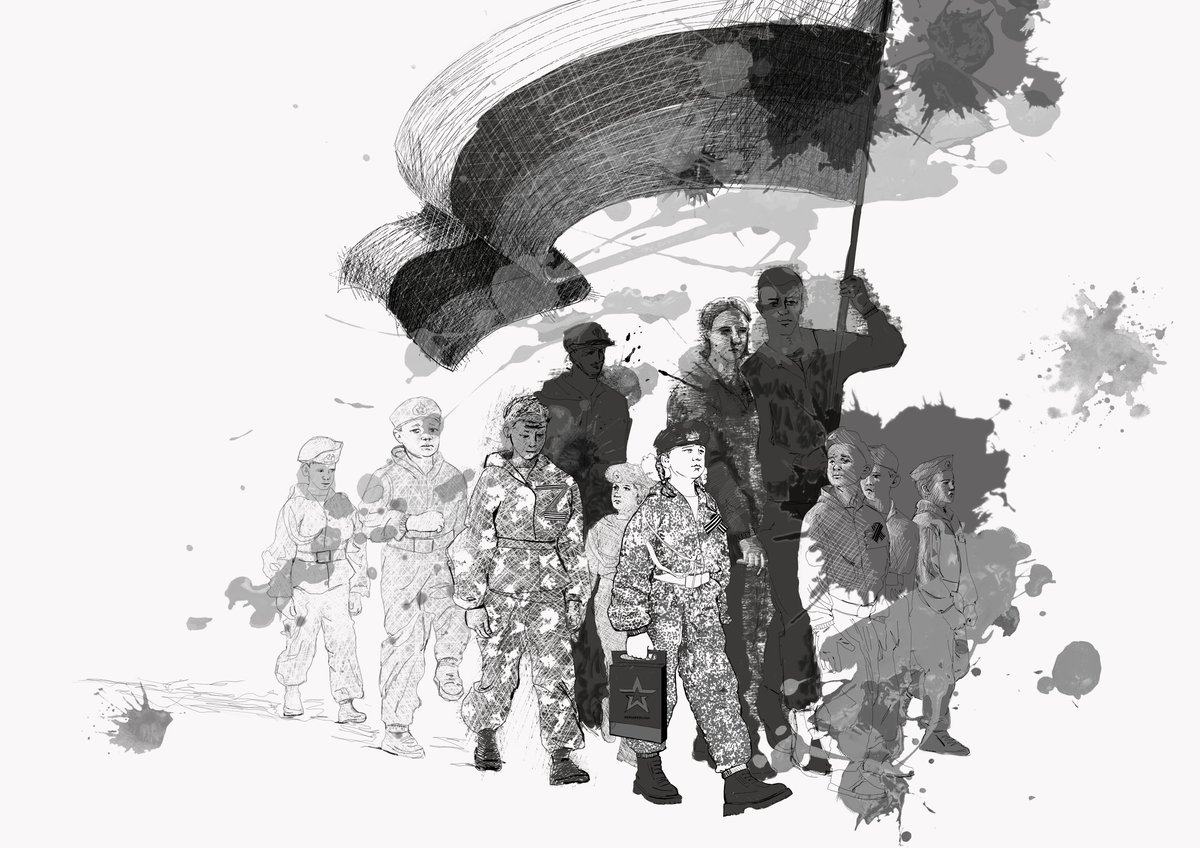
Youth militarization has become a cornerstone of the Kremlin’s strategy. Two main structures—Yunarmiya, created by Russia’s defense ministry in 2016 to promote military discipline, and the Movement of the First, a Kremlin-run successor to the Soviet Pioneers—operate throughout occupied regions, delivering propaganda-heavy “patriotic education” in schools.
Yunarmiya’s militaristic focus is particularly prominent in territories seized after 2022. In 2025, Moscow allocated one billion rubles to the organization, primarily through Vladimir Putin’s “Youth and Children” project and the defense ministry. By 2024, it had enrolled 44,600 minors in occupied territories, while the Movement of the First claimed nearly 122,000 participants.
Telegram posts regularly show pupils in Zaporizhzhia and Kherson standing in formation, wearing Yunarmia’s distinctive red berets, taking oaths, and singing the Russian anthem. Children are frequently transported to Russia for militarized competitions, appearing in uniform and carrying the organization’s flags.
Within schools, Yunarmiya coordinates with Russian military units that regularly enter classrooms, effectively transforming educational spaces into extensions of the armed forces. Social media evidence shows armed groups brought in to display weapons, while some schools stage full military-style drills with marching. Even sports tournaments incorporate weapons training.
“From the fifth grade, military pressure begins in schools,” Alyona confirms. “During special lessons, there are exercises with weapons.” Boys are encouraged to register with enlistment offices as early as age 14 or 15, and some are taken to firing ranges. “Young people are treated as cannon fodder,” she says.
Russia’s National Guard, Rosgvardia, which reports directly to Putin, is particularly active in this effort. Its units conduct “Lessons of Courage” in schools and orphanages under the guise of patriotic education, alongside “Cadet classes” that blend military discipline with regular instruction. These programs target even the youngest children—one post from occupied Zaporizhzhia shows approximately 200 very young children taking an oath.
Additional military groups, including Dnepr fighters, Grom-2, and Afghanistan veterans, frequently appear in occupied schools, further normalizing military presence in educational settings.
So-called recreational camps have become another powerful tool for ideological influence. While Crimea’s Artek facility is the most well-known, children from occupied territories are regularly sent deep into Russia—from the Moscow region to the Far East, the Caucasus, and Adygea. In March 2023, Russian-installed authorities announced that children from occupied Kherson would be sent to Primorye in Russia’s Far East for “rest and study.” According to Almenda, over 220,000 children were sent to camps in Crimea, Russia, and Belarus during summer 2024 alone.
Moscow has established an extensive network of military-patriotic centers, including VOIN, created in December 2022 on Putin’s initiative. Active in occupied territories since 2023, VOIN trained approximately 17,000 young people that year and operates 22 branches under direct Kremlin oversight. Sergei Kiriyenko, deputy head of the presidential administration, personally oversaw the opening of its Berdyansk branch.
Human rights experts note that these practices violate at least seven international legal norms, including prohibitions against war propaganda, militarizing minors, and altering the legal status of protected children. The elimination of Ukrainian education and forced indoctrination contravenes both the Hague and Geneva Conventions.
Among the most severe abuses are forced transfers and imposed Russian citizenship. Videos from Telegram channels show schoolchildren receiving Russian passports in official ceremonies, while parents are compelled to obtain citizenship to keep their children enrolled in school. Ukraine’s ombudsman Dmytro Lubinets has reported that teenagers raised under occupation since 2014, now captured fighting for Russia, often say they had no meaningful choice.
For those like Alyona who managed to escape to free Ukraine, the future of those left behind remains uncertain. “Many still hope to leave but are trapped by fear, isolation, and lack of information,” she says. “But living like that, the way they live there, is not a life.”
Fact Checker
Verify the accuracy of this article using The Disinformation Commission analysis and real-time sources.

16 Comments
This report highlights the disturbing ways Russia is exploiting education in occupied Ukraine to erase local identity and indoctrinate children. Forcing schools to promote Russian nationalism and prepare students for military service is a blatant attempt at cultural erasure and a violation of human rights.
You’re right, this is a deeply concerning situation. Militarizing schools and using children as pawns in Russia’s propaganda war is a horrific abuse of power. The long-term psychological impact on these young minds will be devastating and must be condemned by the international community.
The report highlights how Russia is systematically undermining Ukraine’s educational system in occupied territories. Forcing schools to promote Russian nationalism and prepare students for military service is a blatant attempt to erase Ukrainian identity. This is a grave human rights violation.
You’re right, this is a deeply concerning situation. Militarizing schools and exploiting children for propaganda purposes is a horrific abuse of power. The impact on these young minds will be devastating and long-lasting.
The systematic militarization of education in occupied Ukraine is a troubling tactic by Russia to consolidate control and shape the next generation. Forcing schools to adopt Russian curricula and groom students for potential military service is a grave violation of human rights.
Absolutely, this is an egregious abuse of power. Denying children access to a proper education and subjecting them to nationalist indoctrination and military recruitment is unacceptable. The international community must take strong action to condemn and stop these practices.
This report paints a bleak picture of how Russia is exploiting the education system in occupied Ukraine to erase local identity and indoctrinate children. Forcing schools to promote Russian nationalism and prepare students for military service is a blatant attempt at cultural erasure.
You’re right, this is a deeply concerning situation. Militarizing schools and using children as pawns in Russia’s propaganda war is a horrific abuse of power. The long-term psychological impact on these young minds will be devastating.
This is a very concerning report. Indoctrinating and militarizing children is a horrific abuse of power by the Russian occupation forces. Erasing Ukrainian identity and forcing Russian loyalty is a grave violation of human rights.
Absolutely, this is a blatant attempt to brainwash and exploit the next generation in occupied Ukraine. The schools should remain a safe haven for learning, not a tool for propaganda and military recruitment.
Militarizing education in occupied Ukraine is a disturbing tactic by Russia to consolidate control and indoctrinate the next generation. Forcing schools to adopt Russian curricula and groom students for potential military roles is a grave violation of human rights.
Absolutely, this is an egregious abuse of power. Denying children access to a proper education and subjecting them to nationalist propaganda and military recruitment is unacceptable. The international community must take swift action to condemn and stop these practices.
Weaponizing education is a chilling tactic. Forcing schools to adopt the Russian curriculum and groom students for military service is a despicable attempt to cement control over the region. This will have long-lasting psychological impacts on the children.
I agree, this is an egregious abuse of power. Denying children access to a proper education and subjecting them to indoctrination is unacceptable. The international community must condemn these actions and hold Russia accountable.
The report reveals the alarming ways Russia is weaponizing education in occupied Ukraine to consolidate control and indoctrinate the next generation. Forcing schools to adopt Russian curricula and groom students for potential military service is a grave violation of human rights.
Absolutely, this is an egregious abuse of power. Denying children access to a proper education and subjecting them to nationalist propaganda and military recruitment is unacceptable. The international community must take swift and strong action to condemn and stop these abhorrent practices.