


Listen to the article
Russian aggression against Europe intensifies as Putin broadens offensive strategies, prompting debate on Western response
Russian President Vladimir Putin has expanded his aggressive posture toward Europe following unsuccessful negotiations with U.S. President Donald Trump. Recent weeks have seen multiple drone incursions into Polish and Danish airspace, accompanied by intensified cyberattacks against various NATO member states. These provocations have reignited discussions about appropriate countermeasures from Europe and the United States.
Historically, Ukraine’s allies have shown restraint in applying maximum pressure on Russia. However, the conversation is shifting as experts propose more assertive approaches. Jack Watling of the Royal United Services Institute has suggested blocking Russian oil exports through the Baltic Sea while enabling Ukraine to target Russian refineries. Former Ukrainian Defense Minister Andriy Zagorodnyuk advocates for disrupting military assets deep within Russian territory.
Beyond kinetic and economic warfare, security experts increasingly emphasize the importance of information operations – what NATO refers to as the “cognitive domain.” NATO is developing a cognitive warfare concept aimed at “affecting attitudes and behaviors by influencing, protecting, and/or disrupting individual and group cognitions to gain an advantage,” which includes targeted information campaigns directed at adversary populations.
Such cognitive strategies offer both immediate tactical benefits, such as undermining Russian military recruitment, and contribute to broader deterrence efforts. The Russian leadership under Putin is particularly vulnerable to these approaches due to their obsession with maintaining the appearance of domestic control.
This preoccupation manifests in multiple ways, from blatantly rigged elections to constant population polling. When Putin’s approval ratings decline, Russian elites and media circles immediately speculate about potential instability, prompting intensive propaganda campaigns to restore public confidence.
The Kremlin’s fear of losing control became evident early in the Ukraine war when rumors of mobilization prompted approximately one million Russians to flee the country, creating chaos that undermined the government’s image of authority. Since then, the regime has preferred using expensive contract soldiers rather than risking another politically damaging exodus.
The current generation of Russian leaders, most in their 60s and 70s, vividly remembers the Soviet Union’s sudden collapse in 1991. Their fear of domestic instability represents a potential pressure point that remains largely unexploited by Western powers. By threatening the Kremlin’s control over its information environment, Ukraine’s allies could compel Putin to reconsider his aggressive foreign policy.
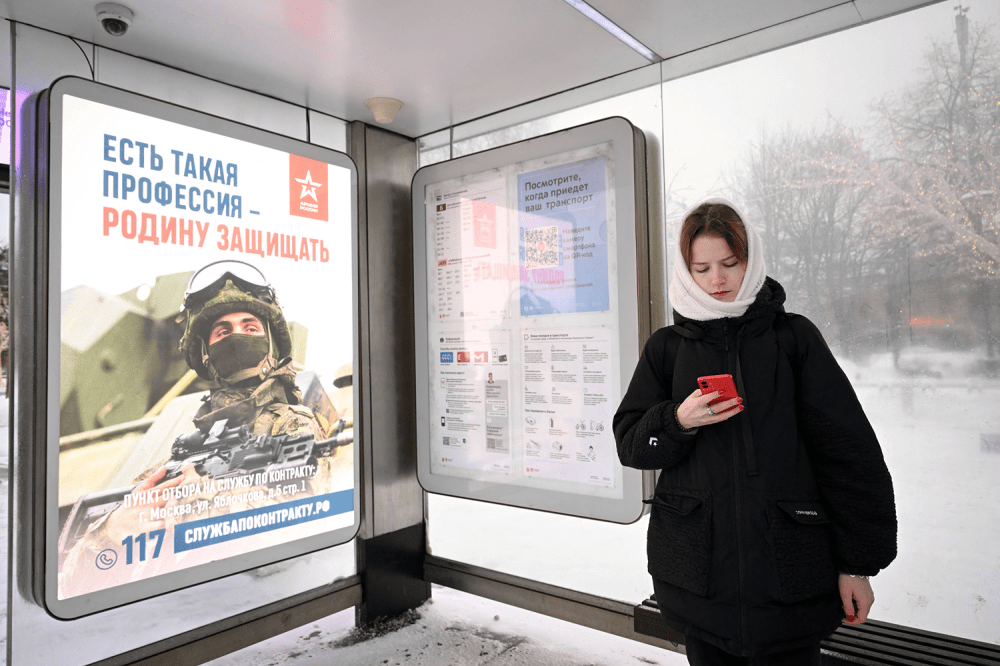
Military recruitment offers one obvious target for information operations. Russia requires approximately 30,000 new military recruits monthly to sustain its war effort, currently enlisting about 1,200 people daily according to Ukrainian intelligence. The Kremlin has developed an extensive social media recruitment campaign, with over 363,000 contract-service posts on VK between March 2022 and September 2024. Recruitment efforts tripled following Ukraine’s incursion into Russia’s Kursk region in August 2024.
Ukrainian information campaigns targeting recruitment have yielded mixed results. While images of civilian suffering or dead Russian soldiers sometimes backfire by triggering patriotic responses, other messages prove more effective. These include concerns about criminal elements within the military, uncertainties about compensation for families of deceased soldiers, war-related cuts to social services, and fears about deceptive recruitment practices.
Economic pressure represents another vulnerability. Despite sanctions, research by U.S. data analytics firm FilterLabs indicates that socioeconomic issues remain the narrative the Kremlin struggles most to control. Government data shows increasing citizen complaints about quality-of-life issues including infrastructure, housing, and communal services.
Ukraine’s Kursk incursion in August 2024 demonstrated how coordinated pressure across multiple domains could destabilize the regime. The operation paralyzed Russian military and propaganda systems, with polls showing trust in Putin dropping to a war-time low of 45 percent. This presented an opportunity for simultaneous pressure through financial sanctions, oil blockades, and targeted information operations – an approach that could potentially force the Kremlin to reconsider its war calculus.
Western reluctance to exploit such opportunities stems largely from fears of escalation – concerns that have repeatedly proven misplaced. The initial hesitation to allow Ukraine to strike military targets inside Russia exemplifies this misunderstanding of effective deterrence.
Modern technology offers numerous channels for information operations despite increasing Russian censorship. Ukrainian tech specialists are pioneering methods to overcome digital restrictions by testing messages, measuring behavioral changes, and identifying effective distribution channels.
Rather than replicating Russia’s disinformation tactics, Western information campaigns should emphasize factual information and suppressed truths. The approach need not choose between attributable government messaging and disguised content. During World War II, British radio broadcasts to Germany succeeded by demonstrating detailed understanding of front-line conditions while maintaining a degree of official distance. Similarly, American “freedom radios” during the Cold War remained popular with Soviet bloc audiences even after their CIA funding was exposed.
Achieving similar success today will require diverse initiatives beyond traditional channels. While the Ukrainian military employs psychological operations against adversaries, broader impact requires large-scale media engagement beyond Russia’s liberal minority. The challenge isn’t hiding Western involvement – most Russians already believe they’re targeted by Western information operations – but rather demonstrating detailed understanding of Russian internal dynamics while minimizing risks for audiences.
This presents an opportunity for collaborative efforts across countries and sectors. Nations with higher risk tolerance, particularly Ukraine, can focus on content delivery, while others develop technologies to penetrate censorship. Private sector innovation can complement civil society’s agility in creating campaigns and media initiatives.
Such collaboration represents a form of “cognitive deterrence,” demonstrating to Putin that his adversaries are unified and prepared to target his most significant vulnerabilities.
Fact Checker
Verify the accuracy of this article using The Disinformation Commission analysis and real-time sources.

7 Comments
The cognitive domain is just as important as the kinetic one. NATO needs to ramp up its information operations to counter Russian disinformation and sway public opinion. A multifaceted strategy is required.
Absolutely, information warfare is a key battleground. Fact-based messaging and digital campaigns will be crucial to blunting Russia’s propaganda push.
This is a complex and rapidly evolving situation. I’m curious to see how Western leaders balance the need for assertiveness with maintaining moral high ground and avoiding escalation.
Valid point. Finding that right balance will be challenging but essential. Measured, strategic responses may be more effective than knee-jerk retaliation.
The article raises important questions about ethical approaches to countering Russian aggression. Protecting democratic values while pushing back firmly will be crucial.
Interesting perspective on the information warfare aspect of this conflict. Ethical approaches are critical to maintaining the moral high ground against Russian propaganda.
While I agree that restraint has been the norm so far, the stakes are clearly escalating. Disrupting Russian oil exports and military assets could be necessary deterrents, if done carefully.