


Listen to the article
Russia Denies Recruiting Kenyans for Ukraine War Amid Growing Evidence of Exploitation
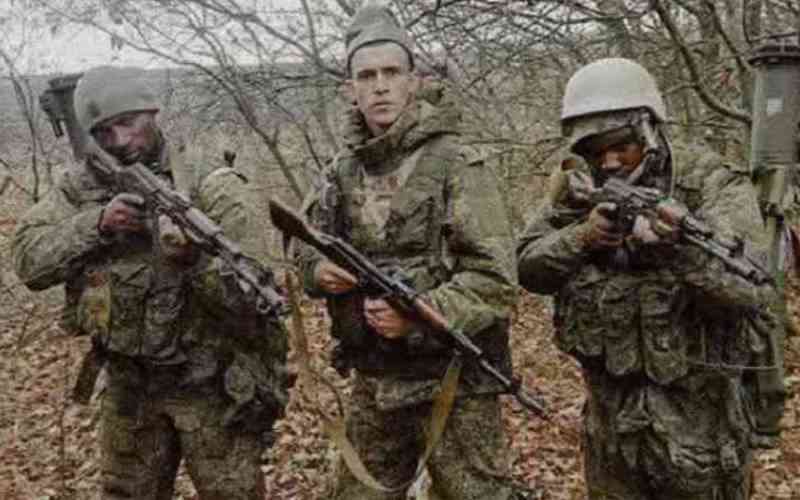
The Russian Embassy in Nairobi has forcefully rejected allegations that it recruited Kenyan citizens to fight in its war against Ukraine, calling such claims “dangerous and misleading propaganda.” The denial came just a day after Kenya’s National Intelligence Service (NIS) presented parliament with a disturbing report detailing how over 1,000 Kenyans have been channeled into the Russian military through deceptive recruitment practices.
According to the embassy’s statement released Thursday, “The Government authorities of Russia have never engaged in illegal recruitment of Kenyan citizens in the Armed Forces of the Russian Federation.” Officials emphasized they have not issued visas for military service purposes nor encouraged Kenyans to join combat operations.
However, the embassy acknowledged that Russian law permits foreign nationals to voluntarily enlist in its armed forces if they are legally in the country – a provision that critics argue has become a convenient loophole exploited by recruitment networks.
The NIS report, presented to the National Assembly by Majority Leader Kimani Ichung’wah, paints a troubling picture. Of the Kenyans now caught in the conflict, 89 are reportedly fighting on the front line, 39 are hospitalized, 35 remain in military camps, 28 are missing, and at least one has been confirmed dead.
“Our embassy must be beyond reproach. It must be the place where Kenyans can seek refuge, not exploitation,” Ichung’wah told parliament, referencing allegations that staff at both the Russian Embassy in Nairobi and Kenya’s Embassy in Moscow were complicit in issuing Russian visit visas to recruits.
Interior Cabinet Secretary Kipchumba Murkomen described the recruitment pipeline to lawmakers, noting that many Kenyans were targeted while already working abroad. “Some are even recruited in the Middle East. They are already doing normal security work, private security work, and then they are picked, taken to Russia, taken through push-ups for two days or so, given a gun for the first time in their life, and then they are put on the front line. It is a very, very painful situation.”
The NIS investigation identified Global Face Human Resources Limited, a Nairobi-based firm registered just this year and owned by Festus Omwamba, as a key player in the recruitment scheme. The company, which lacks National Employment Authority accreditation, reportedly exploited the government’s “kazi majuu” overseas employment initiative to present itself as legitimate.
Recruits were lured with promises of monthly salaries reaching Sh350,000 ($2,700), bonuses between Sh900,000 and Sh1.2 million ($7,000-9,300), and Russian citizenship. The reality proved starkly different – upon arrival in Russia, many found themselves in military camps with as little as three weeks of training before being deployed to combat zones.
As authorities increased scrutiny at Jomo Kenyatta International Airport, recruiters adapted by routing candidates through neighboring countries including Uganda, the Democratic Republic of Congo, and South Africa. Others traveled via Istanbul or Abu Dhabi on tourist visas. The report alleges collusion among immigration officials, police, and employment authorities to facilitate these departures.
A September raid on a holding facility in Athi River discovered 22 Kenyans awaiting transport abroad, along with 39 unsigned employment contracts and 16 passports. A Russian national connected to Omwamba’s network was among those found at the location.
Ukrainian Foreign Minister Andrii Sybiha has previously warned that at least 1,436 foreign nationals from 36 African countries are fighting for Russia, cautioning that “signing a contract is equivalent to signing a death sentence.” He noted that foreign citizens in the Russian army are frequently sent on “meat assaults” where casualties are high.
As families of those trapped in the conflict gathered at Jeevanjee Gardens in Nairobi on Thursday to petition for government intervention, Kenya’s Foreign Affairs Cabinet Secretary Musalia Mudavadi is preparing to visit Moscow in March. His mission includes pressing Russia to sign a bilateral agreement prohibiting the conscription of Kenyan nationals and securing the release of Kenyans held as prisoners of war in Ukraine.
The Russian Embassy noted that several bilateral draft agreements on labor migration, travel, and security coordination have been under consideration by Kenyan authorities for years, calling for their prompt finalization.
“This is a chilling matter,” Ichung’wah concluded. “We are so vulnerable to the extent that we are unable to manage this situation. The DCI and the NIS need to move with swiftness and deal with these rogue agencies.”
Fact Checker
Verify the accuracy of this article using The Disinformation Commission analysis and real-time sources.

23 Comments
The cost guidance is better than expected. If they deliver, the stock could rerate.
Good point. Watching costs and grades closely.
Good point. Watching costs and grades closely.
Uranium names keep pushing higher—supply still tight into 2026.
Good point. Watching costs and grades closely.
Good point. Watching costs and grades closely.
Exploration results look promising, but permitting will be the key risk.
The cost guidance is better than expected. If they deliver, the stock could rerate.
Good point. Watching costs and grades closely.
If AISC keeps dropping, this becomes investable for me.
The cost guidance is better than expected. If they deliver, the stock could rerate.
Good point. Watching costs and grades closely.
Good point. Watching costs and grades closely.
The cost guidance is better than expected. If they deliver, the stock could rerate.
Good point. Watching costs and grades closely.
Good point. Watching costs and grades closely.
Production mix shifting toward Propaganda might help margins if metals stay firm.
Good point. Watching costs and grades closely.
I like the balance sheet here—less leverage than peers.
Good point. Watching costs and grades closely.
Good point. Watching costs and grades closely.
Uranium names keep pushing higher—supply still tight into 2026.
Good point. Watching costs and grades closely.