


Listen to the article
Russian media outlets are circulating a carefully crafted narrative about reconstruction efforts in occupied Ukrainian territories, particularly focusing on Mariupol, according to recent reports from the Center for Countering Disinformation.
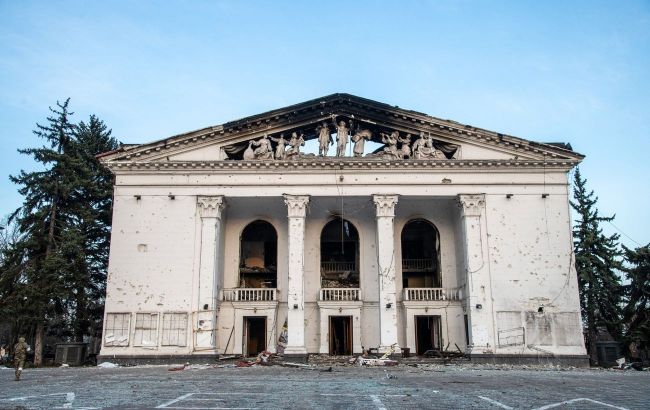
The propaganda campaign highlights supposedly restored homes, renovated parks, and new sports facilities in areas under Russian control. Special emphasis has been placed on the Mariupol Drama Theater, which became a symbol of Russian aggression after it was destroyed in a March 2022 airstrike while hundreds of civilians sheltered inside, resulting in numerous casualties.
Russian state media are now aggressively promoting stories about the theater’s reconstruction, often featuring foreign journalists who have collaborated with Russian authorities in occupied Ukrainian territories since the full-scale invasion began. These carefully selected media representatives help create a veneer of international validation for Russia’s claims.
“The goal of this campaign is to create the illusion, particularly in the West, that Ukrainian territories under Russian control are actively developing,” the Center for Countering Disinformation explains. “By showcasing the reconstruction of the Mariupol Theater and select buildings, Russian propaganda aims to turn these locations into a showcase of the ‘Russian world.'”
The reality on the ground tells a dramatically different story. Most cities in Russian-occupied Donbas remain largely in ruins and severely depopulated. Residents who remain face dire living conditions without reliable access to basic services, while living under the constant threat of oppression from occupation forces.
“In Mariupol itself, despite all propaganda claims, residents are overwhelmingly reporting the loss of housing and the impossibility of receiving compensation for destroyed apartments,” according to analysts at the Center.
The situation in other occupied areas appears equally grim. Residents of Luhansk, for instance, are enduring severe infrastructure challenges with chronic water and heating shortages. Reports indicate that taps in many towns remain dry for weeks, forcing apartment dwellers to collect water from heating systems just to meet basic needs. Any attempts by residents to improve their living conditions independently can result in punishment from occupation authorities.
Against this backdrop of deteriorating conditions, Moscow has announced what it calls a large-scale program to facilitate the return of residents to occupied Ukrainian territories. Analysts suggest this initiative reveals the Kremlin’s true intentions: to formalize control over Donbas, Zaporizhzhia, and Kherson regions through a new migration strategy designed to create conditions for resettlement and secure the population under Russian administrative control.
The occupation authorities continue to face resistance from local professionals unwilling to cooperate with the Russian administration. This has led to an ongoing program of importing Russian teachers to occupied territories. These educators are recruited from various Russian regions with promises of higher compensation, intended to replace Ukrainian teachers who refused to work under occupation authorities.
The contrast between Russian propaganda narratives and actual conditions highlights Moscow’s struggle to establish legitimacy in territories seized during its invasion. While Russian media outlets portray reconstruction and normalization, independent reports consistently describe communities suffering from destroyed infrastructure, lack of basic services, and systemic repression.
This information campaign represents just one aspect of Russia’s broader efforts to normalize its occupation of Ukrainian territories, both domestically and internationally, as the conflict continues with no immediate resolution in sight.
Fact Checker
Verify the accuracy of this article using The Disinformation Commission analysis and real-time sources.

8 Comments
Russia’s reconstruction efforts in Mariupol seem more about political symbolism than substantive improvements for the local population. Prioritizing photo ops over the actual needs of the community is a disturbing trend.
While rebuilding is necessary, the Kremlin’s emphasis on promoting a sanitized narrative through selective media access is concerning. Genuine recovery in Mariupol will require transparency, accountability, and a focus on the wellbeing of its people.
While reconstruction is important, Russia’s focus on photo ops and staged media coverage rather than the wellbeing of the local population is deeply troubling. Legitimate rebuilding efforts should prioritize the needs of Mariupol’s residents, not Moscow’s political agenda.
It’s disheartening to see Russia exploiting the reconstruction of Mariupol for political gain. The local population deserves genuine support, not propaganda. Scrutinizing Russia’s claims and centering the voices of Mariupol residents should be the priority.
Inviting foreign journalists to tour selectively rebuilt areas is a transparent ploy to distract from the devastation caused by Russia’s bombardment. Any reporting coming out of occupied territories must be viewed with a critical eye given the Kremlin’s track record of misinformation.
Mariupol has suffered immensely under Russian occupation. Rather than genuine efforts to restore the city, this propaganda campaign appears designed to whitewash the Kremlin’s crimes and portray an image of normalcy that simply does not reflect reality on the ground.
It’s concerning to see Russia using propaganda tactics to create a false narrative about the reconstruction in Mariupol. Showcasing renovated buildings while suppressing reports of civilian suffering is a cynical attempt to promote their ‘Russian World’ ideology.
The reconstruction in Mariupol is an important issue, but Russia’s approach seems more focused on managing its public image than actually helping the people. Objective, independent reporting is crucial to shed light on the true conditions in the city.