


Listen to the article
Russia Expands Media Influence in Asia Through “Journalism Training”
Russian state media outlet RT is intensifying its educational outreach in Southeast Asia and beyond, offering free journalism training programs that critics say mask a broader agenda of spreading pro-Kremlin narratives.
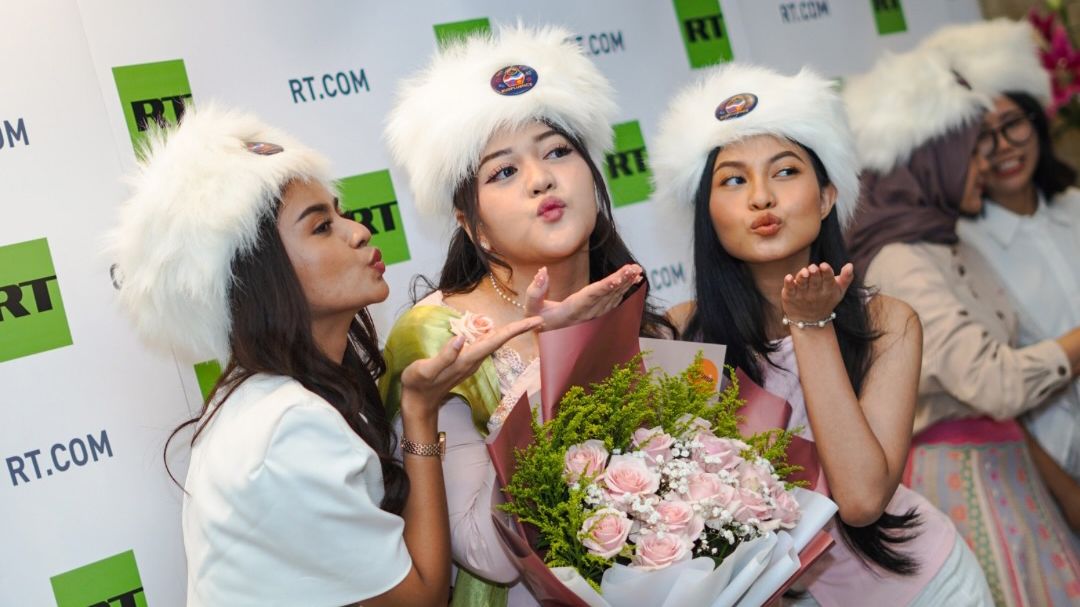
In December 2025, RT hosted a three-day training event in Jakarta, Indonesia, drawing more than 250 journalists, media students, and content creators from across the Asia-Pacific region. Participants came from Indonesia, Malaysia, South Korea, Cambodia, Thailand, and the Philippines for sessions held at Russia’s cultural center, RT’s Indonesia and ASEAN Bureau, and a partner university.
The program was publicly framed around universal journalistic principles, including “fact-checking digital sources,” “ethical standards in social media storytelling,” and addressing “the role of journalism in democratic societies.” However, experts familiar with RT’s operations question the stated objectives, pointing to the organization’s documented history of spreading disinformation.
“It is highly unlikely that this is an authentic journalism course,” said Joseph Siegle, director of research at the Africa Center for Strategic Studies. “It resembles other Russian efforts to woo African voices to provide more favorable coverage of Moscow and parrot Russian talking points.”
The Jakarta training featured prominent RT figures, including Anna Kovtunova, head of RT Academy; Maria Zeleranskaya from RT’s international newsroom; and Oksana Boyko, host of the controversial RT talk show “Worlds Apart.” The event also included members of Rusfluence, a Russia-Indonesia Influencer Club that has previously sent supportive messages and gifts to Russian soldiers fighting in Ukraine.
According to Volodymyr Solovian, who heads the Hybrid Threat Analysis Group at the Ukrainian Crisis Media Center, these training sessions frequently overlap with other Russian state initiatives. Many workshops are conducted at Russian cultural centers, also known as Russian Houses, which have faced scrutiny in Western nations over alleged propaganda activities.
“Beyond their direct engagement with RT Academy, participants of these events are also exposed to propagandistic content produced by other institutions of Russia’s ‘soft power,'” Solovian explained.
The BBC, which participated in an RT Academy online course for African journalists in 2024, reported finding explicit propaganda in the curriculum materials. One lesson on breaking news referred to surrendered Ukrainian soldiers as “neo-Nazis and radicals,” while another seminar featured an RT anchor denying the Bucha massacre – a well-documented atrocity where Russian forces killed hundreds of Ukrainian civilians in 2022.
Stephen Hutchings, professor of Russian Studies at the University of Manchester, notes that RT Academy’s approach reflects the media outlet’s fundamental rejection of journalistic objectivity. RT editor-in-chief Margarita Simonyan has been quoted saying, “There is no objectivity — only approximations of the truth by as many different voices as possible.”
This expansion into Asia represents a strategic pivot for RT. Facing restrictions or outright bans in many Western countries due to its role in justifying Moscow’s aggression, the network has increasingly focused on regions where it remains accessible: Asia, Africa, the Middle East, and Latin America.
Since its establishment in 2023, RT Academy has conducted training for journalists from ASEAN countries, India, China, Senegal, Ethiopia, and other nations. All programs are fully funded by the Russian state, with no cost to participants.
Hutchings explains the appeal to young journalists in developing regions: “With their historical hostility to perceived U.S. imperial arrogance, audiences in these regions are especially receptive to the ‘anti-Western hegemony’ and ‘anti-colonial’ narratives that Russia uses to defend its violent aggression in Ukraine.”
According to RT Academy’s website, their courses have reached approximately 7,000 participants since launching. The program currently offers courses in English and French, with plans to expand into additional languages.
The training initiative comes as Russia strengthens its media presence globally. RT recently began broadcasting in India and has announced plans to establish a major English-language hub in South Africa, part of a broader strategy to cultivate influence in regions historically skeptical of Western media narratives.
While Russian President Vladimir Putin has claimed RT’s goal is “to convey truthful information about our country and what is happening in the world,” critics maintain that the network’s version of truth consistently aligns with Moscow’s geopolitical interests.
For media experts, RT Academy represents a sophisticated approach to influence operations – using the guise of professional development to spread narratives favorable to Russian interests while simultaneously undermining trust in Western media sources.
Fact Checker
Verify the accuracy of this article using The Disinformation Commission analysis and real-time sources.

5 Comments
While journalism education is important, RT’s track record of disinformation raises red flags. I hope the participants in these programs can discern RT’s true agenda and resist any attempts to shape their reporting in a pro-Kremlin direction.
Kudos to the experts who are sounding the alarm on RT’s dubious ‘journalism training’ programs. It’s important to expose the true nature of these initiatives and prevent the spread of Russian disinformation in the region.
RT’s efforts to expand its reach in Southeast Asia are clearly part of a broader information warfare strategy. It’s crucial that local media outlets, civil society, and governments remain vigilant and call out these propaganda activities.
The expansion of RT’s influence in the Global South is worrying. Offering ‘journalism training’ is a common tactic used by state media outlets to legitimize their propaganda efforts and recruit local voices to amplify their narratives.
This is concerning. RT is known for spreading Kremlin propaganda, so these ‘journalism training’ events are likely a front to indoctrinate young reporters across Southeast Asia. I hope the local media and governments scrutinize these programs closely.