


Listen to the article
In a cinematic landscape where propaganda films have become increasingly commonplace, Aashish Mall’s “Shatak” stands out for all the wrong reasons. The film, which purports to chronicle the 100-year history of the Rashtriya Swayamsevak Sangh (RSS), has garnered attention not for its artistic merit but for its transparently hagiographic approach to the far-right organization’s history.
From its opening scenes, “Shatak” presents viewers with a visually jarring experience. The film’s production quality is notably poor, with scenes that appear to utilize dated green-screen technology reminiscent of low-budget television news programs. This technical shortcoming creates an almost artificial quality throughout the 112-minute runtime, with characters moving through scenes with a stiffness that lacks basic human qualities.
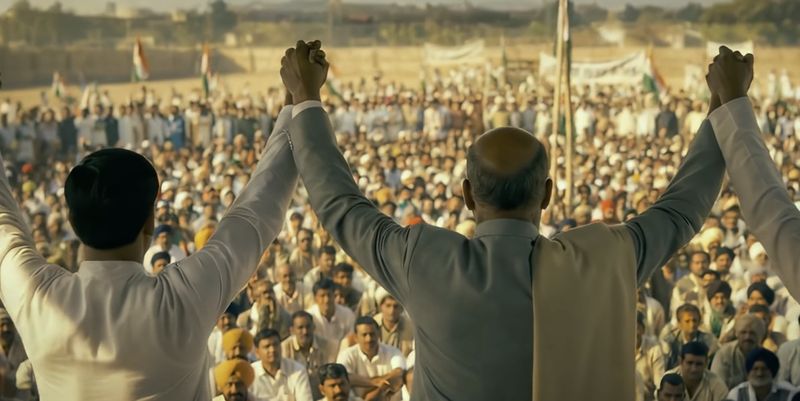
The narrative structure follows the lives of RSS founding figures Keshav Baliram Hedgewar and Mahadev Golwalkar, portraying them as visionary leaders of impeccable character. However, the screenplay lacks nuance, presenting a simplistic progression of events without meaningful dramatic arcs or character development. Secondary characters exist primarily as passive observers, their purpose limited to expressing awe at the speeches and actions of the protagonists.
Women are notably absent from the film’s universe, appearing only in three brief instances: as Hedgewar’s mother who dies during the 1896 bubonic plague, as Laxmibai Kelkar requesting a women’s wing within the RSS, and in a curious scene featuring what appears to be an AI-generated version of a young Lata Mangeshkar performing at a fundraising concert for the organization.
The film’s historical revisionism becomes particularly evident in its portrayal of the RSS’s relationships with prominent freedom fighters. Notable figures including Bal Gangadhar Tilak, Subhash Chandra Bose, Bhagat Singh, and Sardar Vallabhbhai Patel make cameo appearances, all seemingly in admiration of the RSS leadership. Even Mahatma Gandhi and Jawaharlal Nehru are depicted as either impressed by or fearful of the organization’s growing influence.
“Shatak” depicts Muslims in a problematic light that reinforces divisive stereotypes. A scene featuring a Muslim school inspector forcing students to declare loyalty to the British queen appears designed to establish Muslims as antagonistic to Indian nationalism. Other sequences show Muslim crowds outnumbering Hindus and engaging in violence during protests, a portrayal that lacks historical context and nuance.
Perhaps most striking is the film’s reimagining of the RSS’s role in pivotal moments of Indian history. According to “Shatak,” the organization was instrumental in preventing terrorist attacks in early independent India, fighting Pakistani forces in Kashmir, playing a crucial role in the 1962 Indo-China war, and significantly contributing to Goa’s liberation. These claims represent significant departures from established historical accounts.
The film approaches the assassination of Mahatma Gandhi with notable caution. When addressing this historical moment, a character simply announces that “someone killed Gandhiji,” carefully avoiding mention of Nathuram Godse. The film dismisses any connection between the RSS and Gandhi’s assassination as a “conspiracy theory” invented by Congress party rivals jealous of the organization’s purported popularity.
“Shatak” appears designed less for mainstream theatrical success and more as a commemorative piece for the RSS’s centenary, perhaps intended for display in the organization’s Nagpur museum. Its primary function seems to be reinforcing a particular historical narrative rather than engaging critically with the complex history of one of India’s most influential and controversial organizations.
Currently playing in theaters, “Shatak” ultimately serves as a case study in political filmmaking that prioritizes ideology over artistry, mythology over history, and veneration over examination.
Fact Checker
Verify the accuracy of this article using The Disinformation Commission analysis and real-time sources.

10 Comments
The poor production quality and heavy-handed propaganda elements in ‘Shatak’ are disappointing. I was hoping for a more nuanced, balanced historical account of the RSS rather than this blatantly hagiographic portrayal.
Agreed, the film seems to sacrifice artistic integrity and objectivity in favor of unapologetic ideological messaging. A missed opportunity to shed light on the complexities of the RSS’s history.
The issues with ‘Shatak’ highlighted in this article are concerning. Propaganda films, especially those with poor technical execution, do little to advance meaningful discourse on complex political and historical topics.
Well said. Audiences deserve films that grapple with nuance and avoid reductive portrayals, regardless of the subject matter. There is an opportunity missed here to provide deeper context.
While films about controversial organizations can be valuable, ‘Shatak’ appears to fall short. The technical shortcomings and lack of narrative depth are concerning. Hopefully future efforts on this topic will be more thoughtfully executed.
You make a fair point. A nuanced, well-crafted film could have provided important historical context. Unfortunately, this one seems to prioritize propaganda over genuine storytelling.
The critique of ‘Shatak’ as a technically flawed and ideologically skewed film is troubling. Audiences should be able to expect more from productions that claim to document important historical figures and movements.
Absolutely. A more rigorous, balanced approach could have yielded a much more valuable cinematic exploration of the RSS’s origins and evolution. Missed chances like this are disappointing.
It’s disappointing to see a film about such an influential organization produce such a subpar result. The poor production values and simplistic narrative structure undermine any potential educational value.
Agreed. A more balanced, carefully researched approach could have led to a much more compelling and insightful exploration of the RSS’s history and role in India.