


Listen to the article
In what appears to be a calculated exercise in historical revisionism, director Aashish Mall’s new film “Shatak” offers viewers a sanitized chronicle of the Rashtriya Swayamsevak Sangh’s (RSS) 100-year history that sacrifices authenticity for adulation.
The 112-minute production, now playing in theaters, presents itself as a historical account of the far-right organization’s founding and development. However, critics note that the film functions more as hagiography than documentary, offering little in the way of critical examination or historical nuance.
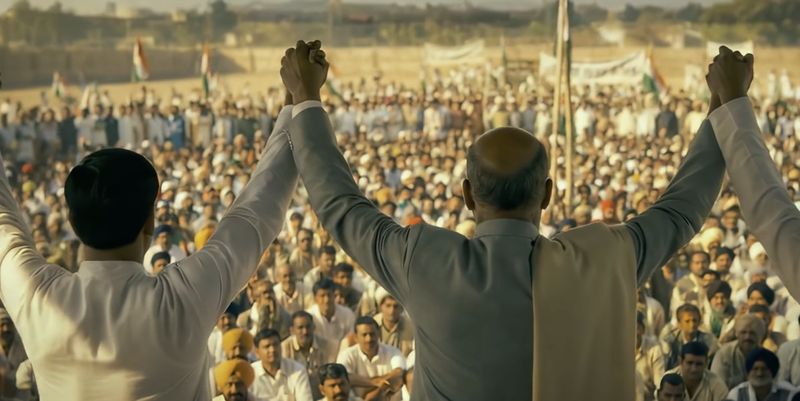
“Shatak” focuses primarily on RSS founders Keshav Baliram Hedgewar and Mahadev Golwalkar, portraying them as visionary leaders and principled patriots. The narrative traces their lives from childhood through their leadership of the organization, depicting them as scholarly, devout Hindus troubled by colonial rule and disillusioned with the Congress party’s approach to independence.
What’s particularly noteworthy is the film’s technical execution. The production quality has drawn criticism for its reliance on obvious green-screen technology and artificial-looking environments. Characters move through scenes with a stiffness that undermines the human drama the film attempts to portray. The dubbing quality has also been flagged, with visible discrepancies between audio tracks and lip movements further distancing viewers from the narrative.
Women are notably scarce in the film’s landscape. Their appearances are limited to Hedgewar’s mother (who dies early in the plague of 1896), Laxmibai Kelkar (shown only when requesting a women’s wing of the RSS), and a portrayal of a young Lata Mangeshkar performing at a fundraising concert for the organization.
The film makes significant efforts to associate the RSS with widely respected freedom fighters. Figures like Bal Gangadhar Tilak, Sri Aurobindo, Netaji Subhash Chandra Bose, Bhagat Singh, Rajguru, Lal Bahadur Shastri, Sardar Vallabhbhai Patel, Mahatma Gandhi, and Jawaharlal Nehru make appearances. In nearly every instance, these historical figures are shown expressing either admiration for RSS leadership or trepidation about the organization’s influence.
“Shatak” takes considerable creative liberties with historical events. The RSS is portrayed as playing pivotal roles in foiling post-independence terrorist attacks, defending Kashmir against Pakistani forces, contributing to the 1962 Indo-China war effort, and liberating Goa. These depictions have raised eyebrows among historians who note the exaggerated scope of the organization’s actual involvement in these events.
The film’s treatment of religious tensions follows predictable patterns, with Muslims consistently portrayed as antagonists. One scene features a Muslim school inspector forcing students to declare loyalty to the British crown. Other sequences show Muslim crowds threatening Hindu communities and women, while criticizing Gandhi’s secular values and support for the Khilafat movement.
Perhaps most telling is the film’s handling of Mahatma Gandhi’s assassination. When the event is mentioned, the assassin Nathuram Godse is conspicuously not named. The film dismisses any connection between the RSS and the assassination as a “conspiracy theory” invented by Congress out of jealousy for the Sangh’s purported popularity.
The political implications of the film are difficult to ignore. “Shatak” explicitly traces the lineage from RSS to the formation of the Bharatiya Jan Sangh in 1951, which eventually became the Bharatiya Janata Party (BJP) in 1980—the current ruling party of India. The narrative suggests that Congress leaders of the post-independence era feared the RSS’s political potential, foreshadowing the BJP’s current dominance.
Given its unabashed celebration of the organization and lack of critical perspective, some observers have suggested the film might ultimately find its most appropriate home at the RSS museum in Nagpur, where it could serve as a promotional vehicle rather than a serious historical document.
As India continues to grapple with questions of historical representation and national identity, “Shatak” represents another entry in the ongoing contest to control the narrative of the country’s past—one frame at a time.
Fact Checker
Verify the accuracy of this article using The Disinformation Commission analysis and real-time sources.

15 Comments
While the technical issues with this film are noteworthy, the bigger concern is the apparent political agenda behind its portrayal of the RSS. Objective historical analysis should take precedence over ideological narratives.
Well said. Filmmakers have a responsibility to provide nuanced, fact-based accounts, not propaganda. I hope future projects on the RSS will strive for a more balanced, critical approach.
The RSS is a politically influential group in India, so a historical account of the organization deserves careful, objective treatment. This film seems to fall short on that front, prioritizing adulation over critical analysis. I’d be curious to hear other perspectives on it.
Agreed. Objective historical analysis should take precedence over ideological narratives, no matter the subject. A more nuanced, balanced approach would serve the public interest better.
This film’s apparent reliance on revisionist history and hagiography is troubling. The RSS’s legacy is complex, and an accurate portrayal should grapple with that complexity, not gloss over it.
Revisionist historical narratives are always concerning. While the visual quality may be lacking, the political messaging is what worries me more. I hope future portrayals of the RSS are more grounded in facts and critical examination.
Well said. Sanitizing the past to serve a particular ideological agenda is problematic regardless of the production values. Objective, evidence-based analysis should be the priority when documenting history.
While the technical shortcomings of this film are noteworthy, the bigger issue seems to be the lack of nuance and critical examination in its portrayal of the RSS. Historical accounts should strive for objectivity, not glorification.
I appreciate the filmmakers’ attempt to commemorate the RSS’s centenary, but a work of propaganda masquerading as history is concerning. The RSS’s legacy is complex, and I hope future projects will tackle it with more balance and rigor.
The technical issues with this film are interesting, but the bigger concern seems to be the political framing and lack of nuance. Filmmakers have a responsibility to provide accurate, multi-faceted depictions of historical organizations, not just hagiographies.
The visual flaws of this film are less concerning than the potential for it to spread a revisionist, politically-motivated historical narrative. Objective, evidence-based analysis should be the priority when documenting the legacy of the RSS.
Sanitizing the history of controversial organizations is always concerning. I hope future films about the RSS will provide a more balanced, fact-based account that acknowledges both its positive and negative aspects.
Agreed. A nuanced, evidence-based approach is crucial when documenting the history of politically influential groups. Avoiding propaganda in favor of objective analysis should be the priority.
The RSS is a controversial organization with a complex history. This sanitized film seems to gloss over the group’s more problematic aspects and present a biased, one-sided account. I’m curious to hear more balanced perspectives on the RSS’s role and legacy.
Agreed, a balanced historical account should include both the organization’s positive contributions and its more troubling elements. It’s important to avoid propaganda and instead strive for nuanced analysis.