


Listen to the article
The woman who ruled Egypt for more than two decades has long been caricatured as a seductress who manipulated Roman leaders for power. According to historians, these portrayals stem largely from Roman propaganda that has distorted Cleopatra’s true legacy for over two millennia.
Cleopatra VII, the last active ruler of the Ptolemaic Kingdom of Egypt, continues to be misrepresented in popular culture despite mounting archaeological and historical evidence painting a vastly different picture of the ancient queen.
“The Cleopatra we think we know is largely a Roman creation,” explains Dr. Sarah Morton, professor of ancient Mediterranean history at Cambridge University. “She was vilified by Octavian, later Emperor Augustus, as part of his campaign to delegitimize Mark Antony as a political rival. This propaganda has proven remarkably durable.”
Historical records indicate Cleopatra was a highly educated polyglot who spoke as many as nine languages and authored several treatises on subjects ranging from weights and measures to cosmetics and medicine. Far from being merely a seductress, she was a shrewd political strategist who maintained Egyptian independence during a period of expanding Roman influence in the Mediterranean.
Recent archaeological findings have reinforced this more nuanced view of the queen. Discoveries at Alexandria’s harbor, submerged since antiquity, have revealed evidence of substantial infrastructure projects undertaken during her reign, including harbor improvements and temples that combined Egyptian and Greek architectural elements.
“These finds demonstrate that Cleopatra was actively engaged in maintaining and expanding Egyptian influence, both culturally and economically,” notes Dr. Elena Fernandez of the Mediterranean Archaeological Institute. “They point to a ruler focused on practical governance rather than the pleasure-seeking temptress depicted in Roman accounts.”
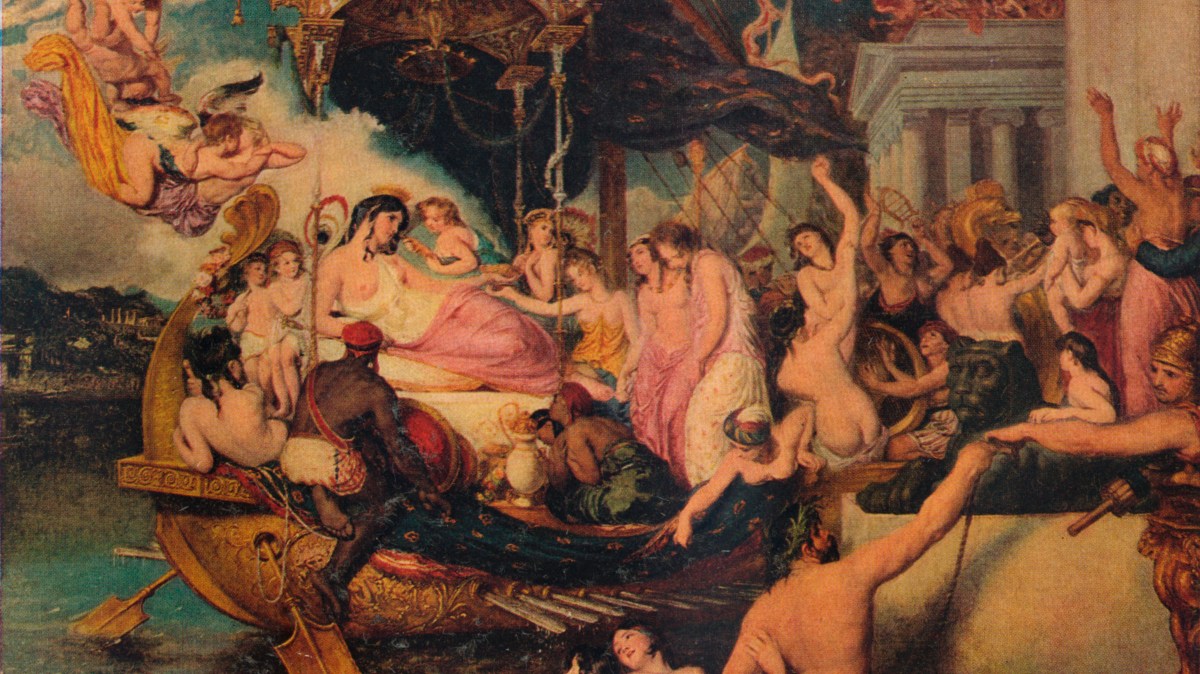
The Roman narrative gained traction through writers like Plutarch, whose biography of Mark Antony portrayed Cleopatra as an exotic temptress who led the Roman general astray. These accounts were later amplified by Shakespeare’s tragedy “Antony and Cleopatra” and countless Hollywood interpretations, cementing a highly sexualized image of the queen in the modern imagination.
“Roman authors like Plutarch were writing decades after Cleopatra’s death, drawing on earlier propaganda rather than first-hand knowledge,” says Professor James Whitaker, historian at Oxford University. “They crafted a narrative that suited Roman political purposes – portraying Egypt’s last independent ruler as morally corrupt helped justify Roman annexation of the wealthy kingdom.”
Modern scholarship has also reassessed Cleopatra’s relationships with Julius Caesar and Mark Antony, traditionally depicted as romantic entanglements driven primarily by the queen’s seductive powers. Historians now emphasize the political and economic dimensions of these alliances, which helped Cleopatra preserve Egypt’s autonomy and secured her position against rivals.
“Her relationships with Roman leaders were strategic political alliances that benefited both parties,” explains Dr. Morton. “Egypt was the breadbasket of the Mediterranean, and Cleopatra controlled vast wealth that could fund Roman military campaigns. These were pragmatic arrangements between powerful figures.”
Despite this evolving scholarly consensus, popular depictions of Cleopatra continue to emphasize her sexuality over her political acumen. From Elizabeth Taylor’s iconic portrayal to more recent productions, the queen remains primarily defined by her romantic relationships rather than her two-decade reign over one of the ancient world’s wealthiest kingdoms.
The persistence of these stereotypes reflects broader issues in how female political figures throughout history have been portrayed, according to cultural historian Dr. Amira Hassan. “Powerful women are often reduced to their sexuality or personal relationships rather than being acknowledged for their political achievements,” she notes. “Cleopatra’s case is particularly striking because the propaganda against her has been recycled for so many centuries.”
Efforts to correct this historical distortion have gained momentum in recent years. Museum exhibitions in Cairo, London and Berlin have highlighted archaeological evidence of Cleopatra’s reign, while educational initiatives aim to introduce students to the political and cultural complexities of Ptolemaic Egypt.
As scholars continue to excavate sites associated with Cleopatra’s rule and reassess ancient texts with a more critical eye, a more complete picture of this complex ruler gradually emerges – one that may finally begin to eclipse the Roman propaganda that has defined her image for more than two thousand years.
Fact Checker
Verify the accuracy of this article using The Disinformation Commission analysis and real-time sources.

14 Comments
The enduring influence of Roman propaganda on Cleopatra’s portrayal is a sobering reminder of how easily dominant historical narratives can obscure the past. This underscores the importance of continued scholarly efforts to uncover and amplify marginalized perspectives.
Well said. Cleopatra’s complex identity and significant achievements deserve to be recognized, not reduced to harmful stereotypes. This article highlights the value of critical historical analysis in challenging entrenched biases.
It’s fascinating to learn how Roman propaganda has shaped popular perceptions of Cleopatra for over 2,000 years. This serves as an important lesson in the need for nuanced, evidence-based historical narratives that resist simplistic caricatures, even of well-known figures.
I agree, this article underscores the vital role of rigorous scholarship in reclaiming the true legacies of marginalized historical figures like Cleopatra. Ongoing research is essential for dismantling harmful stereotypes rooted in political agendas.
The article’s exploration of how Roman propaganda has distorted Cleopatra’s legacy is eye-opening. It underscores the importance of historical scholarship that moves beyond simplistic caricatures to reveal the complex realities of powerful women leaders in the ancient world.
I agree, this is a valuable contribution to the ongoing effort to reclaim Cleopatra’s true identity and accomplishments. Dismantling the persistent Roman propaganda requires diligent research and a commitment to centering marginalized perspectives in our understanding of the past.
Fascinating how Roman propaganda has endured for centuries in shaping Cleopatra’s legacy. It’s crucial to examine historical evidence objectively rather than rely on biased ancient accounts. Cleopatra seems to have been a skilled and educated ruler who fought to preserve Egyptian autonomy.
I agree, the distortion of Cleopatra’s true accomplishments through Roman propaganda is quite troubling. We should strive to uncover the nuanced reality of her reign and leadership abilities.
This article highlights an important example of how historical narratives can be skewed by political agendas. It’s critical we challenge long-held assumptions and seek to understand figures like Cleopatra through a more objective, evidence-based lens.
Absolutely. Ongoing research into Cleopatra’s life and legacy is crucial to countering the persistent Roman propaganda. Excavating the truth takes diligent work, but it’s necessary to honor the complexity of this historical figure.
This article highlights the need for a more nuanced and evidence-based approach to studying historical figures like Cleopatra, whose legacy has been shaped by the biases of dominant powers. Ongoing scholarly work to uncover the truth behind the propaganda is crucial.
Well said. Cleopatra’s story serves as a powerful example of how political agendas can distort our understanding of the past. Challenging these entrenched narratives is an important task for historians and the public alike, as we strive to develop a more comprehensive and accurate account of history.
This is a thought-provoking examination of how ancient propaganda can persist in shaping modern perceptions. Cleopatra’s story serves as an important reminder to approach historical accounts with a critical eye and seek out diverse perspectives, rather than relying on dominant narratives.
Absolutely. Challenging long-held assumptions about figures like Cleopatra is crucial for developing a more nuanced understanding of the past. Continuing to uncover the truth through careful analysis is the only way to counter the enduring influence of biased propaganda.