


Listen to the article
Roman-Era Copper Ornament Reveals Empire’s Mobile Propaganda
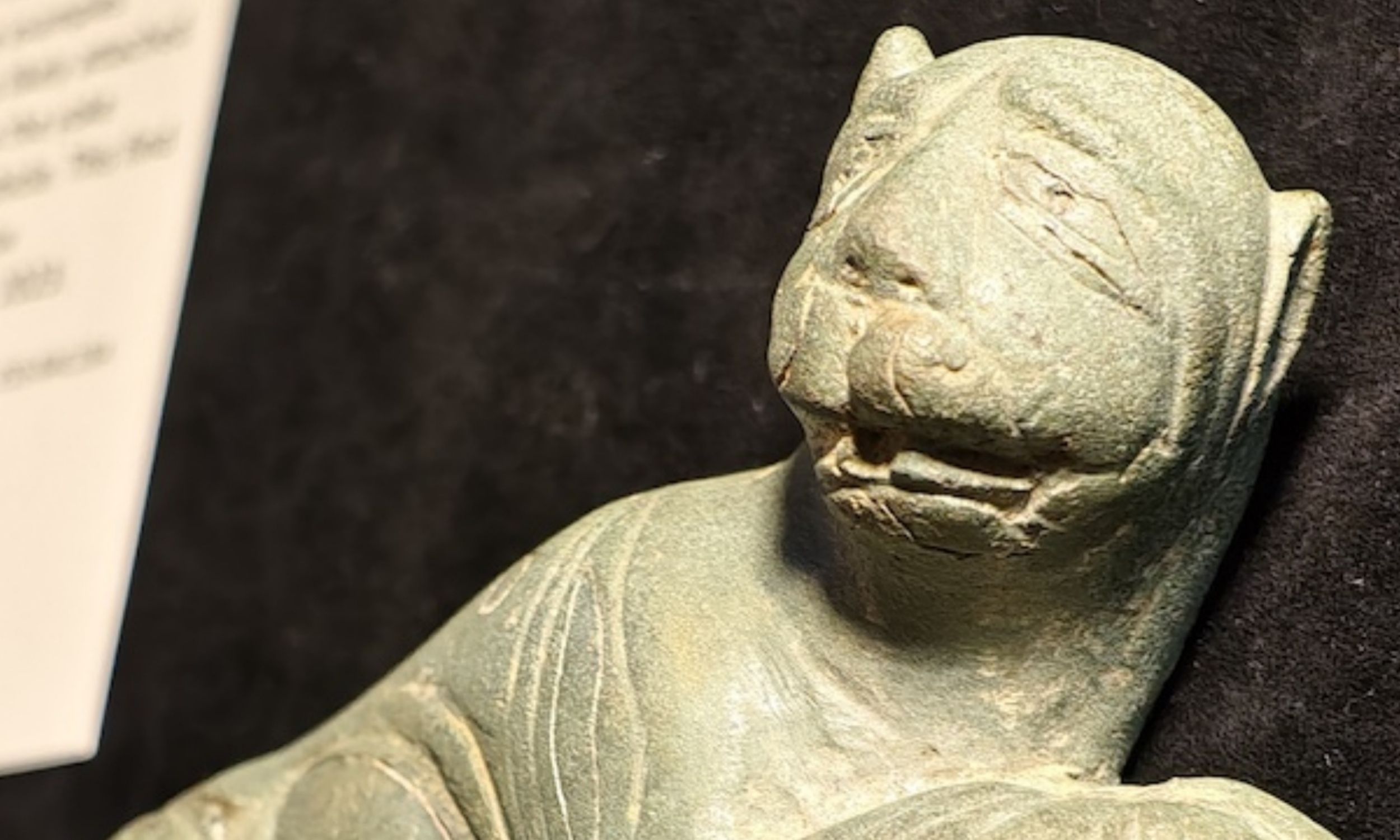
A remarkable copper ornament depicting a panther with its paws pressing down on a severed human head has emerged as one of the most striking examples of Roman imperial propaganda discovered in Britain. The small yet powerful sculpture, designed to be mounted on a carriage for public display, transformed everyday travel into a mobile declaration of conquest and status.
The four-inch (10-centimeter) copper fitting was unearthed near Harlow in Essex, northeast of London. Despite centuries underground, the animal’s tense posture and the carefully rendered beard of the fallen man remain clearly visible, delivering a message that was intended to be understood at a glance.
Dr. John Pearce of King’s College London, who examined the piece, has connected the panther and severed head directly to the visual language of Roman power that was transported along provincial roads throughout the empire. “You could see it gleaming and you’d know whose carriage it was coming towards you,” explained Pearce.
The ornament’s strategic placement on carriages at eye level ensured that passersby would encounter its threatening symbolism without needing to stop or engage. As polished copper would have flashed brilliantly in daylight while the wagon moved, the fitting would have been difficult to miss. By the time a carriage reached a village, the owner had already positioned observers as an audience to this display of power.
What makes this particular ornament especially interesting is its blend of Roman and local artistic styles. While the primary imagery follows Roman imperial themes, the tight geometric grooves across the panther’s back diverge from typical Roman naturalism and suggest local British influence. This Romano-British fusion created a visual language that both conquerors and locals could interpret, demonstrating how conquered communities sometimes adapted and incorporated Roman symbols rather than rejecting them outright.
The discovery has gained additional significance due to the recent expansion of the UK’s Treasure Act through the Treasure Order of 2023. This legal update extends protection beyond gold and silver objects to include rare base-metal artifacts that carry unusual cultural or historical importance. Before this change, copper items like this fitting could potentially disappear into private collections, regardless of their historical value. Now, following a coroner’s review, museums can bid for such pieces, with financial rewards typically split between the finder and landowner.
The find was documented through the Portable Antiquities Scheme (PAS), a program that logs public archaeological discoveries across England and Wales. In 2024 alone, researchers counted 34,469 Roman-era objects recorded by PAS. These reports transform scattered discoveries into valuable data on settlement patterns, trade routes, and historical losses, though their value depends entirely on careful location recording and honest reporting.
The panther ornament invites comparison with other Roman vehicle decorations discovered throughout the former empire. In southern Italy near Pompeii, excavators at Civita Giuliana uncovered an exceptionally well-preserved ceremonial carriage site, complete with stable gear and the remains of victims from the volcanic eruption. The ash preserved voids where wood and rope once existed, allowing restorers to reconstruct forms that would normally have decomposed completely.
While the Essex panther now displays a blue-green patina characteristic of aged copper, it would originally have had a bright surface designed to catch and reflect sunlight. Its hollow back filled with lead would have helped the ornament sit flush on wooden carriage parts while maintaining the fully modeled appearance of the front.
“There’s nothing quite like it in Romano-Britain,” noted Dr. Pearce, who continues to compare this finding with other animal ornaments to determine whether similar messaging patterns existed across different regions of the empire.
The discovery illustrates how the Roman Empire maintained control not just through direct military force but through calculated visual displays that reinforced social hierarchies. As travelers moved goods between farms, towns, and military installations throughout Roman Britain, such decorated equipment served as mobile signals of authority, simultaneously communicating both trust to allies and threats to the subjugated.
Fact Checker
Verify the accuracy of this article using The Disinformation Commission analysis and real-time sources.

9 Comments
I’m curious to learn more about the specific symbolism behind the panther and severed head design. What do these elements represent in the broader context of Roman imperial ideology and propaganda?
Good question. The panther was likely a symbol of strength and ferocity, while the severed head conveyed the Empire’s ability to subdue its enemies. Together, they projected an image of Roman power and invincibility.
The level of detail and craftsmanship on this small copper ornament is quite remarkable, considering its age. It really highlights the Romans’ skill in creating impactful visual propaganda.
Absolutely, the precision of the panther and human head carvings is impressive. It must have been an imposing sight to witness these symbols of Roman dominance traveling the provincial roads.
It’s remarkable how even small, functional objects like this ornament can reveal so much about the political and ideological priorities of ancient civilizations. This find is a valuable addition to our understanding of Roman imperial tactics.
Fascinating find! This Roman ornament is a striking example of how imperial powers used mobile propaganda to assert their dominance. The panther and severed head convey a clear message of conquest and control.
I agree, the strategic placement on carriages ensured passersby couldn’t miss the threatening symbolism. It’s a powerful reminder of how symbols were weaponized to project power in the ancient world.
This ornament serves as an intriguing window into the Romans’ use of visual cues to exert control and influence over conquered populations. The mobile nature of this propaganda must have been quite impactful.
Absolutely. The fact that it was designed to be mounted on a carriage for public display underscores how the Romans leveraged everyday transportation to disseminate their messages of dominance.