


Listen to the article
A recent More in Common poll claiming Reform UK leads among gay and bisexual men has sparked widespread discussion across social media. The data, which has been amplified by Reform figures including Darren Grimes and Dr. David Bull, suggests an unexpected political shift within a community many would not associate with the party’s platform. But a closer examination of the numbers reveals a more nuanced reality—one that highlights how statistics can be presented selectively to craft misleading narratives.
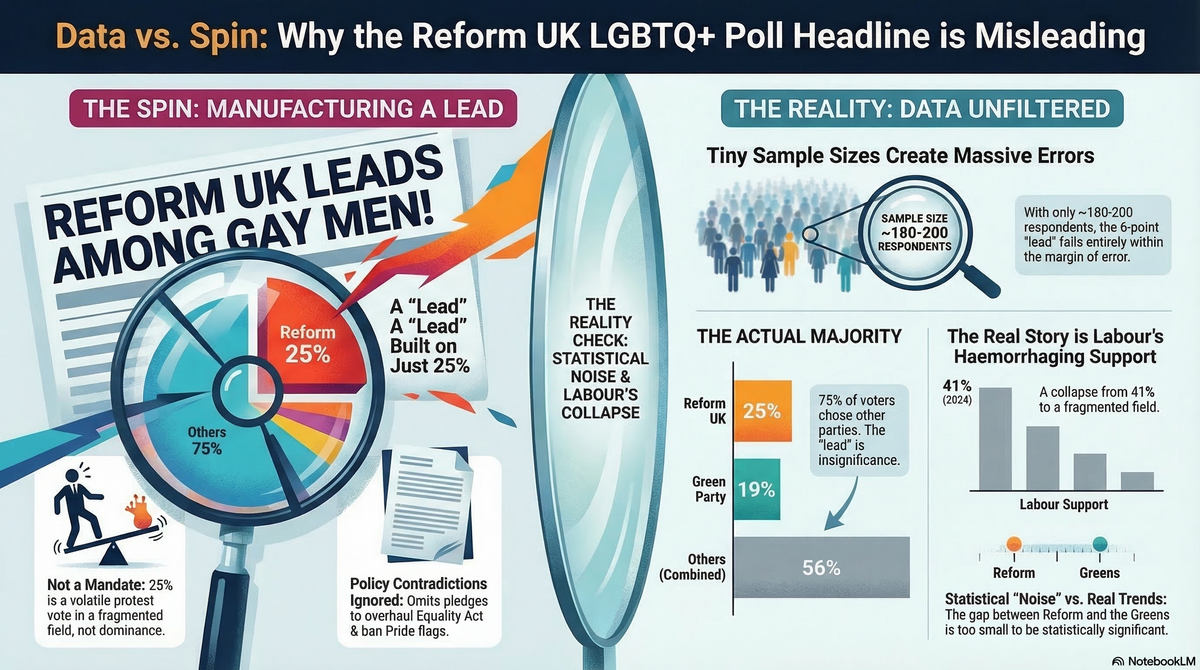
The headline finding shows Reform polling at 25% among gay and bisexual men, placing them six points ahead of the Greens and seven ahead of Labour. At first glance, this appears significant. However, this framing obscures a crucial fact: three-quarters of gay and bisexual men did not intend to vote for Reform. In political analysis, a party “leading” with just 25% support would typically be described as performing in a fragmented or inconclusive field.
Sample size presents another significant issue. More in Common surveyed approximately 9,000 adults across Britain—an impressively large poll. However, the headline focuses on a small demographic subset within that sample. Based on ONS data indicating roughly 4.2% of UK men identify as gay or bisexual, we can estimate only 180-200 respondents fall into this category. With a subgroup this small, the margin of error expands considerably, potentially reaching 5-7 percentage points. This means Reform’s six-point lead over the Greens could statistically be much smaller or even non-existent.
The most dramatic story in the data isn’t Reform’s position but Labour’s collapse. According to the same poll, 41% of gay and bisexual men voted Labour in the July 2024 general election. Their support has since plummeted, with votes scattering toward both the Greens and Reform. This suggests not a unified rightward shift but a fragmented protest vote moving in multiple ideological directions. The editorial decision to frame this as Reform’s success rather than Labour’s failure represents a significant interpretive choice.
Another methodological concern lies in combining gay and bisexual men into a single category. These are distinct communities with different demographic profiles. ONS data shows bisexual identification has increased particularly among younger people aged 16-24, who may prioritize different political issues than older gay men. By merging these groups, the poll potentially masks whether Reform’s support is concentrated in one community or distributed across both.
Context about Reform’s policy positions toward LGBTQ+ communities is also notably absent from most coverage. The party’s 2024 manifesto pledged to overhaul the Equality Act and ban what it termed “transgender ideology” in schools. Reform-controlled councils have been instructed not to fly Pride flags. Party leader Nigel Farage has stated he did not support same-sex marriage and has previously made controversial comments about HIV immigration restrictions. This relevant context would normally frame any analysis of the party’s standing among LGBTQ+ voters.
The amplification pattern of the poll findings deserves scrutiny as well. Reform figures shared the data prominently, creating a self-reinforcing news cycle where the attention itself became newsworthy. The research was conducted in late 2024 but published in early 2026, timing that maximizes impact while avoiding the rigorous scrutiny typically applied to pre-election polls.
What the data actually tells us, when properly contextualized, is that among a relatively small sample of gay and bisexual men, Reform polled first at approximately 25% in a heavily fragmented field. Labour’s support has collapsed dramatically since the 2024 election, with voters moving both left to the Greens and right to Reform. The difference between Reform and the Greens falls within the statistical margin of error for such a small sample.
This presents an interesting political development worth reporting—Labour appears to have a serious problem retaining LGBTQ+ voters, and political allegiances in this community may be more volatile than previously assumed. What the data doesn’t demonstrate, however, is that Reform has become the party of choice for gay and bisexual men or that the community has broadly embraced a party whose policies often oppose their rights.
The incident serves as a reminder that while statistics themselves don’t lie, how they’re selected, framed, contextualized, and headlined can create impressions far removed from the complete picture. When examining polls, particularly those concerning minority communities, readers would be wise to consider sample sizes, full vote distributions, historical trends, and the interests of those promoting particular interpretations.
Fact Checker
Verify the accuracy of this article using The Disinformation Commission analysis and real-time sources.

12 Comments
Interesting to see a more critical look at these poll results. The point about the 25% figure representing a minority of gay/bi men voters is well made. Puts the headline findings in a different light. Good to see a more nuanced take on the data.
Absolutely, the details and context matter a lot when interpreting political polling. Easy to get caught up in the top-line numbers, but digging into the methodology and demographic breakdowns is crucial for understanding the true significance of the results.
This article provides a valuable counterpoint to the initial headlines. Examining the sample size and framing of the data is really important to get a clear picture of what the poll is actually telling us. Appreciate the more balanced perspective.
Completely agree. Contextualizing polling data is key, especially when dealing with smaller demographic subsets. It’s easy for selective reporting to obscure the bigger picture, so this kind of analysis is very useful.
Very thought-provoking piece. The points about sample size and the need for more context around the 25% figure are well made. It’s a good reminder that we should approach political polling data with a critical eye.
Agreed, the nuances highlighted here are crucial. Relying too heavily on top-line numbers can lead to misleading conclusions, so a deeper dive into the methodology and underlying trends is essential.
This article provides a valuable perspective on the polling data, highlighting the need to look beyond just the headline figures. The points about sample size and framing are well taken – it’s easy for selective reporting to create a misleading narrative. Appreciate the more balanced analysis.
Agreed, the nuances here are really important. It’s a good reminder that we should approach political polling with a critical eye, and not take the top-line results at face value. Careful scrutiny of the methodology and underlying trends is essential.
This is a helpful breakdown of the polling data and the potential issues with how it’s being presented. Selective framing can definitely create a misleading narrative, so it’s good to see a more balanced analysis here.
Absolutely, it’s important to dig into the details rather than just accepting the headline claims. Careful statistical analysis is key to understanding the real political dynamics at play.
Interesting analysis of the polling data. Seems like the headline figures don’t tell the full story – 25% support is still a minority, and the sample size for that demographic subset may be quite small. Nuance and context are important when interpreting political surveys.
Agree, the data needs to be examined carefully to avoid drawing overly broad conclusions. A granular look at the survey methodology and demographics is crucial for understanding the true significance of the results.