


Listen to the article
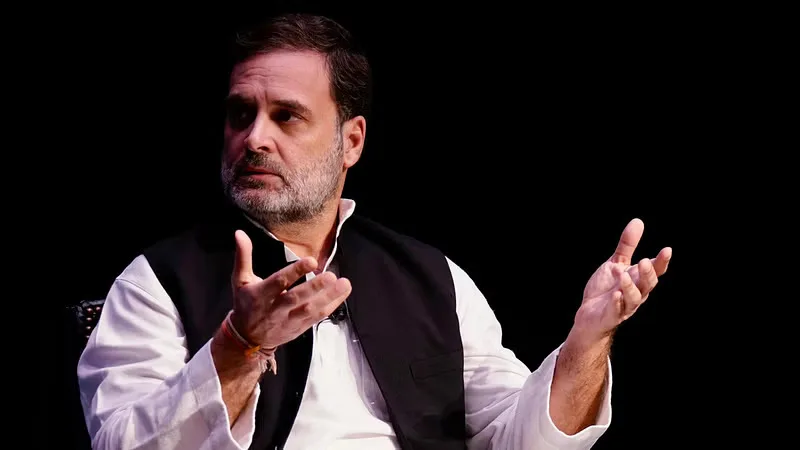
In a series of remarks that have ignited political controversy, Indian opposition leader Rahul Gandhi has come under fire for statements made during a recent five-day visit to Germany, where he questioned the integrity of India’s electoral process and democratic institutions.
Speaking at the Hertie School in Berlin, Gandhi alleged that recent elections in India were “not fair” and that democracy in the world’s largest democratic nation is under threat. These claims have drawn sharp criticism from political observers who view them as part of a concerning pattern of delegitimizing democratic institutions following electoral defeats.
Gandhi’s comments specifically targeted the recent Maharashtra Assembly elections, which he suggested were compromised through “industrial-scale rigging.” He pointed to what he described as suspicious increases in voter registration figures and turnout data as evidence of manipulation.
Political analysts note that this is not Gandhi’s first foray into questioning electoral results on international platforms. Since 2019, the Congress party leader has repeatedly advanced a narrative suggesting that the ruling Bharatiya Janata Party (BJP) does not win elections fairly but instead “manages” them through institutional capture.
“What we’re seeing is a troubling trend where political defeat is reframed as institutional failure,” said Dr. Meena Sharma, a political science professor at Delhi University. “This undermines public trust in democratic processes that have served India well for decades.”
The Election Commission of India has previously addressed Gandhi’s claims regarding the Maharashtra elections. Officials clarified that the increase in registered voters between the 2024 Lok Sabha (parliamentary) elections and the Assembly elections—from 9.29 crore to 9.70 crore—represents a 4.26 percent rise, which is consistent with historical patterns and actually lower than increases recorded in previous electoral cycles.
Regarding voter turnout figures, which Gandhi described as suspiciously rising from 58.22 percent at 5 p.m. to a final 66.05 percent, the Maharashtra Chief Electoral Officer has explained that mid-day figures are provisional estimates based on oral updates from polling stations, while final figures are calculated from Form 17C documentation signed by representatives of all candidates.
Critics have also challenged Gandhi’s assertions about the Election Commission’s appointment process. The opposition leader claimed that the Modi government “rigged the umpires” by altering the panel that appoints Election Commissioners, removing the Chief Justice of India from the process.
What this critique overlooks, electoral experts point out, is that from India’s independence until 2023, Election Commissioners were appointed solely on the recommendation of the Union Cabinet. The 2023 law actually expanded the selection committee to include the Leader of Opposition—a position Gandhi himself now holds—which represents an increase in consultative governance rather than a reduction.
The venue of Gandhi’s remarks has drawn particular scrutiny. His decision to voice these allegations before international audiences in Germany follows similar statements made during visits to the United States and other countries.
“There’s a fundamental difference between domestic political critique and internationalizing claims about democratic failure,” said foreign policy analyst Vikram Sood. “When the Leader of Opposition makes such assertions abroad, they carry weight beyond domestic politics and risk damaging India’s international standing.”
Supporters of Gandhi defend his right to speak candidly about democratic concerns regardless of venue, arguing that global solidarity is essential when democratic norms are under pressure. Congress party spokesperson Jairam Ramesh stated, “Democratic backsliding is a global phenomenon that requires global attention. Mr. Gandhi is simply highlighting legitimate concerns shared by many Indians.”
The controversy highlights broader tensions in Indian politics about the appropriate forums for domestic political disputes and the responsibilities of opposition leadership in a vibrant democracy.
India’s democratic institutions have demonstrated remarkable resilience throughout its 75-year history, weathering numerous political transitions and challenges. The country maintains an independent judiciary, a diverse media landscape, and regular elections administered by an autonomous Election Commission.
As India continues to navigate its complex democratic journey, the debate over Gandhi’s statements underscores the delicate balance between legitimate political opposition and the potential erosion of institutional trust—a challenge that democracies worldwide increasingly face in an era of polarized politics and global information flows.
Fact Checker
Verify the accuracy of this article using The Disinformation Commission analysis and real-time sources.

9 Comments
This is a concerning development that deserves close attention. Allegations of electoral fraud, if true, would be very troubling. At the same time, unfounded claims can also undermine public trust. I hope all stakeholders work together to safeguard the democratic process.
Gandhi’s comments raise important questions about the health of India’s democracy. As an outsider, I can’t judge the merits, but I believe these issues warrant careful, nonpartisan investigation to ensure the integrity of future elections.
While I appreciate Gandhi’s desire to address potential issues, making such serious accusations without clear evidence is risky. I’d encourage all political leaders in India to engage constructively and focus on improving electoral systems and transparency, rather than fueling polarization.
Interesting claims by Rahul Gandhi about electoral integrity in India. However, without clear evidence, such allegations can be damaging to democratic institutions. I’d be curious to hear more details and analysis from independent observers.
Gandhi’s comments raise valid concerns about potential irregularities, but it’s crucial that these issues are investigated thoroughly and objectively. India’s democracy must be protected, even if it means confronting uncomfortable truths.
I agree, claims of electoral fraud should be taken seriously and examined by nonpartisan election authorities. Maintaining public trust in the democratic process is paramount.
As an observer, I think it’s important to balance healthy skepticism with respect for democratic institutions. Gandhi may have a point, but extraordinary claims require extraordinary evidence. I hope this can be resolved through proper channels.
This is a complex and sensitive issue. While I respect Gandhi’s right to raise concerns, making unsubstantiated allegations of rigging could further polarize the political landscape. I’d encourage all sides to engage constructively and focus on electoral reforms, if needed.
Elections are the bedrock of any democracy. If there are genuine irregularities, they must be addressed. However, delegitimizing the process without clear proof is risky. I hope this sparks a serious, fact-based dialogue about strengthening India’s democratic institutions.