


Listen to the article
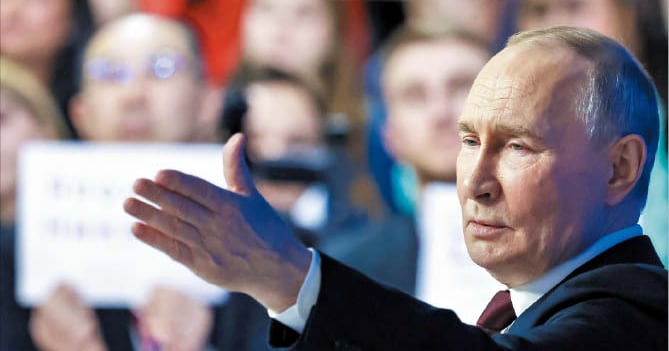
Russian President Vladimir Putin’s latest press conference, a sprawling four-hour affair, has drawn criticism from international observers who question whether these events serve as legitimate news briefings or elaborate propaganda displays designed to bolster his image domestically.
The carefully choreographed event, held in Moscow’s Manezh Central Exhibition Hall, featured Putin responding to questions from both Russian and foreign journalists. Though presented as an opportunity for open dialogue, analysts note that the format allows the Russian leader to control the narrative while projecting an image of accessibility and transparency.
“These annual performances are meticulously planned to showcase Putin as a strong, informed leader in complete command,” said Elena Volkova, a political analyst specializing in Russian media. “The marathon length itself is meant to demonstrate his stamina and comprehensive knowledge of state affairs.”
During the session, Putin addressed a range of topics from the ongoing conflict in Ukraine to relations with the West, domestic economic issues, and Russia’s evolving partnerships with China and other nations. The president consistently presented Russian positions as reasonable responses to Western provocations, particularly regarding the Ukraine conflict, which the Kremlin still refers to as a “special military operation.”
While some foreign journalists were permitted to ask questions, critics point out that the selection process favors those unlikely to pose truly challenging inquiries. When difficult questions did emerge, Putin frequently pivoted to familiar talking points about NATO expansion and what he characterizes as Western hypocrisy.
“The format allows Putin to appear responsive while actually controlling which questions receive attention and how much time he dedicates to each topic,” noted Marcus Henley, a researcher at the European Democracy Institute. “It creates an illusion of accountability without the substance.”
The Russian state media coverage of the event further underscores its propaganda value. Domestic outlets highlighted Putin’s command of facts, his occasional humor, and what they portrayed as his statesman-like demeanor. These broadcasts reached millions of Russians across the country’s eleven time zones, with few alternative interpretations available in a media landscape increasingly dominated by state-friendly voices.
The press conference comes at a critical moment for Russia, as the country continues to face international sanctions while adapting its economy to wartime conditions. Putin used the platform to assert that Russia has successfully weathered Western economic pressure, claiming the economy is growing despite restrictions on trade, technology access, and financial systems.
Independent economic analysts offer a more nuanced view, acknowledging Russia’s economic resilience but noting significant strains in certain sectors and rising defense expenditures that limit investments in public services and infrastructure.
Of particular interest to international observers was Putin’s messaging on the prospects for negotiations regarding Ukraine. While suggesting openness to dialogue, he maintained preconditions that most Western governments and Ukraine find unacceptable, including recognition of territorial claims to occupied regions.
“These statements on negotiations are primarily directed at nations in the Global South and elements within Western countries advocating for compromise solutions,” explained Dmitri Petrov, an international relations expert. “They help Russia position itself as reasonable while making no substantive concessions.”
The event also highlighted the evolution of Russia’s information strategy. Rather than completely blocking foreign media, the Kremlin now frequently incorporates them into its communications approach, using their presence to legitimize proceedings while limiting their actual impact through careful management.
As Russia prepares for presidential elections in 2024, with Putin expected to seek another term, these elaborate media events serve multiple purposes: reinforcing his leadership image domestically, projecting strength internationally, and maintaining the perception that Russia remains engaged with global discourse despite its increasing isolation.
For Russian citizens with limited access to alternative viewpoints, such press conferences remain influential in shaping perceptions of both domestic and international affairs. For the international community, they offer insights into Kremlin messaging priorities, though requiring careful parsing to distinguish substantive policy signals from performative elements designed for various audiences.
Fact Checker
Verify the accuracy of this article using The Disinformation Commission analysis and real-time sources.

7 Comments
The marathon length of these events is certainly notable. I wonder if it’s meant to demonstrate Putin’s stamina and command of the issues, or if it’s also a way to exhaust journalists and limit their ability to ask tough follow-up questions.
That’s a good point. The long format could be a strategic move to overwhelm and discourage in-depth questioning.
While these press conferences may be carefully orchestrated, they still offer a window into Putin’s decision-making and the priorities of the Russian government. It’s important for the public to approach this information critically and seek out diverse sources to form a balanced understanding.
It’s interesting to see how Putin uses these press conferences to control the narrative and project a specific image. While they may be presented as open dialogue, the format seems designed to showcase his authority and knowledge rather than facilitate real transparency.
From a mining and commodities perspective, I’m curious to hear Putin’s views on Russia’s resource sectors and international partnerships. It would be interesting to see how he portrays Russia’s position in the global energy and materials markets.
Yes, that’s a good angle to consider. His comments on Russia’s resource industries and trade relationships could provide insights into the broader geopolitical and economic dynamics at play.
It’s concerning to see how the line between news and propaganda can become blurred, especially when it involves a leader like Putin. These events raise important questions about the role of the media and the public’s access to reliable information.