


Listen to the article
With the war in Ukraine now in its third year, ordinary Russians are increasingly showing signs of fatigue with the conflict, prompting the Kremlin to intensify its propaganda efforts to maintain public support.
Recent polling suggests that while most Russians still passively back what the government calls its “special military operation,” enthusiasm has noticeably waned compared to the early months of the conflict. This shift in public sentiment has not gone unnoticed by Russian authorities, who have responded by ramping up state media messaging and tightening controls on dissenting voices.
“The Kremlin faces a delicate balancing act,” explains Maria Petrova, a political analyst specializing in Russian media. “They need to acknowledge the length of the conflict without admitting to any significant challenges or setbacks.”
State television has increased its coverage of supposed military successes while simultaneously portraying Russia as a victim of Western aggression. The narrative carefully avoids mentioning Russian casualties or the economic impact of sanctions, focusing instead on patriotic themes and alleged threats to Russian sovereignty.
Meanwhile, everyday Russians are feeling the pinch of an economy under pressure. While official statistics show modest growth, many citizens face rising prices, particularly in major cities like Moscow and St. Petersburg. Consumer goods have become more expensive, with some imported products disappearing from shelves altogether.
“People are tired of hearing about the war,” says Anton, a 34-year-old engineer from Yekaterinburg who declined to give his surname for safety reasons. “At first, everyone was talking about it, but now there’s a sense that we just have to live with it.”
The Kremlin’s propaganda machine has adapted to this war fatigue by shifting its messaging strategy. Rather than focusing solely on the conflict itself, state media now emphasizes the supposed inevitability of victory while portraying Western nations as the aggressors prolonging the fighting by supplying Ukraine with weapons.
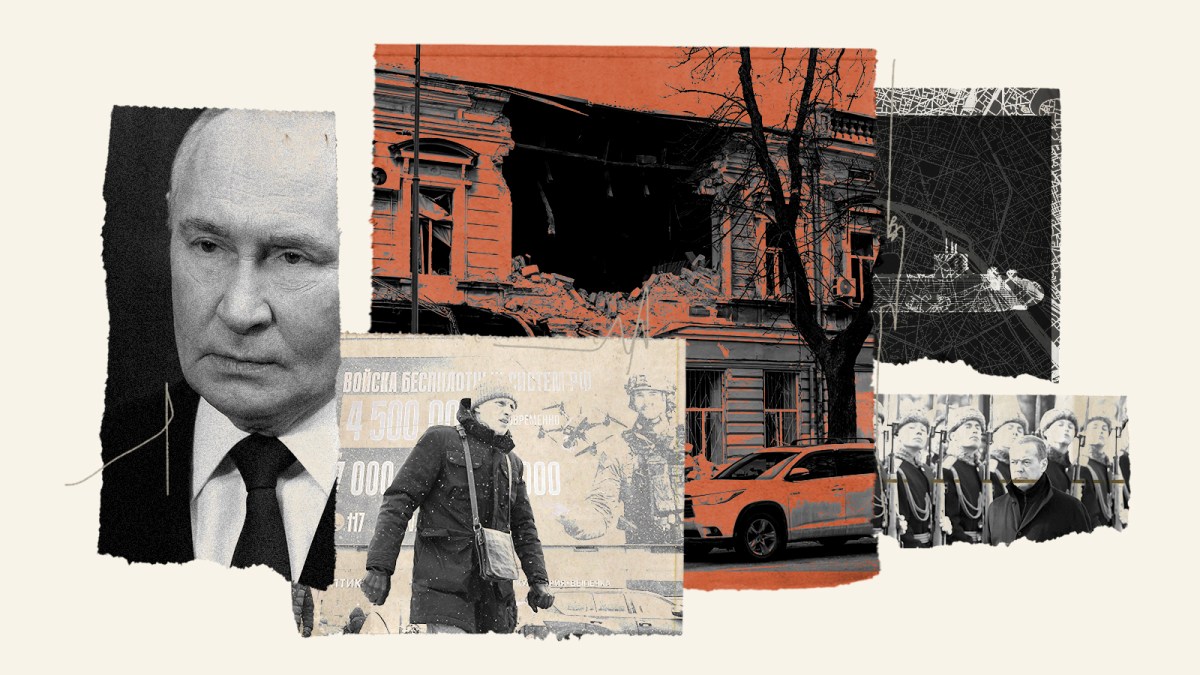
President Vladimir Putin’s recent public appearances have increasingly featured ceremonial events with military personnel, presenting medals and honors to soldiers in carefully choreographed photo opportunities. These events are broadcast prominently on state television, reinforcing the image of a military achieving its objectives despite Western opposition.
Social media platforms, though heavily restricted in Russia, have become another battleground for public opinion. The government employs networks of paid commentators and bots to flood popular platforms with pro-war messaging, while simultaneously cracking down on any content critical of the military operation.
“The digital propaganda effort has become much more sophisticated,” notes Pavel Levin, a digital rights advocate who left Russia in 2022. “It’s no longer just crude messaging but targeted campaigns designed to exhaust opponents and normalize the conflict for everyone else.”
For Russia’s younger generation, particularly in urban centers, the propaganda often falls on skeptical ears. Many use VPNs to access banned western news sources and social media platforms. However, expressing anti-war sentiments publicly carries significant risks, with harsh prison sentences for those found guilty of “discrediting” the Russian military.
The economic impact of the war has been partially masked by the government’s effective macroeconomic management and increased trade with partners like China and India. Russia has redirected much of its sanctioned oil exports to these markets, helping to maintain government revenues despite Western sanctions.
Nevertheless, structural problems in the economy are becoming harder to ignore. Military spending has increased dramatically, crowding out investment in education, healthcare, and infrastructure. Labor shortages have emerged in some sectors as hundreds of thousands of working-age men have either been mobilized for military service or left the country to avoid conscription.
“Putin is betting that Russians’ legendary capacity for endurance will outlast Western resolve to support Ukraine,” says Dmitri Trenin, a political analyst formerly with the Carnegie Moscow Center. “The propaganda is designed to reinforce this national characteristic of patience through hardship.”
As the conflict grinds on with no clear resolution in sight, the effectiveness of the Kremlin’s propaganda strategy will be tested. The question remains whether ramped-up messaging can continue to maintain passive support among a population increasingly eager to move beyond a conflict that has fundamentally altered Russia’s place in the world.
Fact Checker
Verify the accuracy of this article using The Disinformation Commission analysis and real-time sources.

18 Comments
The Russian people deserve to have access to unbiased information about the realities of the conflict, not just state-controlled narratives. Suppressing dissenting voices is a worrying sign of the regime’s insecurity.
Agreed. Tightening controls on media and free speech is a concerning trend that undermines any claims of transparency or democracy in Russia.
The Kremlin’s intensified propaganda efforts are a clear sign of their growing desperation to maintain support for the war. Silencing dissent and controlling the narrative is a dangerous path that could further isolate Russia on the global stage.
You make a fair point. Prioritizing propaganda over addressing the real challenges and costs of the conflict is a recipe for creating an echo chamber that will be difficult to break out of.
The Kremlin’s intensified propaganda efforts are a clear sign of their growing desperation to maintain support for the war. Silencing dissent and doubling down on nationalist rhetoric is a risky strategy that could backfire.
Absolutely. Suppressing free speech and independent media is a hallmark of authoritarian regimes, not democratic societies. This move will only further erode Russia’s standing in the world.
While I understand the Kremlin’s desire to maintain public morale, these heavy-handed propaganda tactics feel like an admission of weakness rather than strength. The long-term costs to Russian society could be severe.
You make a good point. Relying on nationalist rhetoric and blocking outside information is a recipe for creating an echo chamber that will be difficult to break out of.
While I understand the Kremlin’s desire to maintain public morale, these heavy-handed propaganda tactics feel like an admission of weakness rather than strength. The long-term costs to Russian society and global standing could be severe.
Absolutely. Suppressing dissent and doubling down on nationalist rhetoric is a short-term fix that could have far-reaching consequences for Russia’s political and economic stability in the long run.
It’s concerning to see the Kremlin doubling down on propaganda to maintain public support for the war. Acknowledging the challenges and costs while still projecting strength would probably be a more honest approach.
You’re right. Trying to simply dismiss the mounting war fatigue and economic impacts is a short-sighted strategy that could backfire.
The Kremlin’s intensified propaganda efforts are a concerning development that suggests they are struggling to maintain public support for the war. Suppressing dissenting voices and controlling the narrative is a dangerous path that could further isolate Russia.
I agree. Prioritizing propaganda over addressing the real challenges and costs of the conflict is a recipe for creating an echo chamber that will be difficult to break out of.
It’s striking how the Kremlin seems more focused on controlling the narrative than addressing the real challenges posed by the prolonged conflict. This does not bode well for the future of Russia or its relations with the world.
I agree. Prioritizing propaganda over pragmatic solutions is a dangerous path that could further isolate Russia on the global stage.
While I understand the Kremlin’s desire to rally public support, these heavy-handed propaganda tactics feel like a sign of weakness rather than strength. Acknowledging the real challenges and costs of the war would be a more honest approach.
You make a fair point. Doubling down on nationalist rhetoric and dismissing dissent is a short-term fix that could have long-lasting consequences for Russia’s societal stability and global reputation.