


Listen to the article
In a recent critique published in Independent Australia, journalist David Heslin examines how language and framing in media coverage can significantly impact public perception of the Gaza conflict. The article specifically analyzes a controversial piece published in The Nightly, highlighting concerns about journalistic integrity in reporting on the complex and devastating situation.
The piece in question, written by Aaron Patrick, chief writer for the Kerry Stokes-run online publication The Nightly, has drawn sharp criticism for its framing of public executions carried out by Hamas in Gaza City. Patrick, who has previously been a Walkley-nominated correspondent and deputy editor at the Australian Financial Review, presented the executions under the headline “After the fighting ends, Gazans celebrate a public execution like a sporting match.”
Media analysts point to several problematic elements in Patrick’s reporting. His opening statement—”The world demanded peace in the Gaza Strip. This is what peace looks like”—establishes what critics call a false dichotomy. Heslin argues this framing attempts to shift blame for post-ceasefire conditions away from those who conducted military operations and onto activists, humanitarian organizations, and media outlets that advocated for an end to the violence.
The language employed throughout Patrick’s article has raised concerns about ethical reporting practices. His description of the execution scene as having “a mood [that] was celebratory: like the end of a sporting event” suggests widespread civilian participation and approval, rather than acknowledging it as an act carried out by armed forces with limited public presence.
Critics have noted that such characterizations can contribute to dehumanizing narratives about Gaza’s civilian population. Since the beginning of Israel’s military campaign, some Israeli government officials have described Gazans collectively as responsible for the October 7, 2023 attacks, using rhetoric that has included phrases like “there are no innocents in Gaza.”
The broader context of media coverage of Gaza has faced ongoing scrutiny. Media watchdogs have noted patterns in mainstream reporting, including the regular addition of qualifiers such as “Hamas-run Gaza Health Ministry” when reporting casualty figures, despite these figures being considered conservative by many humanitarian observers. Such practices, critics argue, subtly undermine the gravity of the humanitarian situation.
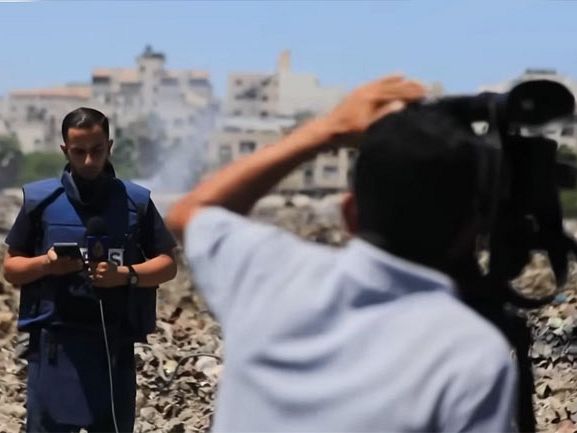
Patrick’s article also addresses the deaths of Palestinian journalists, characterizing claims of targeted killings as mere “allegations” disputed by the Israel Defense Forces. This framing minimizes widely reported concerns from press freedom organizations about the unprecedented number of media casualties in the conflict.
Industry observers note that Patrick has previously participated in press tours organized by pro-Israel lobby groups, and is releasing a book that reportedly takes a sympathetic view toward disgraced Victoria Cross winner Ben Roberts-Smith. These connections raise questions about potential biases in his reporting on Middle East issues.
The controversy highlights ongoing tensions in journalistic practice when covering complex conflicts. While objectivity remains a core principle, how facts are presented, which perspectives are centered, and what context is provided all shape public understanding of events.
Media literacy experts suggest that such reporting underscores the importance of critical consumption of news, particularly during times of geopolitical crisis when the stakes of accurate information are highest.
As the situation in Gaza continues to evolve, the role of responsible journalism in providing context, humanity and accuracy remains as crucial as ever for informing public opinion and policy decisions regarding one of the world’s most persistent humanitarian crises.
Fact Checker
Verify the accuracy of this article using The Disinformation Commission analysis and real-time sources.
