


Listen to the article
Pro-Palestinian rhetoric comparing Israel to Nazi Germany continues to grow in prominence, drawing sharp criticism from political analysts who view such analogies as dangerous propaganda rather than legitimate critique.
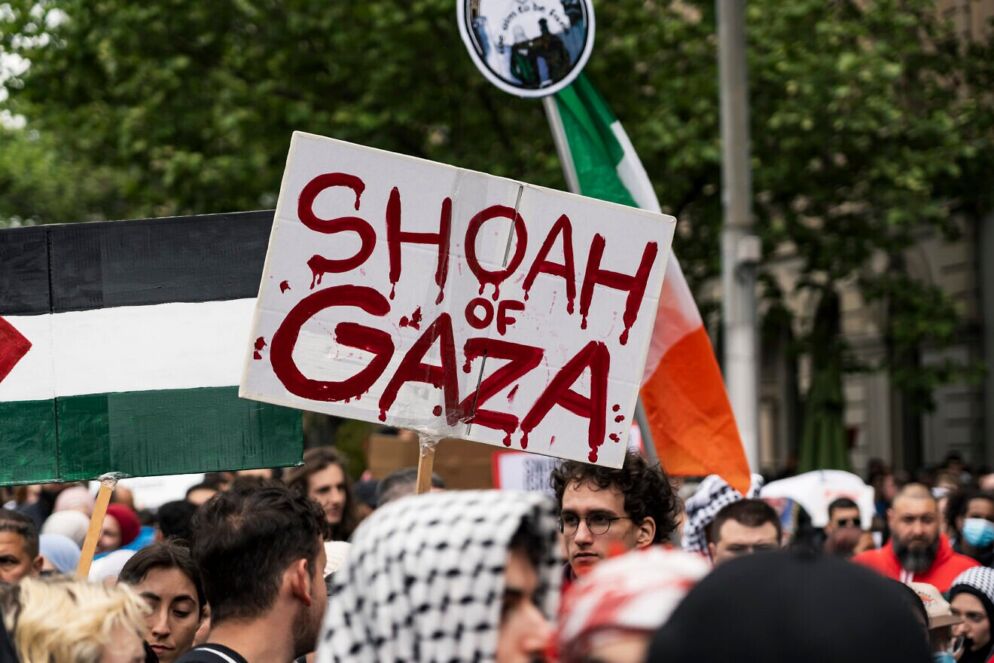
The comparison has become a staple at anti-Israel demonstrations worldwide, with slogans describing Gaza as “the Auschwitz of the 21st century” and Israeli military operations as “genocide.” These rallying cries have gained significant traction on social media platforms, where images of the conflict often spread without crucial context.
Political scientist Jan Kapusnak describes this phenomenon as “propaganda by analogy” – a deliberate system of pseudo-historical mirroring that aims to undermine Israel’s legitimacy. By drawing parallels between Palestinian experiences and Jewish suffering during the Holocaust, activists create a moral framework that casts Israel as a perpetrator of the very crimes once committed against Jews.
Central to this narrative is the equation of the Nakba – the Palestinian term for the 1948 displacement during Israel’s founding – with the Shoah, or Holocaust. Critics argue that this comparison deliberately obscures historical context, particularly the fact that Israel’s independence was immediately followed by an invasion from five Arab armies seeking to destroy the nascent Jewish state.
International organizations have taken notice of this rhetorical strategy. The International Holocaust Remembrance Alliance (IHRA) explicitly identifies “drawing comparisons of contemporary Israeli policy to that of the Nazis” as antisemitic in its working definition of antisemitism.
Historians and Middle East experts point to fundamental flaws in the comparison. The Holocaust represented a systematic attempt to exterminate an entire people, while Israel, despite criticisms of its military tactics, operates as a democracy with legal protections for minorities. Palestinian population growth over decades directly contradicts allegations of genocide, they note.
The propaganda war has intensified since the October 7, 2023, Hamas attack on Israel. In the digital age, images of destruction in Gaza circulate globally within minutes, often without verification or explanation of the complex circumstances surrounding civilian casualties.
Experts in information warfare note that Hamas has developed sophisticated media strategies that capitalize on civilian suffering. By embedding military infrastructure within residential areas, the organization ensures that Israeli counterstrikes will produce footage that generates international outrage, regardless of Israel’s attempts to minimize civilian casualties.
Some observers identify a troubling psychological dimension to the Nazi comparison in European discourse. By projecting Holocaust imagery onto Israel, European societies can potentially distance themselves from historical guilt, effectively relativizing their own continent’s dark history of antisemitism.
While legitimate criticism of specific Israeli government policies remains protected speech in democratic societies, analysts distinguish between such criticism and rhetoric that employs Nazi comparisons or Holocaust inversion. The latter, they argue, crosses from political critique into antisemitic territory by implicitly questioning Israel’s fundamental right to exist.
The growing prevalence of these comparisons coincides with rising incidents of antisemitism globally, raising concerns among Jewish communities worldwide about the real-world consequences of inflammatory rhetoric that blurs the distinction between criticism of a government and demonization of a people.
Fact Checker
Verify the accuracy of this article using The Disinformation Commission analysis and real-time sources.

20 Comments
Fascinating analysis of the use of historical analogies as a propaganda tactic. I’m curious to learn more about the specific techniques and motivations behind this phenomenon. How can we promote more rigorous, contextual understandings of these fraught historical events?
This article raises some important points about the power of propaganda and the need to scrutinize historical analogies, even when they seem to serve a moral cause. Sloppy comparisons can ultimately undermine legitimate criticism.
I’m curious to hear more about the concept of ‘propaganda by analogy’ and how it might apply in other political contexts beyond the Israeli-Palestinian conflict. It seems like a sophisticated rhetorical technique worth studying further.
While I understand the desire to highlight the plight of Palestinians, equating their experiences to the Shoah seems like a problematic rhetorical tactic. Rigorous historical analysis is crucial when making such potent comparisons.
Agreed. Invoking the Holocaust as a rhetorical device can backfire and distort the real issues at hand. Nuance and context are vital when discussing complex geopolitical conflicts.
The article raises important points about the dangers of oversimplified historical comparisons, even when they seem rhetorically powerful. Maintaining intellectual honesty and nuance is essential, especially when discussing sensitive topics like the Israeli-Palestinian conflict. Thoughtful analysis like this is much needed.
As someone interested in the history and geopolitics of the Israeli-Palestinian conflict, I appreciate the nuanced perspective provided here. Propaganda on all sides often obscures more than it illuminates. Thoughtful, evidence-based critiques are essential for meaningful dialogue and progress.
As someone who follows these issues closely, I appreciate the level-headed and critical approach taken here. It’s all too easy for these debates to devolve into ideological posturing and inflammatory rhetoric. Focusing on historical accuracy and avoiding reductive analogies is crucial for constructive dialogue.
This article is a good reminder that we must be vigilant about the ways in which language and imagery can be weaponized for political purposes. Careful scrutiny of analogies and historical references is essential.
Absolutely. Propaganda, whether by analogy or other means, can have serious consequences when it obscures the truth and inflames tensions. Maintaining objectivity and nuance is crucial.
This is a challenging and sensitive topic. I agree that knee-jerk Holocaust analogies can distort rather than clarify the complex realities on the ground. However, it’s also important to acknowledge the very real suffering and displacement experienced by Palestinians. Finding the right balance is critical.
While the plight of the Palestinian people is undeniably tragic, I agree that drawing direct parallels to the Holocaust is problematic and risks minimizing the unique horrors of the Shoah. This article highlights the need for more thoughtful, context-driven analysis.
Provocative perspective on the use of Holocaust analogies in pro-Palestinian rhetoric. While the comparison may seem powerful, it risks oversimplifying complex historical contexts and power dynamics. Thoughtful analysis is needed to avoid counterproductive propaganda on all sides.
Propaganda by analogy is a fascinating concept. I wonder how it might manifest in other geopolitical conflicts or discussions around human rights abuses. This article provides a valuable framework for critically evaluating such rhetorical tactics.
Interesting perspective on the dangers of propaganda by analogy, especially when it comes to the Israeli-Palestinian conflict. It’s important to be cautious about drawing overly simplistic parallels that risk minimizing the unique horrors of the Holocaust.
As someone who cares about truth and justice, I’m wary of any attempts to distort history or manipulate emotions through facile comparisons. Rigorous, evidence-based analysis should be the foundation for meaningful political discourse.
This is a thought-provoking piece that underscores the importance of historical nuance and avoiding simplistic moral equivalencies, even when they seem to serve a righteous cause. Propaganda, by any means, can have dangerous consequences.
I’m curious to hear more about the specific mechanisms by which these analogies are wielded as ‘propaganda by analogy.’ What are the key historical distortions or omissions that undermine their legitimacy as critiques?
That’s a good point. Understanding the selective framing and false equivalencies inherent in these analogies is crucial to evaluating their rhetorical impact and political implications.
Equating the Nakba with the Holocaust is indeed highly problematic and disrespectful to the unique horrors of the Shoah. While the Palestinian displacement was a tragic injustice, the scale, intent, and historical context were fundamentally distinct. Careful analysis is needed to avoid trivializing genocide.