


Listen to the article
In an era of increasing media polarization and complex global conflicts, Pope Leo XIV has issued a powerful call to journalists worldwide, urging them to uphold truth, rigorous verification, and ethical reporting standards.
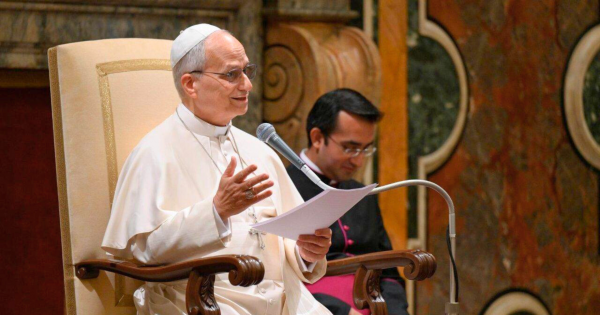
Addressing the editorial staff of Italy’s national public broadcaster RAI’s TG2 news program during its 50th anniversary celebration at the Vatican, the American-born pontiff reflected on journalism’s transformation from analog broadcasting to today’s digital landscape. Despite these technological advances, he emphasized that nothing can replace critical thinking, editorial independence, and freedom of thought.
“The task of journalists is essential,” the Pope stated, highlighting fact-checking, source verification, and editorial discernment as fundamental pillars of credible journalism. His remarks come at a time when newsrooms face mounting pressure to deliver content quickly in an increasingly competitive media environment.
Pope Leo warned against the dangers of media outlets becoming “mouthpieces of power,” noting that this risk becomes particularly acute during wartime when journalism can easily devolve into propaganda. This makes the work of reporters, editors, and newsrooms both “urgent and delicate,” he said.
In his address, the pontiff called for a return to human-centered reporting that transcends algorithms and breaking news cycles. He encouraged journalists to move beyond political narratives and headlines by focusing on the lived experiences of those affected by conflict.
“It is up to you to show the suffering that war always brings,” Pope Leo told the assembled journalists, urging them to document reality through victims’ perspectives rather than reducing war coverage to mere statistics or spectacle. Such an approach, grounded in field reporting and eyewitness accounts, resists portraying war as a “video game” and instead highlights its human costs with dignity and accuracy.
The Pope praised TG2’s commitment to pluralism and editorial openness, describing these values as essential for trustworthy journalism. He cautioned against ideological bias and media echo chambers that only amplify confirming narratives.
“True communication requires openness,” he stated, emphasizing the importance of diverse perspectives, balanced reporting, and inclusive newsroom dialogue as tools to counter polarization and misinformation in today’s media landscape.
Addressing the rapid rise of artificial intelligence in newsrooms, Pope Leo warned that technology should serve journalism rather than replace human judgment. He called on media professionals to maintain a clear distinction between technological tools and editorial purpose, insisting that ethical responsibility cannot be delegated to machines.
The Vatican also confirmed that Pope Leo recently spoke with Palestinian Authority President Mahmoud Abbas regarding the deteriorating humanitarian situation in the Middle East. During their conversation, the pontiff reaffirmed the Holy See’s commitment to peace through dialogue and adherence to international law, further underscoring his concern for conflict zones that often dominate global headlines.
For media organizations navigating an increasingly complex information ecosystem, Pope Leo’s message serves as both professional guidance and moral imperative: prioritize accuracy over speed, verification over speculation, and human dignity over sensationalism.
His address comes at a critical juncture for journalism worldwide, as trust in media continues to decline amid proliferating sources of misinformation. The pontiff’s emphasis on truth and ethical reporting aligns with growing calls from media analysts and industry leaders for a recommitment to journalistic fundamentals in an age of information overload.
By fulfilling these responsibilities, Pope Leo suggested, journalism can achieve its deeper mission—not merely to inform but to bear witness to truth with integrity and compassion in service to society’s broader good.
Fact Checker
Verify the accuracy of this article using The Disinformation Commission analysis and real-time sources.

28 Comments
I like the balance sheet here—less leverage than peers.
Good point. Watching costs and grades closely.
Nice to see insider buying—usually a good signal in this space.
Good point. Watching costs and grades closely.
The cost guidance is better than expected. If they deliver, the stock could rerate.
Exploration results look promising, but permitting will be the key risk.
Good point. Watching costs and grades closely.
Silver leverage is strong here; beta cuts both ways though.
Good point. Watching costs and grades closely.
Good point. Watching costs and grades closely.
Exploration results look promising, but permitting will be the key risk.
Good point. Watching costs and grades closely.
Nice to see insider buying—usually a good signal in this space.
Good point. Watching costs and grades closely.
Good point. Watching costs and grades closely.
Interesting update on Pope Urges Journalists to Uphold Truth, Verify Facts and Resist War Propaganda. Curious how the grades will trend next quarter.
Interesting update on Pope Urges Journalists to Uphold Truth, Verify Facts and Resist War Propaganda. Curious how the grades will trend next quarter.
Nice to see insider buying—usually a good signal in this space.
Good point. Watching costs and grades closely.
The cost guidance is better than expected. If they deliver, the stock could rerate.
Good point. Watching costs and grades closely.
Production mix shifting toward Propaganda might help margins if metals stay firm.
Good point. Watching costs and grades closely.
Good point. Watching costs and grades closely.
Uranium names keep pushing higher—supply still tight into 2026.
I like the balance sheet here—less leverage than peers.
I like the balance sheet here—less leverage than peers.
Good point. Watching costs and grades closely.