


Listen to the article
In a vocal defense of a landmark rural employment program, Warangal West MLA Naini Rajender Reddy criticized the central government’s proposed legislation to remove Mahatma Gandhi’s name from the Mahatma Gandhi National Rural Employment Guarantee Act (MGNREGA).
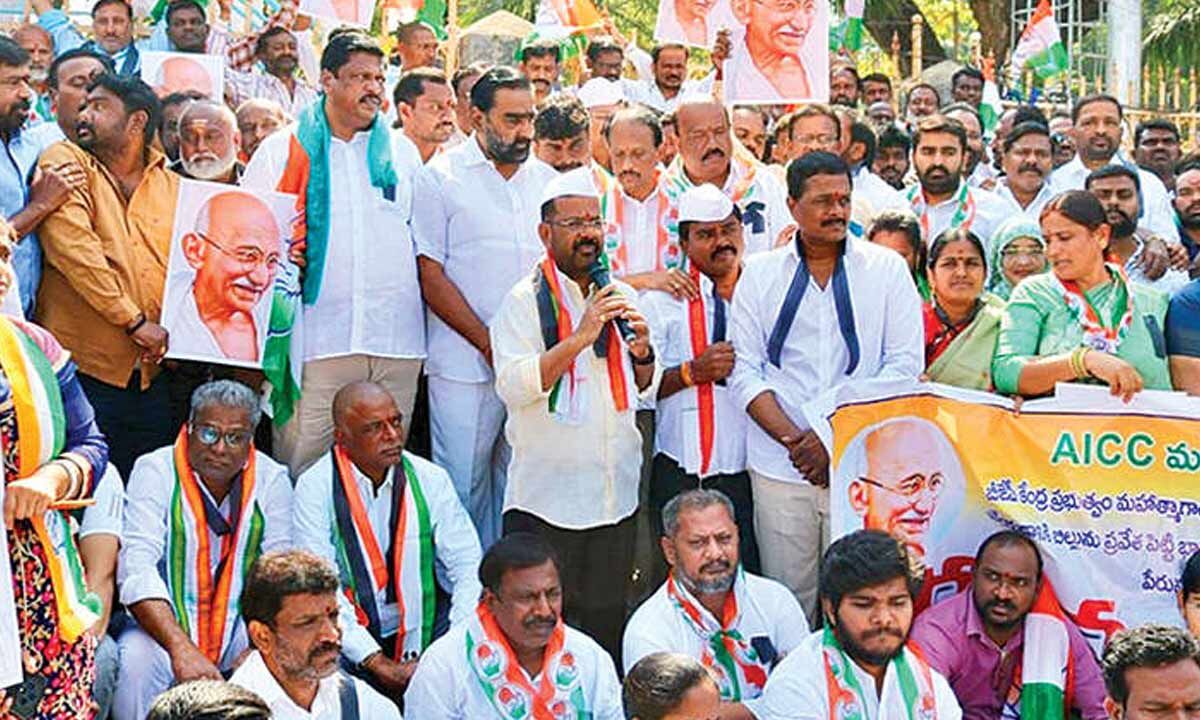
Speaking at a protest event in Hanumakonda on Sunday, Reddy characterized the Congress party’s governance period as a “golden era” for India, particularly for marginalized communities. The demonstration, organized in response to calls from the All India Congress Committee (AICC) and Telangana Pradesh Congress Committee (TPCC), began with participants placing floral tributes at Mahatma Gandhi’s statue in the Public Garden.
“MGNREGS is not merely a welfare scheme, but a legally guaranteed right,” Reddy declared to gathered supporters. He emphasized the program’s multifaceted impact on rural India, noting how it has reduced migration from villages by creating local employment opportunities.
The employment guarantee scheme, implemented nationwide in 2006 during the UPA government, provides up to 100 days of wage employment annually to rural households whose adult members volunteer for unskilled manual labor. The program has been widely credited with creating a financial safety net for vulnerable communities during economic downturns.
Reddy highlighted the scheme’s particular significance for women’s empowerment, explaining that it has gained nationwide recognition for providing women with financial independence—often their first opportunity for formal paid work with equal wages. “It acted like a protective shield for Dalits, tribals, and backward classes,” he added, underscoring its role in sustaining rural economies across India.
The MLA firmly demanded that Gandhi’s name remain attached to the program, asserting that “a truly developed India is possible only by ensuring people’s rights.” His comments reflect growing concern among opposition parties about potential fundamental changes to the program’s structure and identity.
Reddy accused the central government of engaging in superficial rebranding exercises rather than addressing substantive policy issues. “Changing names of laws serves only political propaganda and offers no real benefit to people,” he stated, suggesting that such moves are designed to claim political credit rather than improve governance.
The Congress leader also leveled serious allegations about the current administration’s commitment to the program over the past eleven months, claiming it has failed to allocate adequate funding. “By reducing the number of workdays and delaying wage payments, the livelihoods of the poor were severely affected,” Reddy said.
These funding concerns reflect a broader debate about the program’s implementation. While MGNREGA has been credited with reducing rural distress and providing critical income support during economic shocks like the COVID-19 pandemic, it has faced persistent challenges including delayed wage payments and inadequate funding allocations in recent years.
Critics of the proposed renaming see it as part of a pattern of diminishing the program’s effectiveness. Reddy specifically condemned what he described as introducing “new names and new missions” as attempts to weaken a scheme designed to provide employment security to India’s rural poor.
The controversy highlights ongoing tensions between the central government and opposition parties over the legacy and future direction of one of India’s most significant social welfare programs. As debates continue over potential amendments to the act, advocates maintain that preserving both Gandhi’s name and the core principles of the program remains essential to honoring its original intent of providing economic dignity to rural communities.
Fact Checker
Verify the accuracy of this article using The Disinformation Commission analysis and real-time sources.

12 Comments
The proposed MGNREGA name change seems to be a politically charged issue, with the Congress party accusing the government of trying to erase Mahatma Gandhi’s legacy. While the program has been beneficial, its association with the previous government makes it a target for the current administration. Balancing the practical and symbolic aspects will be crucial.
This controversy highlights the politicization of even basic social welfare initiatives in India. The MGNREGA program has been impactful, but its name change is being framed as an attack on the Congress party’s legacy. Objective analysis of the program’s merits is getting lost in the partisan rhetoric.
While the name change may have practical or administrative rationales, the emotional and symbolic significance of removing Gandhi’s name should not be underestimated. This could become a lightning rod issue if not handled carefully by the government.
This name change controversy highlights the political divides in India. While the MGNREGA has been an important social safety net, its association with the Congress party’s rule means the current government may want to distance it from Gandhi’s name. But that could be seen as an attack on the program’s foundational principles.
The proposed name change for MGNREGA seems to be a politically charged issue. While the rural employment program has had a significant impact, removing Mahatma Gandhi’s name could be seen as downplaying his legacy and the original intent behind the scheme.
I can understand the concern from the Congress party and local leaders about preserving the program’s association with Gandhi’s vision. Maintaining that connection could be important for the scheme’s public perception and continued support.
This controversy highlights the challenges of maintaining social welfare programs in India’s divisive political climate. The MGNREGA has been an important rural safety net, but its association with the previous Congress government makes it a target for the current administration. Objective analysis of the name change proposal is needed, beyond the partisan posturing.
Removing Mahatma Gandhi’s name from the rural employment program could be seen as an attempt to undermine his enduring influence and the Congress party’s legacy. However, the government may have administrative reasons for the change that should be evaluated objectively, beyond partisan politics.
This controversy illustrates the challenges of maintaining key social programs in India’s highly polarized political landscape. The MGNREGA has provided vital employment support to rural communities, but its ties to the Congress party’s rule make it a target for the current government. Objective analysis of the name change’s merits is needed, beyond the partisan rhetoric.
It’s interesting to see the political opposition to the proposed MGNREGA name change. The rural employment scheme has undoubtedly helped many marginalized communities, so the Congress party’s defense of its Gandhian roots is understandable. But the government may have pragmatic reasons for the change that should also be considered.
The concerns raised by MLA Reddy about the program’s legal status and impact on rural livelihoods are valid. Any efforts to alter the MGNREGA will need to carefully weigh its benefits against the political sensitivities around Mahatma Gandhi’s legacy.
The MGNREGA name change debate seems to be more about political point-scoring than the program’s actual merits and impact. While the Congress party’s defense of Mahatma Gandhi’s legacy is understandable, the government may have reasonable administrative reasons for the proposed modification. Striking the right balance will be crucial to ensure the scheme’s continued effectiveness.