


Listen to the article
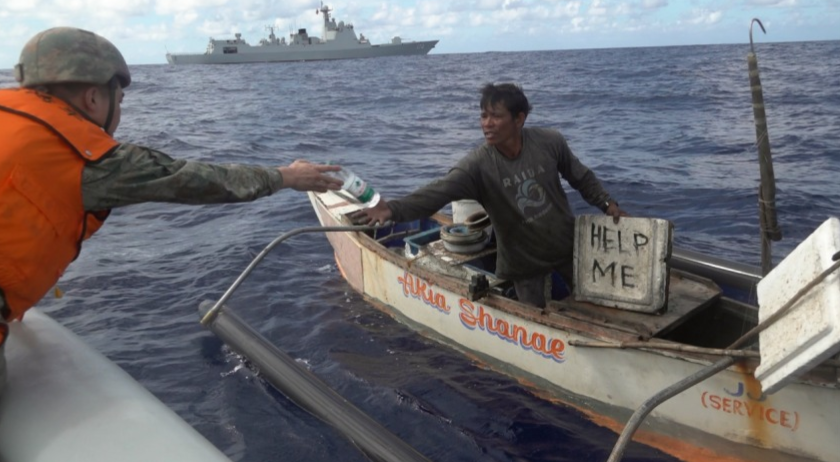
The Philippine Coast Guard (PCG) has cautioned against Chinese propaganda efforts following a maritime encounter where a Chinese naval vessel provided assistance to a Filipino fisherman off Zambales province.
The incident, which took place in waters within the Philippines’ Exclusive Economic Zone (EEZ), has become a point of diplomatic tension after the Chinese Embassy in Manila publicized the event on social media, claiming their navy had aided a stranded Filipino fisherman.
Commodore Jay Tarriela, PCG spokesperson for the West Philippine Sea national task force, disputed key elements of China’s account, emphasizing that the situation should not be exploited to distort territorial realities in the contested region.
“We hope this incident is not exploited as propaganda by China. Instead, it should serve as recognition that Filipino fishermen have full rights to fish in the waters around Bajo de Masinloc,” Tarriela stated, referencing the Filipino name for Scarborough Shoal, an area that has been a flashpoint in territorial disputes between the Philippines and China.
According to the Chinese Embassy’s Friday social media post, a People’s Liberation Army Navy (PLAN) ship provided food and water to a Philippine fishing boat allegedly stranded for three days with engine trouble. The embassy also claimed they had coordinated with the PCG for follow-up assistance.
However, Tarriela directly contradicted these assertions, noting that the PCG received no prior communication from Chinese naval authorities before the post was made public. He also rejected the claim that the fisherman had been adrift for three days.
“The fisherman was safely moored to a Floating Aggregate Device (FAD) or ‘payao’ and awaiting pickup by their mother boat. The claim that he had been adrift for three days is inaccurate,” Tarriela explained. He provided a timeline showing the service boat had departed for fishing on December 24 at approximately 3 p.m., and the fisherman was located by both the PCG and the mother boat the following afternoon—less than 24 hours later.
While acknowledging the PLAN’s humanitarian gesture of providing “a bottle of water and three packs of biscuits” to the fisherman, Tarriela highlighted the contrast between this action and what he described as “barbaric, illegal, coercive, aggressive, and deceptive actions often employed by the China Coast Guard against Filipino fishermen.”
The PCG spokesperson also raised significant concerns about the presence of the Chinese vessel, identified as a Luyang III-class guided-missile destroyer with bow number 174, operating within Philippine waters. According to coordinates provided by Tarriela (14°33.470’N, 118°52.120’E), the incident occurred approximately 71 nautical miles west of Silanguin Island, Zambales—well within the Philippines’ 200-nautical-mile EEZ.
“The PLAN destroyer had no legitimate reason to operate within the Philippines’ Exclusive Economic Zone,” Tarriela asserted.
This incident occurs against a backdrop of escalating tensions in the West Philippine Sea, where Chinese vessels have repeatedly challenged Philippine fishing and exploration activities. The PCG emphasized that this event should be viewed within the broader context of ongoing maritime disputes between the two nations.
The territorial conflicts in the South China Sea involve multiple claimants, including Vietnam, Malaysia, Brunei, and Taiwan, though China’s expansive claims, demarcated by its “nine-dash line,” overlap significantly with the EEZs of these nations. A 2016 ruling by the Permanent Court of Arbitration in The Hague invalidated China’s claims, but Beijing has continued to reject this decision.
For Filipino fishermen who rely on these waters for their livelihoods, such territorial disputes represent not just geopolitical tensions but practical challenges to their daily operations in traditional fishing grounds.
Fact Checker
Verify the accuracy of this article using The Disinformation Commission analysis and real-time sources.

11 Comments
This incident highlights the need for all parties involved to engage in constructive dialogue and find peaceful resolutions to the ongoing maritime disputes in the South China Sea. Resorting to propaganda tactics is unlikely to foster long-term stability.
Interesting development in the ongoing territorial disputes between the Philippines and China. It’s concerning to see China potentially trying to spin this incident for propaganda purposes. The PCG’s caution against such tactics seems prudent.
Agreed. It’s important to maintain a clear-eyed and impartial view on these sensitive maritime issues, rather than letting them be distorted for political gain.
This highlights the complex geopolitical dynamics at play in the South China Sea region. While providing aid to fishermen is commendable, it appears China may be attempting to leverage the situation for its own strategic interests.
Absolutely. Transparency and adherence to international law should be the priority here, not propagandistic posturing.
The PCG’s warning against propaganda is well-founded. It’s crucial that these types of incidents are objectively assessed, rather than exploited for nationalist or expansionist narratives. Maintaining a rules-based order in the region is paramount.
The Philippines has a legitimate claim to the waters around Scarborough Shoal, as recognized by international law. China’s attempts to distort this reality through selective reporting are concerning and should be closely scrutinized.
Agreed. Upholding the rule of law and respecting national sovereignty in the region should be the priority, not nationalist posturing.
The PCG’s warning is a timely reminder that we must be vigilant against the spread of disinformation, especially when it comes to sensitive geopolitical issues. Maintaining a clear and objective understanding of the facts is crucial.
Absolutely. Transparency and adherence to international norms should be the guiding principles in navigating these complex maritime disputes.
It’s concerning to see China potentially attempting to exploit this incident for propaganda purposes. The PCG’s caution is well-warranted, as maintaining a rules-based order in the region is of paramount importance.