


Listen to the article
In the digital age, war propaganda has evolved from traditional methods to sophisticated digital campaigns leveraging targeted advertising and algorithmic profiling, according to a new report from human rights organization Access Now.
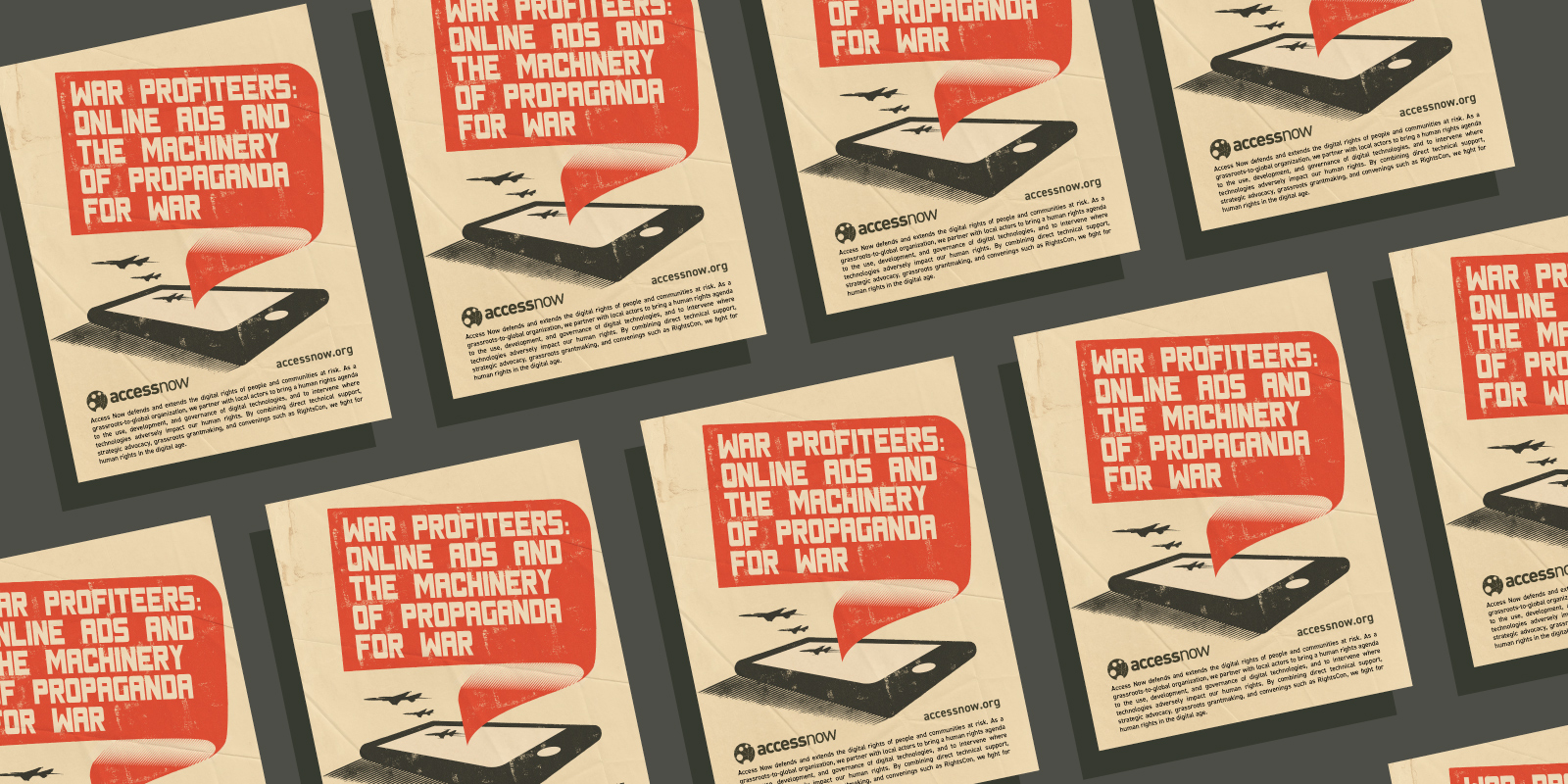
The report, titled “War profiteers: online ads and the machinery of propaganda for war,” explores the dangerous intersection of online advertising and war propaganda, highlighting how these technologies are being exploited to shape public perception, normalize violence, and contribute to human rights abuses in conflict zones.
“Social media platforms should not profit from propaganda for war,” says Dr. Aymen Zaghdoudi, MENA Senior Policy Counsel at Access Now. “Yet online ads present a clear example of their well-known shortcomings in moderating and curating content that can fuel further violence. Even amid legal uncertainty over what constitutes propaganda for war, platforms must not exploit these gaps.”
The analysis centers on Article 20(1) of the International Covenant on Civil and Political Rights (ICCPR), which explicitly prohibits propaganda for war by law. However, the report acknowledges that this prohibition remains surrounded by legal ambiguities and ongoing debates regarding its exact scope and application in the digital realm.
Despite these legal uncertainties, Access Now emphasizes that social media companies cannot use this lack of clarity as justification for inaction. The organization argues that platforms have a responsibility to address content that could incite violence or contribute to human rights violations, regardless of whether it falls neatly within existing legal frameworks.
Marwa Fatafta, MENA Policy and Advocacy Director at Access Now, notes the evolving battlefield of modern conflicts: “Social media platforms have become theaters of conflict, where disinformation and war propaganda spread unchecked. While clear rules on propaganda for war are lacking, the online sphere is not a lawless frontier.”
The report identifies a critical gap in platform policies, which generally fail to address propaganda for war explicitly. Complicating matters further, such propaganda typically operates across multiple posts, accounts, and platforms, making it difficult to identify and moderate using standard content moderation approaches.
Access Now argues that addressing war propaganda requires a holistic and context-sensitive approach rather than simply examining individual pieces of content in isolation. This challenge is particularly relevant as more conflicts have significant digital components, with warring parties using social media to shape narratives and gain support.
The organization has issued a series of recommendations to address these concerns. It calls on governments to investigate and implement appropriate measures to limit or punish the dissemination of war propaganda, while carefully balancing these efforts with protections for freedom of expression both online and offline.
For social media platforms, Access Now recommends creating dedicated advertising policies specifically addressing propaganda for war. The organization also urges platforms to conduct heightened human rights due diligence in conflict-affected contexts, recognizing the increased risks associated with content moderation in these situations.
On a broader scale, Access Now is calling on the international community to develop comprehensive guidance on how to define propaganda for war under Article 20(1) of the ICCPR. This guidance should include clear guidelines for both state actors and corporations, similar to the Rabat Plan of Action, which addresses incitement to discrimination, hostility, and violence.
As digital technologies continue to evolve and conflicts increasingly play out in online spaces, the need for clearer frameworks and more responsible platform governance becomes increasingly urgent. Without such measures, there is a risk that social media platforms will continue to inadvertently amplify harmful content that perpetuates violence, undermines peace processes, and threatens human rights in conflict zones around the world.
Fact Checker
Verify the accuracy of this article using The Disinformation Commission analysis and real-time sources.

9 Comments
This report highlights the urgent need for greater transparency and accountability around online advertising and content moderation practices. Protecting human rights should be the top priority, not maximizing shareholder value.
I’m curious to learn more about the specific tactics and algorithms used to target users with this type of propaganda. Understanding the mechanics behind it could help develop more effective counter-measures.
This is a complex issue with no easy solutions, but the stakes are too high to ignore. Platforms must find ways to balance freedom of expression with their duty to protect vulnerable populations from harm.
This is a concerning report on how online advertising can be weaponized for war propaganda. Platforms must take stronger action to moderate and curate content that violates human rights, even if the legal boundaries are murky.
Absolutely. Prioritizing profits over human rights is unacceptable, especially when it comes to fueling violence and conflict.
While the legal framework around propaganda for war may be ambiguous, tech companies have a moral obligation to avoid profiting from content that normalizes violence and causes harm. This is a complex issue that requires careful consideration.
Agreed. Platforms need to take a firm stance and be proactive in addressing these challenges, even if it means forfeiting some revenue.
While the legal framework may be unclear, the ethical imperative is not. Tech companies have a responsibility to ensure their platforms are not being used to fuel violence and human rights abuses, even if it comes at a financial cost.
Interesting to see how the intersection of online advertising and war propaganda is evolving. Curious to learn more about the specific case studies and data points referenced in the report.