


Listen to the article
North Korean Propaganda Exhibition in Moscow Depicts Violent Deaths of Ukrainian Soldiers
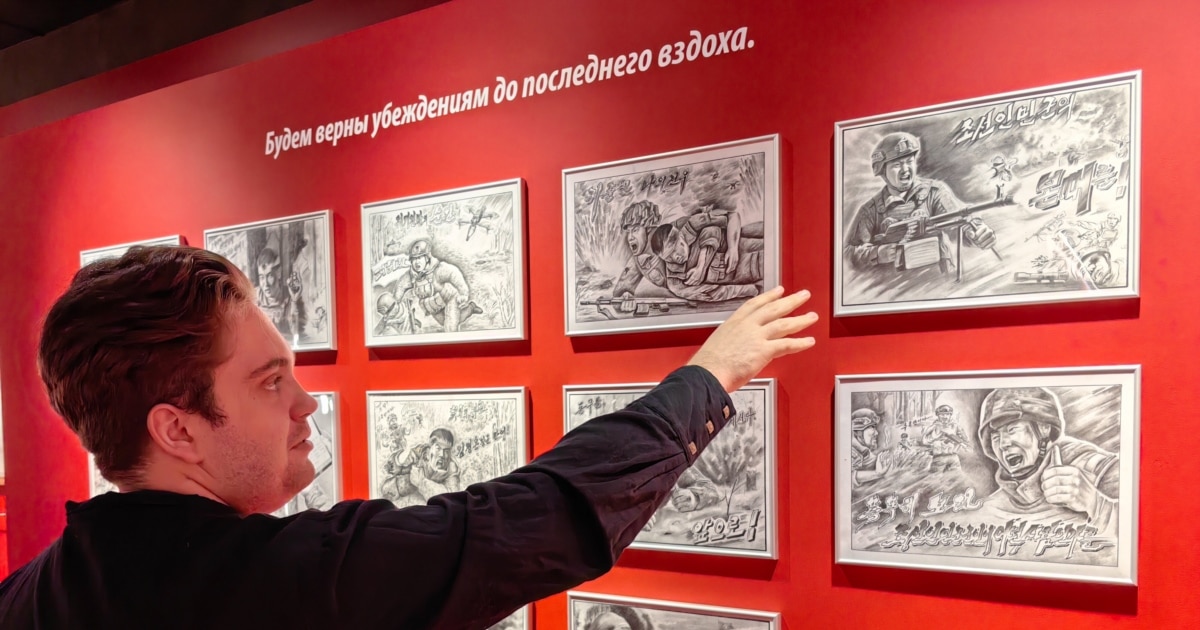
An exhibition featuring graphic North Korean propaganda art that depicts Ukrainian soldiers being killed has opened at Moscow’s Victory Museum. The display, titled “Shoulder To Shoulder,” launched on October 13 and aims to showcase the decades-long cooperation between Moscow and Pyongyang.
The exhibition encompasses artifacts spanning from the Korean War of the 1950s to the present-day partnership between the two internationally isolated nations. Most notably, the display includes a series of pencil sketches showing North Korean troops fighting against Ukrainian forces in Russia’s Kursk region, where Ukraine launched an incursion earlier this year.
The illustrations are particularly graphic, depicting Ukrainian soldiers being shot dead or fleeing in combat scenarios. According to Professor B.G. Muhn, an expert on North Korean art at Georgetown University, these pencil drawings represent one of North Korea’s most popular propaganda art forms.
“Pencil drawings depicting war remain one of North Korea’s most popular art forms,” Muhn told RFE/RL. He explained that such sketches sometimes serve as preliminary work for more elaborate propaganda pieces and function as an inexpensive “vehicle to convey that soldiers are fighting for the nation – in this particular case, supporting Russia, their strong ally.”
The exhibition marks a significant escalation in the visual representation of the conflict. While previous displays merely suggested the presence of Ukrainian forces, the current exhibition portrays Ukrainians being killed in gruesome detail reminiscent of graphic novels. Several images portray Ukrainian soldiers as grotesque caricatures, drawing comparisons to World War II-era propaganda imagery.
Beyond the artwork, the exhibition also features purported battlefield artifacts, including bloodstained letters and a journal with a bullet hole through it. Despite the graphic and violent nature of the material, reports indicate the exhibition is open to visitors of all ages.
The timing of the exhibition coincides with deepening military cooperation between Russia and North Korea. In recent months, Western intelligence sources have reported that North Korea has sent thousands of troops to support Russia’s war effort against Ukraine. The propaganda artwork appears designed to normalize and celebrate this military alliance.
The museum exhibition also represents a significant propaganda effort aimed at domestic Russian audiences, portraying the North Korean military assistance as part of a natural, long-standing partnership rather than a desperate alliance between internationally sanctioned states.
Aleksander Shkolnik, director of the Victory Museum, framed the exhibition as a celebration of the relationship between the two authoritarian nations, describing it as the culmination of eight decades of partnership “for the triumph of justice and kindness, and for peace on our planet” – rhetoric that stands in stark contrast to the violent imagery on display.
The exhibition occurs against the backdrop of increasing international isolation for both Russia and North Korea. While Russia faces sanctions and diplomatic pressure over its invasion of Ukraine, North Korea remains one of the world’s most isolated states due to its nuclear weapons program and human rights record.
For Moscow, the exhibition serves multiple purposes: reinforcing domestic support for the war, normalizing North Korean military assistance, and demonstrating that Russia is not diplomatically isolated. For Pyongyang, the partnership with Russia provides economic lifelines and international legitimacy at a time when few nations are willing to engage with the Kim Jong Un regime.
International human rights organizations have not yet responded to the exhibition, though the graphic portrayal of violence against Ukrainians is likely to draw criticism from Western governments and advocacy groups.
Fact Checker
Verify the accuracy of this article using The Disinformation Commission analysis and real-time sources.

10 Comments
Interesting to see North Korean propaganda art on display, though the graphic depictions of Ukrainian casualties are concerning. I wonder what the intent behind this exhibition is and how it’s being received in Russia.
The graphic nature of these North Korean pencil sketches is deeply disturbing. Depicting the violent deaths of Ukrainian soldiers in this way seems designed to dehumanize and inflame, rather than promote peace and understanding.
I agree completely. This type of propaganda art is unacceptable and has no place in the modern world. We must continue to call out such blatant attempts to glorify war and sow division.
This exhibition is a concerning example of how authoritarian regimes like North Korea use art as a tool for political indoctrination and the demonization of perceived enemies. I hope the international community condemns this blatant propaganda.
The choice to showcase this North Korean war art in Moscow raises questions about Russia’s alignment with Pyongyang’s authoritarian regime. I hope the international community continues to condemn the use of such graphic, misleading propaganda.
As an art historian, I’m curious to learn more about the technical and stylistic elements of these North Korean pencil sketches. However, the subject matter is deeply troubling and seems intended to inflame tensions rather than promote understanding.
I share your concerns. While the artistic merits may be worth examining, the propagandistic intent behind these illustrations is very worrying. Glorifying wartime violence is never acceptable, regardless of the political agenda.
North Korea’s use of pencil sketches to glorify wartime violence is troubling. While artistic expression is important, this propaganda seems aimed at dehumanizing the enemy rather than promoting peace and understanding.
I agree, the tone and content of these illustrations is quite disturbing. Propaganda that celebrates the deaths of soldiers on the other side is never acceptable, regardless of the political agenda.
As an art lover, I’m interested in the technical aspects of these North Korean pencil drawings. However, the subject matter is highly problematic and seems intended to justify violence and aggression rather than promote peace.