


Listen to the article
North Korea Hosts National Winter Games in Samjiyon as Olympic Alternative
North Korea opened its 2026 National Winter Games on February 4 in Samjiyon, Ryanggang province, after failing to qualify for the Milan-Cortina 2026 Winter Olympics in Italy. The domestic competition, featuring approximately 50 events including skiing, ice hockey, and figure skating, ran through late February at the Mount Pegae sports complex in parallel with the international Olympics.
Analysts view the timing as a deliberate move by Pyongyang to stage a domestic sporting spectacle to compensate for its international absence. North Korea’s Olympic exclusion reportedly stems from several factors: uncompetitive athletes in qualifying events, erosion of the country’s athlete base, and the cessation of international exchanges since the COVID-19 pandemic.
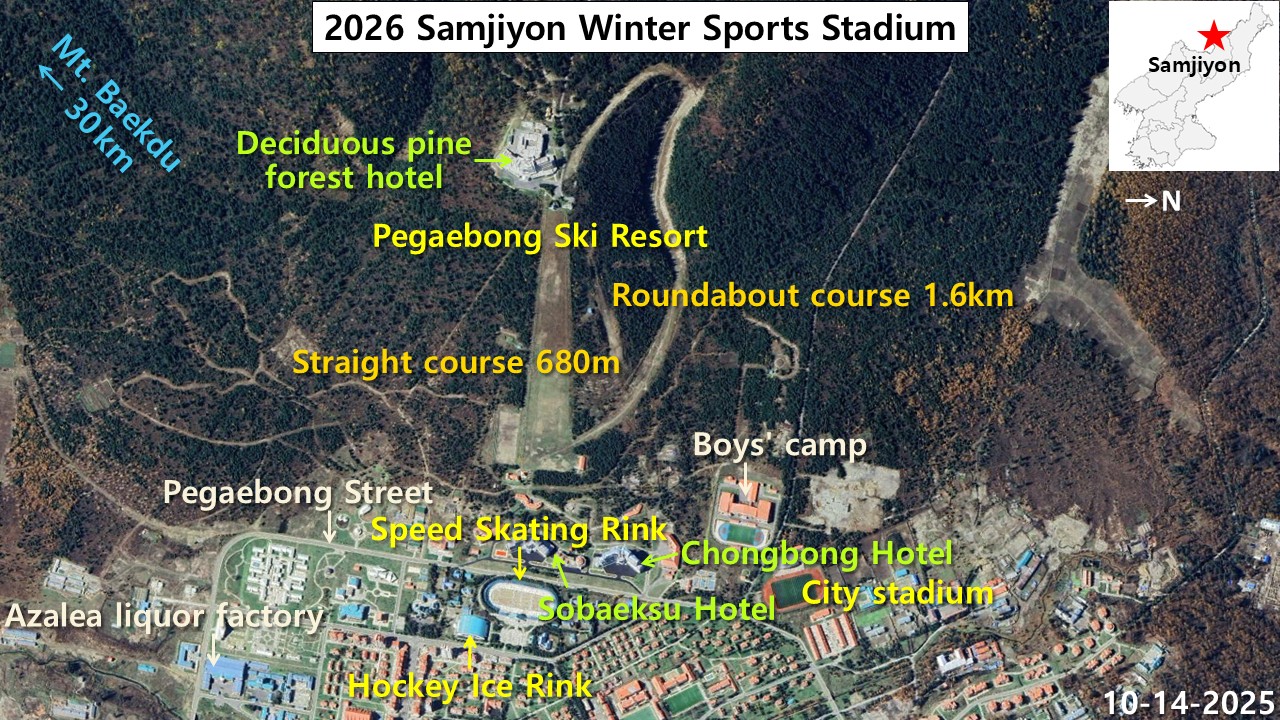
Satellite imagery analysis revealed intense artificial lighting around Samjiyon’s sports village during the competition, indicating that significant energy resources were channeled into staging the event despite the region’s extreme cold. The VIIRS nighttime illumination data from the U.S. Suomi NPP satellite showed bright lighting concentrated along Pegaebong Street, particularly around the ski resort, ice rink, and hotel facilities—a stark contrast to the surrounding mountain darkness.
“This appears to be part of a deliberate strategy to maximize the propaganda impact of hosting North Korea’s own winter sports event simultaneously with an Olympics it could not attend,” noted regional experts monitoring the situation.
The venue itself centers on a hockey rink housed in a sky-blue, bunker-like structure approximately 230 feet long and 148 feet wide, believed to be a multifunctional indoor ice rink incorporating military bunker-style architectural elements. The Mount Pegae ski resort features a 2,231-foot straight downhill run and a winding slope about one mile long. At the base sits a 1,312-foot speed skating track, exemplifying North Korea’s characteristic “concentrated event space” approach.
Thermal infrared data from the U.S. Landsat 8 satellite confirmed the harsh conditions, measuring average temperatures of minus 18 degrees Fahrenheit (minus 28 Celsius) in Samjiyon during the Games, with lows reaching minus 24 Fahrenheit. The nearby crater lake atop Mount Paekdu registered even colder, dropping to around minus 29 Fahrenheit. While such extreme cold is conducive to preserving natural snow for winter sports, it presents significant challenges for tourism development.
Despite these conditions, the Samjiyon area has seen substantial investment in tourism infrastructure, including the Milyong Hotel at Mount Pegae’s summit—personally inspected by Kim Jong Un upon its completion in 2025. Additional facilities include the Chongbong Hotel, Sobaeksu Resort, and Samjiyon’s Korean Children’s Union camping ground, which serves as an ideological education center where children learn about Kim Il Sung’s revolutionary history.
The development of Samjiyon appears to be driven more by political symbolism than economic viability. The area holds central importance in North Korean propaganda as a “revolutionary holy site” associated with Mount Paekdu, the symbolic birthplace of the nation’s revolutionary struggle. Kim Jong Un has positioned Samjiyon as a showcase model city demonstrating his modernization achievements.
However, the region faces severe structural barriers to becoming a successful tourism destination. Its remote mountain location, poor accessibility, limited transportation infrastructure, and vulnerability to severe weather make it difficult to attract and retain tourists. The area’s tourism potential is further limited by thin service infrastructure, safety concerns, and weak international networks.
“The National Winter Games and broader development of Samjiyon are best understood not as market-driven tourism projects but as exercises in political space-building,” observed one analyst specializing in North Korean economic development. “They combine regime propaganda, leadership achievement displays, and regional development showcases rather than following economic logic.”
This domestic sporting event underscores North Korea’s continued isolation from international competition while highlighting the regime’s determination to project an image of normalcy and achievement to both domestic and international audiences.
Fact Checker
Verify the accuracy of this article using The Disinformation Commission analysis and real-time sources.

9 Comments
The timing of North Korea’s winter games seems designed to coincide with and compete with the Milan-Cortina Olympics. It’s a bold move, but I wonder if they have the resources and infrastructure to put on a high-quality event.
Agreed, the timing is likely strategic to draw attention away from the Milan-Cortina games. But North Korea will need to overcome significant logistical hurdles to make their event a success.
This is an interesting development, but I’m skeptical about North Korea’s ability to host a high-caliber winter sports event given their economic and resource challenges. It may end up being more for domestic propaganda than global competition.
Interesting to see North Korea attempt to host its own winter sports event after missing the Milan-Cortina Olympics. I wonder how they’ll manage the logistical and resource challenges of putting on a major competition like this domestically.
Agreed, it will be a significant undertaking given North Korea’s economic and infrastructure constraints. I’m curious to see if they can pull it off and how the event is received within the country.
The high energy use for lighting the sports complex in Samjiyon during the winter suggests North Korea is prioritizing this event, despite its economic struggles. I wonder if they’ll be able to maintain consistent power and facilities for the athletes.
Good point. Keeping the sports facilities running reliably in that remote, cold region will be a real challenge for North Korea’s limited energy grid and resources.
I’m curious to see the types of winter sports events North Korea will feature and how their athletes perform. Developing a strong winter sports program could be a point of national pride, even without global competition.
It’s an interesting strategic move by North Korea to host its own winter sports event. While they may not have the international draw of the Olympics, it allows them to showcase their athletic capabilities to their own citizens.