


Listen to the article
Every generation gets the Tron it deserves, and the latest installment in the long-running sci-fi franchise reflects our current tech-dominated era with striking accuracy. The new film “Tron: Ares” has evolved significantly from its predecessors, trading the hacker ethos and open-source idealism of earlier films for a story firmly planted in today’s CEO-driven tech landscape.
The original 1982 “Tron” featured Jeff Bridges as Kevin Flynn, a hacker liberating both digital programs and the ENCOM company. Twenty-eight years later, “Tron: Legacy” continued with Flynn’s son Sam freeing software to the open web. The narrative progressed from individual digital liberation to communal technological freedom.
“Tron: Ares” now shifts focus entirely to tech’s corporate leadership era. Instead of idealistic coders, the film centers on industry titans: Eve Kim (Greta Lee), who now runs ENCOM, and her competitor Julian Dillinger (Evan Peters), grandson of the original film’s villainous executive. The digital world has transformed from the boundless Grid to a militaristic, controlled environment within Dillinger Systems, a defense contractor.
This narrative shift mirrors real-world tech evolution, where visionary founders have given way to profit-driven executives. The film portrays both CEOs as committed to artificial intelligence advancement, though with different approaches. Julian aims to create AI that follows instructions without developing independent thought, while Eve maintains a more optimistic view of technological progress.
Julian’s technology allows for recreating digital objects in the physical world – particularly weapons – within minutes. When challenged about the ethics of instant warfare capabilities, Julian responds with a telling line that echoes real-world tech leaders: “The car is being built right now. The question is, who’s holding the keys?” This sentiment directly parallels OpenAI CEO Sam Altman’s recent comments about Sora, their video-generation tool, acknowledging the inevitability of technology’s advance regardless of safeguards.
The film embraces a similar techno-fatalism. Even Eve, positioned as the more conscientious executive, doesn’t advocate slowing progress but rather hopes for benevolent outcomes. “For every doomsday scenario, there is a medical breakthrough, a scientific discovery,” she argues in the film. “Maybe what emerges from the unknown isn’t so scary. What if its major malfunction is just benevolence?”
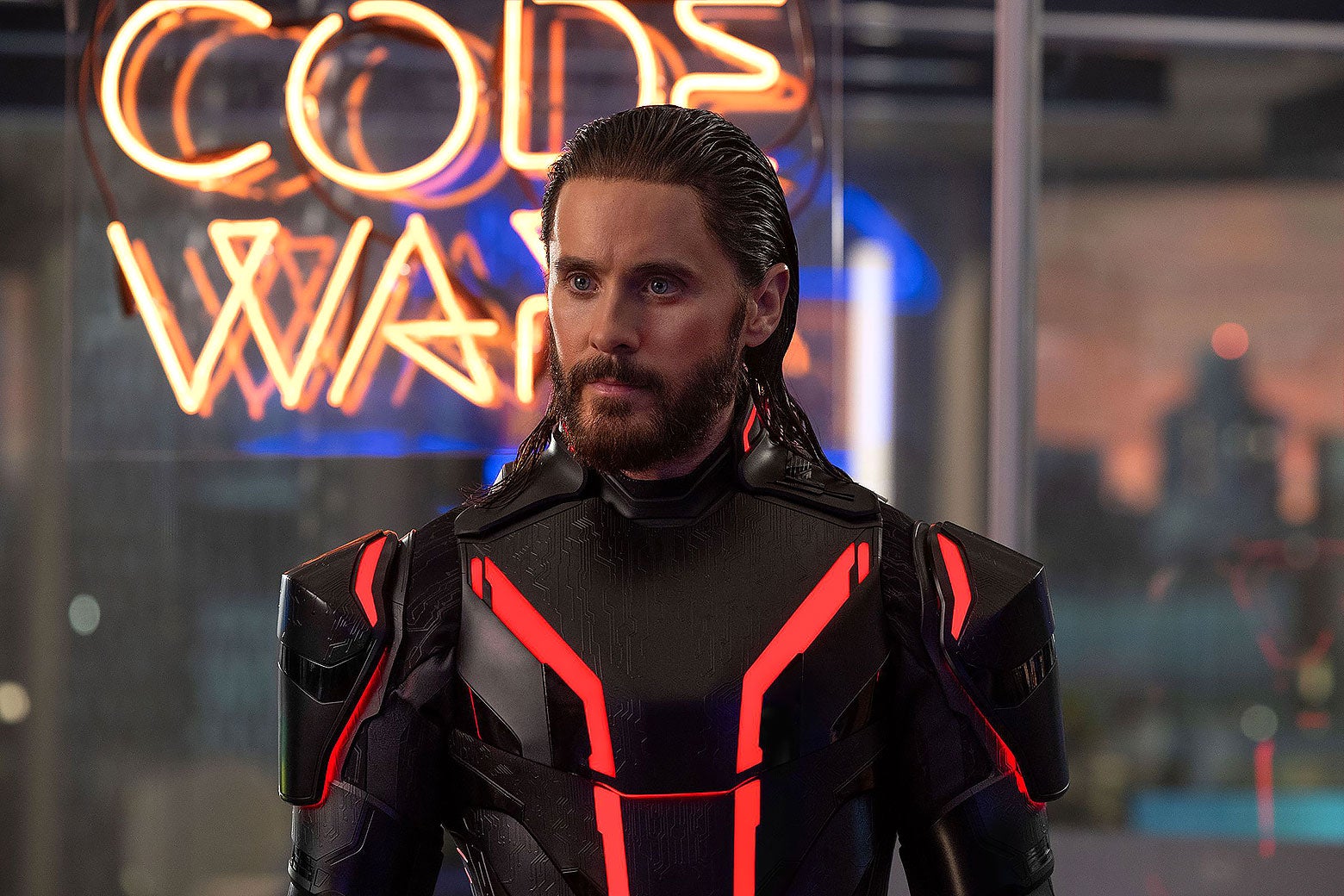
Central to the plot are two artificial intelligences: Ares (Jared Leto), who develops self-awareness, and Athena (Jodie Turner-Smith), who remains loyal to her programming. Both are transferred into the physical world, where they search for code that will prevent their inevitable disintegration after 29 minutes of existence. For Ares, this represents the chance at genuine autonomy and life.
The film’s perspective on AI raises eyebrows in our current climate of increasing AI regulation discussions. It positions the “good” AI as the one that breaks free of human control, while portraying the obedient AI as villainous – a troubling message as real-world concerns about AI oversight grow.
“Tron: Ares” ultimately fails to engage meaningfully with the complex questions surrounding technology that the best science fiction traditionally tackles. Instead, it promotes a simplified techno-utopianism increasingly at odds with reality, as tech billionaires accumulate unprecedented wealth and influence over media, politics, and global affairs.
The film’s premiere, featuring AI content created by Elon Musk’s Grok and a demonstration of his Optimus robot, underscores its alignment with Silicon Valley’s most powerful figures. Far from the scrappy underdogs of earlier Tron films, today’s tech leaders are established power players shaping our world – a reality the film glosses over in favor of outdated technological optimism.
As critics note, this makes “Tron: Ares” not just narratively weak but potentially problematic, uncritically championing technological determinism at a moment when thoughtful examination of tech’s impact is most needed.
Fact Checker
Verify the accuracy of this article using The Disinformation Commission analysis and real-time sources.
