


Listen to the article
Nepal Film Festival Draws Fire for “Xizang Panorama” Program Amid Accusations of Chinese Propaganda
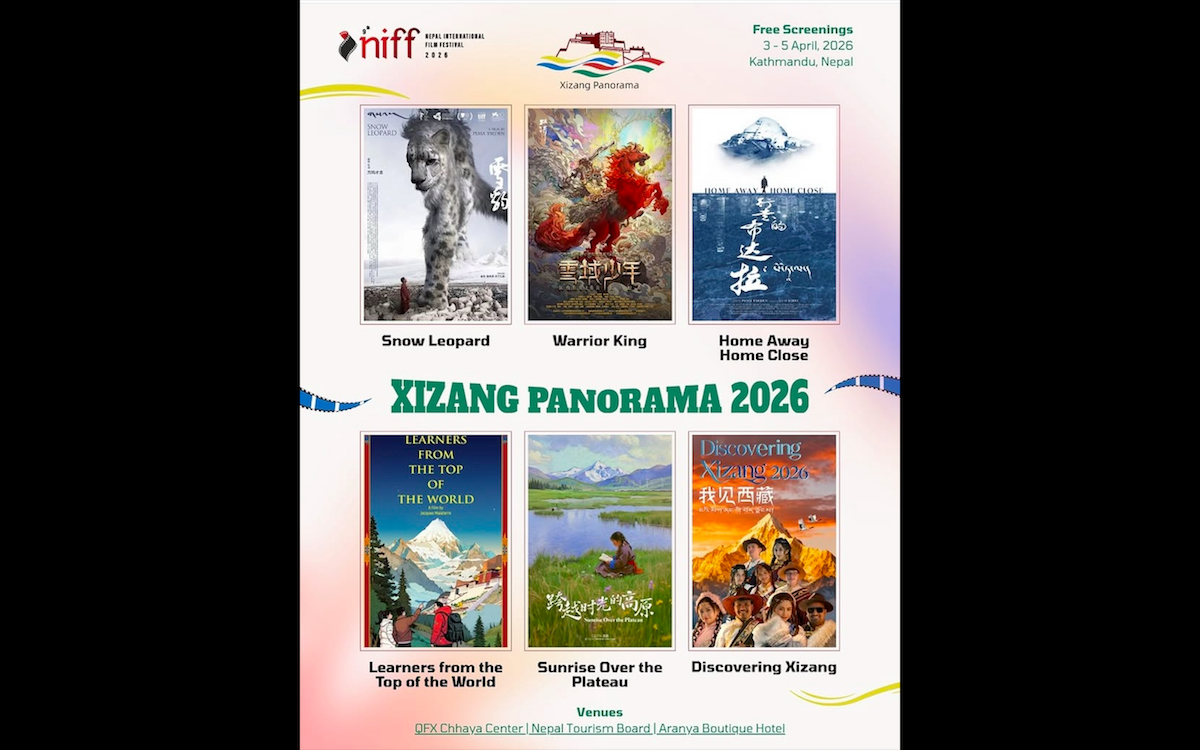
The Nepal International Film Festival (NIFF) has become embroiled in controversy following its decision to feature a segment called “Xizang Panorama” during this year’s event, which ran from April 3 to 5 in Kathmandu.
Critics have taken aim at the festival’s use of “Xizang” – the Chinese government’s official designation for Tibet – rather than using “Tibet,” the name historically recognized internationally. Scholars and activists view this nomenclature as part of Beijing’s broader strategy to solidify its sovereignty claims over the region, which has remained under Chinese control since the 1950s.
The contested film segment, organized in partnership with the Pan-Himalayan Cultural Research Center, showcased six films including “Warrior King,” “Snow Leopard,” “Home Away Home Close,” “Learners from the Top of the World,” “Sunrise Over the Plateau,” and “Discovering Xizang 2026.”
Students for a Free Tibet (SFT), a prominent advocacy group, has condemned the festival’s programming choices, characterizing the segment as “a Chinese propaganda operation funded by a Chinese government university.” The organization argues that several featured films misrepresent Tibet’s reality and serve to whitewash China’s policies in the region.
“NIFF exists to platform independent voices outside of state control,” SFT stated. “Screening Chinese state propaganda betrays that purpose.”
Of particular concern to critics is the documentary “Learners from the Top of the World,” which SFT claims portrays controversial boarding schools as “progressive development.” Human rights organizations have long criticized these institutions, alleging they separate Tibetan children from their families and cultural roots as part of a systematic assimilation strategy.
Similarly, “Discovering Xizang 2026” faced criticism for allegedly presenting environmental degradation in Tibet as sustainable “green” development, which activists say contradicts well-documented ecological challenges in the region.
The controversy intensified following a post-screening discussion captured on video and later shared by SFT. During the Q&A session, when an audience member questioned why independence is considered essential for snow leopards but not for Tibetans, a speaker reportedly responded that Tibetans have been “free for 61 years” and described Tibet as modern and developed, adding that “everybody is free, except the prisoners.”
SFT strongly rejected this characterization, countering that expressions of Tibetan identity – including language use, religious practices, and possession of images of the Dalai Lama – can result in imprisonment under Chinese rule. The group further warned that China’s recent “Ethnic Unity” policies potentially criminalize even minimal expressions of Tibetan cultural identity.
The terminology debate extends beyond semantics. The use of “Xizang” instead of “Tibet” is viewed by many as part of what activists describe as a calculated effort to accelerate the Sinicization of Tibetan culture, language, and religion – effectively erasing Tibetan identity through linguistic and cultural means.
This controversy isn’t isolated. The Kathmandu International Mountain Film Festival (KIMFF) faced similar criticism during its 21st edition, which also featured a “Xizang Panorama” segment showcasing Chinese-produced films about Tibet.
The situation highlights the complex geopolitical tensions that continue to surround Tibet, with cultural events increasingly becoming battlegrounds for competing narratives about the region’s identity and political status. It also underscores the growing concern among Tibetan advocacy groups about what they perceive as China’s expanding influence in neighboring Nepal’s cultural sphere.
As international film festivals navigate these politically charged waters, questions persist about their responsibility to represent diverse perspectives while avoiding becoming platforms for state-sponsored messaging about contested regions.
Fact Checker
Verify the accuracy of this article using The Disinformation Commission analysis and real-time sources.

16 Comments
I like the balance sheet here—less leverage than peers.
Silver leverage is strong here; beta cuts both ways though.
Nice to see insider buying—usually a good signal in this space.
Good point. Watching costs and grades closely.
Nice to see insider buying—usually a good signal in this space.
Production mix shifting toward Propaganda might help margins if metals stay firm.
If AISC keeps dropping, this becomes investable for me.
Good point. Watching costs and grades closely.
Uranium names keep pushing higher—supply still tight into 2026.
Good point. Watching costs and grades closely.
Uranium names keep pushing higher—supply still tight into 2026.
Interesting update on Nepal Film Festival Criticized for Including Chinese State-Backed “Xizang Panorama” Segment. Curious how the grades will trend next quarter.
Good point. Watching costs and grades closely.
Good point. Watching costs and grades closely.
If AISC keeps dropping, this becomes investable for me.
Good point. Watching costs and grades closely.