


Listen to the article
Pentagon’s New Press Policy Draws Widespread Media Backlash
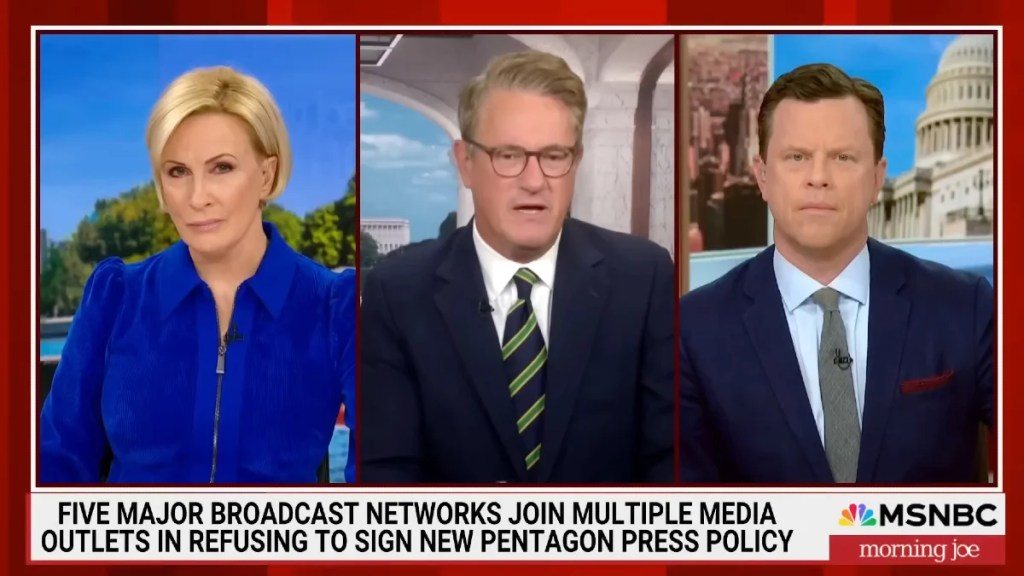
A controversial new Pentagon press policy has sparked unified opposition from major news outlets, with MSNBC’s “Morning Joe” leading vocal criticism against what participants called a direct challenge to First Amendment principles.
The policy, which reportedly penalizes journalists who solicit information from military officials, has been rejected by virtually all major news organizations including Fox News, CNN, ABC, NBC, CBS, and The Associated Press, according to host Joe Scarborough.
“I think it’s a remarkable thing that every organization, nearly every organization, has come forward and said, ‘We will not agree to this,'” said Atlantic writer Nancy Youssef during Wednesday’s broadcast.
Youssef emphasized that the media’s opposition stems from fundamental constitutional concerns. “We’re doing so because it goes against the principles of the First Amendment,” she explained. “Our responsibility is not to put out what the Pentagon wants us to put out, but to put out information that the American public needs to know about an organization that takes nearly a trillion of taxpayer dollars and has the awesome responsibility of potentially deploying America’s sons and daughters into harm’s way.”
The policy comes under the leadership of recently appointed Secretary of Defense Pete Hegseth, a Trump administration appointee. Critics suggest the measure represents an unprecedented attempt to control media access and messaging about military affairs.
Scarborough framed the issue as being about accountability rather than political positioning. “This isn’t about Pete Hegseth or members of his family that don’t want the press around. This is about protecting the men and women in uniform from civilians that get put in positions and generals who may make bad, boneheaded decisions,” he said.
The host emphasized that Pentagon decisions have life-or-death consequences, making transparency crucial. “When you make mistakes, you have men and women sacrificing for this country who die,” Scarborough noted. “The idea that these people are not to be asked questions — it’s not the Soviet Union. This is the United States of America, thank you very much.”
MSNBC National Affairs Analyst John Heilemann offered perhaps the sharpest critique, suggesting the policy reveals a fundamental misunderstanding of press-government relations. “It reflects a fundamental misunderstanding of the relationship between journalists and government and what our role is and how the government, in some ways, even benefits from the discomfort that the press puts it in when it holds government accountable and honest.”
Heilemann warned that the policy could represent an attempt to “institutionalize propaganda,” noting that while all administrations engage in messaging, the current administration’s approach goes further. “This administration, in the age of social media, has probably the most sophisticated and most advanced kind of propagandistic capacities and skill set of any administration in U.S. history. But this is trying to kind of make that the institutional order of operations.”
The media resistance to the Pentagon policy comes amid broader concerns about press freedom under the Trump administration, which has frequently characterized mainstream news outlets as “fake news” and “enemies of the people.” Media advocacy groups have documented numerous challenges to press access across multiple federal agencies since the administration took office.
Despite the Pentagon’s efforts, Heilemann expressed confidence that the policy would ultimately fail. “Apart from the fact that it’s profoundly wrong, it’s not going to have anything like the effect that Pete Hegseth thinks it’s going to have.”
The Pentagon has not publicly responded to the widespread media rejection of its new guidelines, leaving questions about how the standoff between military leadership and the fourth estate will ultimately be resolved.
Fact Checker
Verify the accuracy of this article using The Disinformation Commission analysis and real-time sources.

10 Comments
It’s good to see the media industry standing united against this Pentagon policy. Protecting the First Amendment and the public’s right to know should be the top priority here.
I’m glad to see widespread media opposition to this policy. Restricting journalists’ ability to gather information from military sources is an unacceptable threat to press freedom. Kudos to Morning Joe for calling this out.
This policy raises major First Amendment concerns. The media’s role is to inform the public, not simply echo the Pentagon’s messaging. I hope this heavy backlash forces the military to reconsider this misguided attempt at censorship.
Absolutely. A free press is essential for maintaining accountability and oversight of powerful institutions like the military.
While national security is important, this policy seems to go too far in limiting press access. The public deserves transparent and objective reporting, not just the government’s preferred narrative.
It’s concerning to see the military trying to crack down on journalists in this way. This is a slippery slope that could undermine the public’s right to know what their government is doing.
I agree, this is a worrying development that should be closely watched. A free press is a cornerstone of democracy.
Concerning news about this new Pentagon press policy. It seems like a worrying attempt to limit media access and control the narrative. Transparent and independent reporting is crucial for holding the military accountable.
While the military has legitimate security concerns, this policy seems to go too far in limiting press freedom. The public deserves an independent media that can effectively scrutinize and hold the government accountable.
This policy appears to be an attempt to ‘institutionalize propaganda’ as Morning Joe suggested. The media must remain vigilant in pushing back against efforts to restrict access and control the flow of information.