


Listen to the article
Arakan Army Spokesman Refutes Military Claims of Gwa Town Encirclement
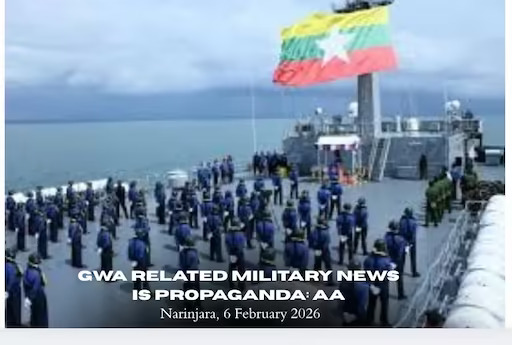
The Arakan Army (AA) has strongly denied reports from military-controlled media outlets claiming that Myanmar’s military forces have surrounded Gwa, the southernmost town in Rakhine State currently under AA control.
“These reports are propaganda,” AA spokesman U Khaing Thukha told Narinjara News, dismissing claims that junta forces have positioned themselves just six miles from the strategic town and are intensifying offensive operations in the area.
According to Khaing Thukha, Myanmar military vessels are conducting long-range bombardments rather than engaging in close combat operations. “Sometimes, their navy ships come closer, around 10,000 meters from the shore, and fire heavily on villages near the Gwa market area,” he explained. “Many villagers and displaced people have been hit by their weapons. Some of them sustained injuries, and damages occurred to their houses.”
Military-controlled media had reported that Gwa, which borders Ayeyarwady Division, was effectively surrounded by junta forces blocking movement by both land and sea. These reports also claimed the military had recaptured 24 villages in the vicinity of Gwa and that armored vehicles and drones were advancing from Bawmy to Thin Paung Taw, approaching Gwa Chaung bridge.
The reports further suggested that naval vessels had positioned themselves near Rahai Kutoe village north of Gwa, preparing to land troops to complete the encirclement of the town. They also claimed that some AA fighters had fled Gwa and retreated to other parts of Rakhine State.
However, local residents contradict these assertions. One Gwa resident, speaking on condition of anonymity, told reporters they had received no information about the military capturing 24 villages in the township. The resident added that reports of a mainland invasion were implausible given ongoing fighting in neighboring Ayeyarwady region.
An independent investigation by Narinjara News revealed a different situation on the ground. According to their findings, multiple military camps and outposts in Laymyin township, established at the mouth of the Baw Mi river with the intention of launching attacks on Gwa, were actually destroyed in recent AA offensives. The report indicates that many junta troops retreated after suffering heavy casualties.
The conflicting narratives highlight the ongoing information war that has characterized Myanmar’s civil conflict since the February 2021 military coup. The Arakan Army, one of the country’s most powerful ethnic armed organizations, has made significant territorial gains in Rakhine State over the past year, capturing several key towns and military positions.
Military pressure on Gwa holds significant strategic importance, as the coastal town provides the AA with access to maritime supply routes and serves as a gateway between Rakhine State and Myanmar’s central regions. Control of Gwa also impacts civilian movement and humanitarian access in a region already facing severe displacement and food insecurity.
The situation in Rakhine State has deteriorated significantly since fighting resumed between the AA and Myanmar military in late 2022, following a temporary ceasefire. The renewed conflict has displaced tens of thousands of civilians and further complicated humanitarian efforts in a region still recovering from previous waves of violence.
While independent verification of claims from either side remains challenging due to access restrictions and communications blackouts, the pattern of heavy artillery use and naval bombardments reported by AA spokesperson Khaing Thukha is consistent with the military’s tactics in other conflict areas across the country.
As fighting continues across multiple fronts in Myanmar, civilian populations remain caught in the crossfire, with international humanitarian organizations repeatedly expressing concern about the protection of non-combatants and access to essential services in conflict-affected areas.
Fact Checker
Verify the accuracy of this article using The Disinformation Commission analysis and real-time sources.

10 Comments
If the AA’s statements about civilian casualties and damage are accurate, that is very concerning. The military’s actions need to be closely scrutinized to ensure compliance with international laws and norms.
Agreed, the protection of civilians should be the top priority. Independent monitors may be needed to verify the conditions on the ground.
The Arakan Army’s rebuttal of the military’s claims raises questions about the accuracy of the information being reported. Reliable information is important, especially in volatile regions.
You’re right, it’s important to get a clear picture from multiple credible sources before drawing conclusions about the situation in Gwa.
This is concerning news about the military’s reported actions in the Gwa region. I hope the claims of propaganda and indiscriminate attacks on civilians can be properly investigated and verified.
Agreed, unbiased reporting and transparency around military operations in conflict zones is crucial. The civilian impact needs to be taken seriously.
The conflicting narratives highlight the complexity of the situation in the Gwa region. I hope impartial observers can gain access to verify the facts and ensure the protection of all affected communities.
That’s a good point. Independent monitoring and reporting will be essential to cutting through the propaganda and establishing the truth of what is happening on the ground.
Bombardment of villages near Gwa market, if true, is deeply troubling. The military must be held accountable for any indiscriminate attacks or disproportionate use of force against civilians.
Absolutely, the reported civilian impacts need to be investigated thoroughly. Transparency and accountability are critical in conflict zones.