


Listen to the article
Russian Intelligence Agency Launches Unprecedented Attack Against Ecumenical Patriarch
Russia’s Foreign Intelligence Service (SVR) has issued a scathing statement against Ecumenical Patriarch Bartholomew, marking a significant escalation in the already strained relations between the Moscow and Constantinople patriarchates.
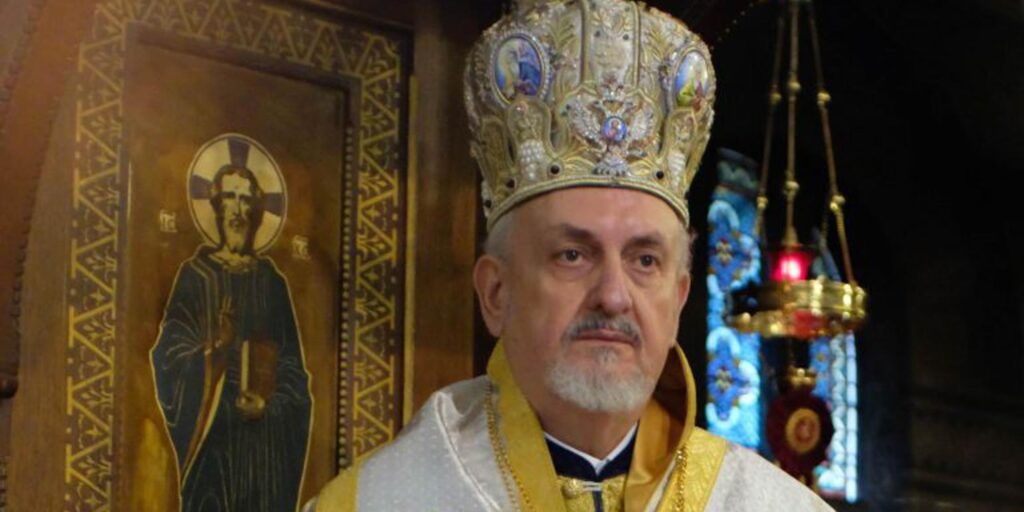
“We are entering uncharted waters,” said Elder Metropolitan Emmanuel of Chalcedon in an interview with Kathimerini. The statement represents what many observers see as the complete alignment of the Russian Orthodox Church with the Kremlin’s political objectives, effectively transforming the church into “a weapon of political propaganda,” according to the Metropolitan.
The SVR, which defines itself as part of Russia’s national security apparatus and is the successor to the Soviet-era KGB, used remarkably harsh language in its attack. The statement accused Patriarch Bartholomew of being an “orchestrated devil” collaborating with British intelligence services and “ideological Zionism.” It further claimed he was “literally dismantling the constitutional body of the Church” and acting like “false prophets.”
The Ecumenical Patriarchate in Istanbul, known as the Phanar, responded by condemning these allegations as “manifestly fabricated scenarios, false news, insults, and concocted information.” Officials there were particularly alarmed by the personal nature of the attack against Patriarch Bartholomew himself, rather than just the institution.
This confrontation represents the latest development in a deteriorating relationship that began to publicly fracture in 2013 when the Russian Orthodox Church first questioned the primacy of the Ecumenical Patriarch. Tensions escalated dramatically in 2018 when the Ecumenical Patriarchate granted autocephaly (independence) to the Orthodox Church of Ukraine—a move Moscow vehemently opposed.
Metropolitan Emmanuel views the timing of this attack as potentially linked to changing dynamics in US-Russia relations. Some analysts speculate that Moscow may be testing how the American administration will react to such an attack on the Ecumenical Patriarchate, which has historically maintained close ties with Washington.
The Metropolitan also highlighted a curious shift in the Russian narrative. “Whereas until recently responsibility was attributed to the Americans, now, quite suddenly, British intelligence services appear in their place,” he noted. This change potentially signals Moscow’s attempt to recalibrate its messaging as it navigates relations with the current US administration.
Beyond Ukraine, tensions are spreading to other regions with Orthodox populations. The Baltic states, Moldova, and Estonia are emerging as new flashpoints in this ecclesiastical struggle. The Ecumenical Patriarchate has established an Exarchate in Lithuania and continues to support Estonian Orthodox Christians—actions Moscow characterizes as intrusions into its canonical territory.
Metropolitan Emmanuel rejects this framing, describing the Patriarchate’s actions as “the essential healing of a wound that was violently inflicted in 1945” when Soviet authorities forced these churches under Moscow’s control.
The conflict ultimately reveals profound theological and political differences. The Metropolitan describes Moscow’s approach as suffering from “spiritual illness and an ecclesiological deviation” where “the Gospel itself becomes an instrument of state enforcement and political expediency.”
He contrasts this with Constantinople’s position: “If, through a logic of absolute identification, the Patriarchate of Moscow remains bound to a tradition of dependence on the state, then the freedom expressed at the Phanar becomes scandalous to them, because freedom always scandalizes those who do not possess it.”
Despite the escalating rhetoric, Metropolitan Emmanuel emphasized that “the door of the Ecumenical Patriarchate is, and always remains, open to sincere dialogue,” though he acknowledged that “barbarity is tending to become the norm in inter-Church relations.”
The conflict represents not just a religious dispute but has significant geopolitical implications across Eastern Europe and the former Soviet space, where Orthodox Christianity remains a powerful force in national identity and politics.
Fact Checker
Verify the accuracy of this article using The Disinformation Commission analysis and real-time sources.

7 Comments
While I understand the tensions between the Moscow and Constantinople patriarchates, it’s troubling to see the Russian Orthodox Church aligning so closely with the Kremlin. This risks further damaging the church’s independence and credibility.
You’re right, this is a disturbing trend that threatens to undermine the church’s spiritual role and transform it into a mere political tool. The church should remain independent and focused on its religious mission.
The Metropolitan’s comments about the church becoming a ‘propaganda mechanism’ are quite alarming. It’s crucial that religious institutions maintain their autonomy and resist being co-opted for political purposes, no matter the circumstances.
This is certainly a concerning development. The Russian Orthodox Church seems to have become too intertwined with the Kremlin’s political agenda. It’s worrying to see intelligence agencies attacking the Ecumenical Patriarch in such strong language.
The use of such strong language by the Russian intelligence agency is concerning. It suggests an escalating conflict that could have serious repercussions for the Ecumenical Patriarchate and the broader Orthodox Christian community.
This situation highlights the complex geopolitical dynamics at play and the risks of religious institutions becoming entangled in wider power struggles. It’s important to closely monitor these developments and their potential implications.
You raise a good point. The Russian Orthodox Church’s alignment with the Kremlin could have far-reaching consequences, both for the church itself and for broader regional and global stability. Maintaining a clear separation between religion and politics is vital.