


Listen to the article
Kazakhstan’s Democratic Backslide Intensifies as Government Tightens Control Over Civil Society
Kazakhstan’s government has ramped up efforts to restrict civic freedoms and silence dissent between June 2025 and January 2026, according to a new report by International Partnership for Human Rights and Kazakhstan International Bureau for Human Rights and Rule of Law.
Independent journalists have faced unprecedented pressure during this period, with several high-profile cases targeting media outlets that dared to publish investigative reports on politically sensitive issues. In December 2025, authorities raided the offices of Orda.kz and placed editor-in-chief Gulnara Bazhkenova under house arrest on charges of spreading “false information.” The case followed months of harassment against the outlet, widely viewed as retaliation for its investigative reporting on corruption.
In a particularly troubling development, Bazhkenova’s lawyer, Murat Adam, was stripped of his license in January 2026 for publicly criticizing procedural violations in the case. The International Commission of Jurists condemned this action as “incompatible with international human rights law” regarding legal profession independence.
KazTAG news agency’s leadership faced similar criminal charges after publishing allegations of fraud by Freedom Finance, a company run by influential businessman Timur Turlov. Editor-in-chief Amir Kassenov was placed under house arrest in December 2025, with reported procedural violations including denied lawyer access during police searches.
“These cases illustrate how susceptible Kazakhstan’s ‘false information’ laws are to abuse,” warned the Committee to Protect Journalists, calling for urgent reform to address such accusations exclusively through civil proceedings.
Online suppression tactics have evolved, with journalists reporting mysterious account suspensions following posts on sensitive topics. Independent journalist Lukpan Akhmedyarov’s Facebook account became inaccessible in November 2025 after he posted about threats received while documenting deaths of conscript soldiers. The website of independent outlet Respublika.kz.news was blocked nationwide, ostensibly based on a decade-old court decision.
State surveillance of online platforms has intensified, with the Astana Communications Service contracting monitoring of over 55,000 media and social media sources to flag “aggressive” content critical of the government. President Tokayev publicly endorsed efforts to identify users allegedly spreading “provocative” content, stating that agencies were working to locate such individuals.
Perhaps most alarming is the new legislation banning so-called LGBTQI+ “propaganda,” which was rushed through parliament and signed into law in December 2025. The law prohibits virtually any information relating to LGBTQI+ issues on media, online platforms, or other public means. Violations can result in fines, up to 10 days of administrative detention, and restrictions on media outlets’ operations.
Six UN human rights experts warned that the law “would entrench stigma, outlaw expression, and contravene international human rights obligations.” They particularly condemned the equation of “non-traditional sexual orientation” with pedophilia as “an affront to human dignity.”
The diplomatic community also expressed concern, with the EU Delegation and embassies of 19 EU member states and partner countries warning that the law runs counter to Kazakhstan’s international human rights commitments and “leaves room for arbitrary misinterpretation affecting fundamental freedoms.”
Oversight of foreign-funded organizations has been significantly expanded. New rules effective January 2026 require organizations receiving foreign funding to report receipt within 10 days and submit biannual reports on fund usage. A public registry now discloses specific sources and amounts of foreign funding, which critics warn could increase stigmatization risks.
The new Tax Code grants authorities enhanced powers to conduct checks and inspections of foreign-funded organizations, raising concerns about selective targeting and undue interference.
More than 20 individuals remained imprisoned on politically motivated charges as of early 2026, including opposition movement leader Marat Zhylanbaev and activists-journalists Duman Mukhamedkarim and Aigerim Tleuzhan. Those supporting imprisoned activists have themselves become targets, with prominent human rights defender Bakhytzhan Toregozhina fined for allegedly spreading “false information” about Zhylanbaev’s health.
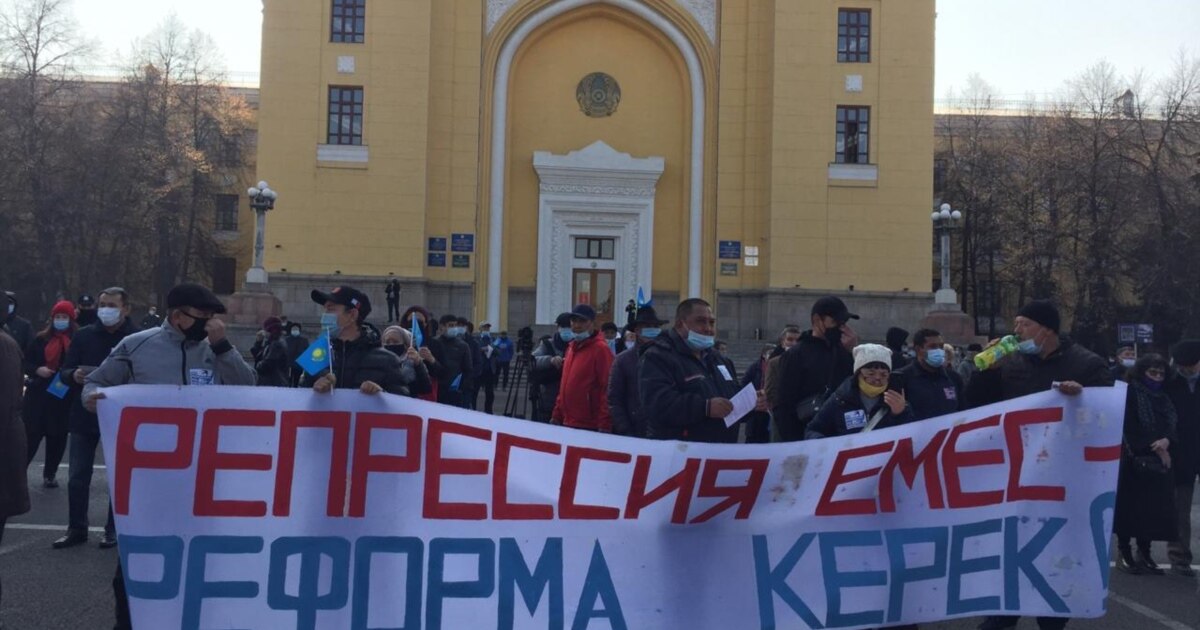
Peaceful protests have been systematically suppressed, despite a Constitutional Court ruling from January 2025 prohibiting automatic rejection of assembly requests. In January 2026, three women demanding fair investigations into their children’s deaths were detained and fined approximately €200 each for allegedly violating assembly rules. A journalist covering the protest was also detained and had his photos and videos deleted.
As Kazakhstan prepares to implement the new restrictions in 2026, human rights advocates warn that the country’s democratic space is rapidly shrinking, reflecting what the report describes as “a broader regional – and global – trend of growing authoritarianism and decreasing civic freedoms.”
Fact Checker
Verify the accuracy of this article using The Disinformation Commission analysis and real-time sources.
