


Listen to the article
The military operation dubbed “Midway Blitz” in Chicago’s South Shore neighborhood has sparked intense controversy and legal battles between the Trump administration and Illinois state officials. What began as a targeted operation against undocumented immigrants accused of criminal activity quickly escalated into what critics are calling a “war zone” in American streets.
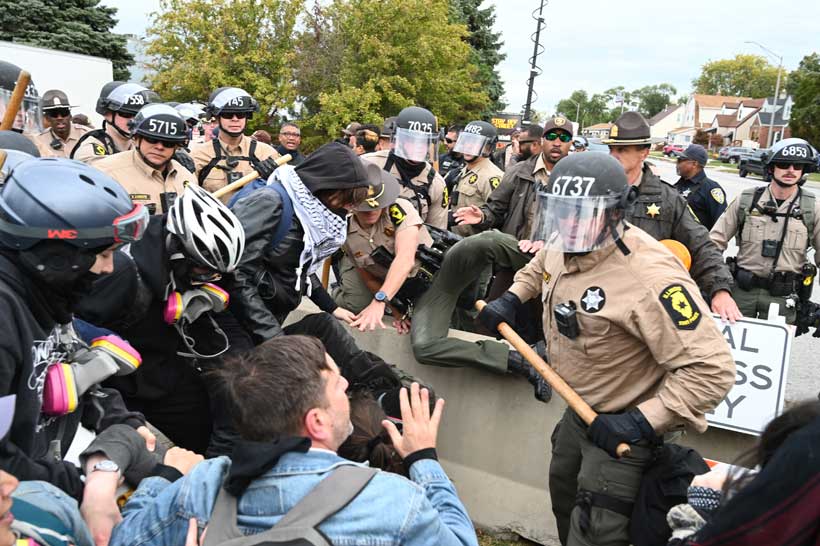
On September 30, 2025, U.S. military forces entered the predominantly Black South Shore community in Chicago to conduct mass arrests of what the administration described as “criminal illegal aliens.” However, the operation’s tactics—including home searches of uninvolved residents, deployment of tear gas, and what witnesses characterized as excessive force—immediately drew fierce criticism.
Illinois Governor JB Pritzker condemned the operation, suggesting President Trump deliberately provoked unrest to justify deploying federal troops under his direct command. “What we’re seeing is the creation of a pretext for rebellion,” Pritzker said in a statement. “This administration is using the military to carry out violence against communities under the guise of law enforcement.”
The confrontation highlights growing tensions over immigration enforcement and federal-state jurisdiction. Residents and community activists began referring to South Shore as a “war zone,” a term that quickly spread through media coverage and social media channels. The framing of the situation as a “war zone” has proven particularly powerful, shifting public perception away from a law enforcement operation toward imagery of military occupation.
Media coverage has split along partisan lines, with some outlets emphasizing the administration’s law and order objectives while others focus on civilian impacts and potential civil rights violations. Social media platforms have become battlegrounds for competing narratives about the legitimacy and proportionality of the federal response.
The conflict escalated further on October 6, when the State of Illinois filed a lawsuit in the Northern District of Illinois federal court against the Trump administration. The legal action seeks to halt what state officials describe as an unconstitutional attempt to transfer state control to federal authorities and to block the deployment of approximately 300 additional National Guard troops from Texas to Chicago.
According to court documents, Texas has already deployed around 400 National Guard personnel to the area for what was initially described as a 60-day assignment. The Illinois lawsuit argues that these actions represent a violation of state sovereignty and exceed federal authority.
The Trump administration has defended its actions, maintaining that federal authorities have legitimate power to protect federal property and enforce immigration laws, particularly when local jurisdictions are perceived as failing to cooperate with federal immigration enforcement efforts.
The controversy has become a textbook example of how political communication shapes public perception. The Trump administration has constructed a narrative depicting Chicago as unsafe due to liberal policies and sanctuary protections for immigrant communities. Meanwhile, Illinois officials counter with messaging about federal overreach and discriminatory targeting of minority communities.
Legal experts note the irony that while the operation was ostensibly grounded in law enforcement authority, the execution has been widely perceived as violence against immigrant communities. This perception gap illustrates how political messaging can dramatically influence public understanding of government actions.
Community organizations in Chicago have organized protests demanding an immediate cessation of the operation, while civil liberties groups have announced plans to file additional legal challenges alleging constitutional violations.
The confrontation represents more than a jurisdictional dispute—it symbolizes fundamental disagreements about immigration policy, federal-state relations, and appropriate use of military resources for domestic law enforcement. As both sides attempt to control the narrative, the residents of South Shore find themselves caught in what one community leader described as “a political battleground where civilian safety has become secondary to scoring political points.”
The case continues to develop as courts consider the legal challenges and as both state and federal officials maintain their opposing positions on the legitimacy of the operation.
Fact Checker
Verify the accuracy of this article using The Disinformation Commission analysis and real-time sources.

10 Comments
The allegations of excessive force and creating a ‘pretext for rebellion’ are quite serious. It will be important to get the full facts and context around this controversial operation.
Absolutely, a thorough and impartial investigation is needed to understand exactly what happened and why. The public deserves transparency on such a sensitive national security matter.
This is a complex and sensitive issue. I appreciate the in-depth reporting and multiple perspectives being shared. It’s important to get the facts right, rather than jumping to conclusions.
Agreed. Maintaining objectivity and nuance in the coverage will be key, rather than fueling further polarization. A thoughtful, evidence-based approach is needed.
This highlights the challenges of balancing national security concerns with respecting civil liberties and community relations. Finding the right approach will be crucial moving forward.
Interesting to see the media framing and propaganda narratives around this military operation in Chicago. It seems there are major questions around the tactics used and the overall justification for deploying federal troops against a community.
As an investor, I’ll be watching closely to see how this situation develops and whether it has any broader economic implications. Transparency and accountability will be crucial.
The media framing of this as a ‘war zone’ in American streets is quite striking. I hope we can avoid further escalation and find a peaceful resolution.
As a commodity investor, I’m curious to see if this incident has any broader economic or market implications, particularly for industries like defense, security, or urban infrastructure.
That’s a good point. Geo-political tensions and domestic unrest can certainly impact commodity and equity markets in unpredictable ways. It will be worth monitoring closely.