


Listen to the article
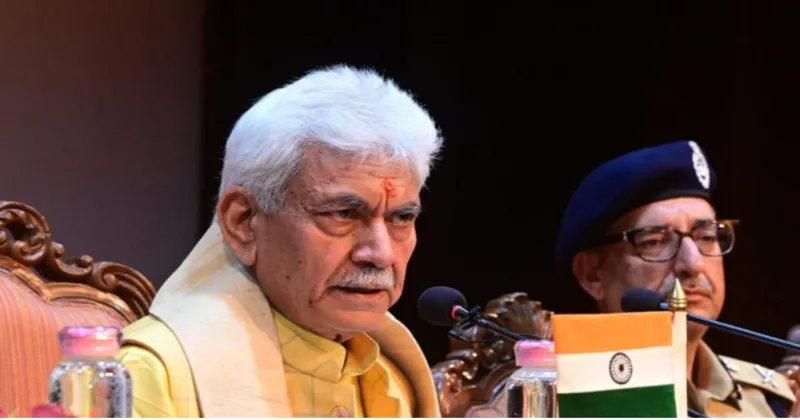
In a powerful condemnation of those attempting to minimize the 1990 Kashmiri Pandit exodus, Jammu and Kashmir Lieutenant Governor Manoj Sinha declared the event “one of the most painful human tragedies of independent India” during a book launch ceremony in Jammu on Thursday.
Speaking at the release of Professor Ashok Kaul’s book “Kashmir: Nativity Regained,” Sinha criticized efforts to label the forced displacement as mere “propaganda,” calling such characterizations a “second genocide” that kills “truth, memory and justice.”
“When the genocide of Kashmiri Pandits was exposed, some elements linked to a particular ecosystem dared to call it propaganda. By doing so, they carried out a second genocide—an attempt to murder truth itself,” Sinha said to the gathered audience.
The Lieutenant Governor emphasized that the suffering of Kashmiri Pandits had been not only suppressed for decades but deliberately misrepresented, inflicting additional trauma on victims by denying them recognition and justice. He described the events of 1989-90 as a “deep civilisational wound” that forced families to leave their ancestral homes under terror threats.
“The pain is so deep that even time’s balm has not reduced it. Families were uprooted like trees from their own soil,” Sinha remarked, characterizing the exodus as more than a political event but rather a “human catastrophe where trust collapsed and silence prevailed.”
According to Sinha, terrorism in Kashmir targeted not just individuals but entire generations, creating an atmosphere of fear that affected innocent children and attacked “the soul of an entire civilisation.” He noted that the violence led to a breakdown of social bonds, with neighbors becoming silent and familiar faces complicit through inaction.
The Lieutenant Governor described the exodus as a “genocide of faith, memory and coexistence,” highlighting that both Kashmiri Pandits and Muslims suffered immensely due to Pakistan-sponsored terrorism that has plagued the region for decades.
Praising Professor Kaul’s literary work, Sinha said the book represents more than literature—it serves as “a voice against decades of enforced silence.” Through characters like Mohan and Hasan, the narrative captures the trauma of involuntary displacement, of leaving behind homes, villages, gardens, and temples.
Sinha pointed to the abrogation of Article 370 in 2019 as a watershed moment for the region. “That day, the call of abandoned homes was heard again. A belief was born that the new generation can now touch those roots without fear,” he said, reaffirming that Prime Minister Narendra Modi remains committed to ensuring the dignified return of Kashmiri Pandits to their homeland.
The administration has taken concrete steps toward addressing property issues faced by displaced Kashmiris, including the launch of the Kashmiri Migrant Web Portal in 2021, designed to help reclaim encroached properties and facilitate rehabilitation efforts.
In a stern warning to those involved in terrorism, Sinha pledged that his administration would completely dismantle the terror ecosystem in Jammu and Kashmir. “Every link of terrorism will be exposed. Every individual associated with terror will be brought to justice. Those who betray the nation will face punishment so severe that generations will tremble,” he declared.
The Lieutenant Governor urged younger generations to remember the atrocities committed during “that dark phase of history,” describing the displacement of Kashmiri Pandits as “one of the world’s most heartbreaking tragedies” that must not be buried under political noise or collective amnesia.
“Justice cannot come without remembrance,” Sinha said, commending displaced families for preserving their cultural identity through decades of exile. He concluded his address on a note of hope: “This is the time of reconstruction. Even after the darkest night, the sun will rise again.”
Fact Checker
Verify the accuracy of this article using The Disinformation Commission analysis and real-time sources.

17 Comments
I like the balance sheet here—less leverage than peers.
Good point. Watching costs and grades closely.
Good point. Watching costs and grades closely.
If AISC keeps dropping, this becomes investable for me.
Good point. Watching costs and grades closely.
I like the balance sheet here—less leverage than peers.
Exploration results look promising, but permitting will be the key risk.
Good point. Watching costs and grades closely.
Good point. Watching costs and grades closely.
The cost guidance is better than expected. If they deliver, the stock could rerate.
Good point. Watching costs and grades closely.
Good point. Watching costs and grades closely.
Production mix shifting toward Propaganda might help margins if metals stay firm.
The cost guidance is better than expected. If they deliver, the stock could rerate.
Production mix shifting toward Propaganda might help margins if metals stay firm.
Good point. Watching costs and grades closely.
The cost guidance is better than expected. If they deliver, the stock could rerate.