


Listen to the article
Iran’s Supreme Leader Addresses National Resistance in Meeting with Religious Eulogists
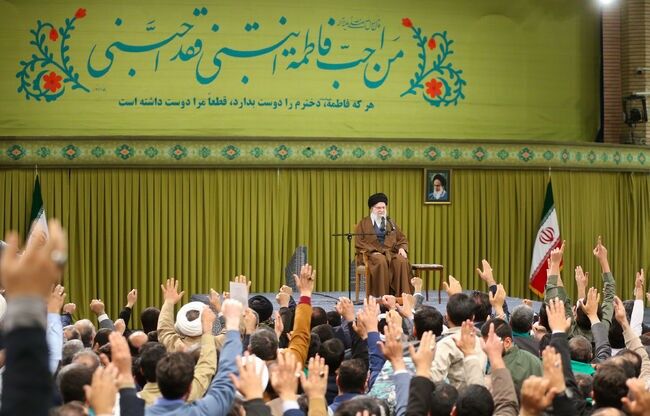
Ayatollah Khamenei emphasized the critical importance of national resistance against foreign pressures during an extensive three-hour meeting with eulogists on Thursday, coinciding with celebrations marking Lady Fatemeh’s birthday anniversary.
In his address, the Supreme Leader provided a comprehensive definition of national resistance, describing it as “endurance and steadfastness against all forms of pressure from hegemonic powers.” He specified these pressures extend across multiple domains, including military actions, economic sanctions, cultural influence campaigns, media operations, and political maneuvering.
The Iranian leader specifically pointed to what he characterized as Western media campaigns and political-military propaganda as prominent examples of external pressure. According to Khamenei, these efforts serve various strategic objectives of global powers, from territorial expansion—citing current American activities in Latin America as an example—to gaining control over natural resources, influencing lifestyle changes, and ultimately attempting to transform national identities.
“For over a century, global powers have been struggling to change Iran’s religious, historical, and cultural identity,” Khamenei stated, emphasizing how the 1979 Islamic Revolution effectively countered those efforts. He added that in subsequent decades, the Iranian population has maintained this resistance, consistently frustrating what he described as enemy attempts to undermine the nation’s sovereignty.
The Supreme Leader highlighted what he sees as a significant achievement: the spread of resistance ideology from Iran throughout the Middle East and beyond. This expansion of resistance philosophy represents a tangible reality in regional geopolitics, where several non-state actors and governments have adopted similar positions against Western influence.
Khamenei suggested that Iran has withstood pressures that would have overwhelmed many other nations. “The enemy has realized that this divine and spiritual land cannot be subdued through military pressure,” he declared, noting that contemporary challenges facing Iran extend beyond conventional military confrontation to encompass an extensive propaganda and media campaign orchestrated by adversaries.
The meeting comes at a time of heightened regional tensions, with ongoing conflicts in Gaza and Lebanon, where Iran-backed groups like Hamas and Hezbollah are engaged in confrontations with Israel. Additionally, Iran continues to face significant economic challenges stemming from international sanctions, particularly those reimposed by the United States following its 2018 withdrawal from the nuclear agreement.
Iran’s emphasis on “resistance” has become a cornerstone of its foreign policy doctrine, especially in its approach to regional conflicts and relations with Western powers. This doctrine has manifested in Iran’s support for various non-state actors across the Middle East, including in Iraq, Syria, Yemen, and the Palestinian territories.
The concept of resistance has deep cultural and religious significance in Iranian political discourse, often framed within the context of historical struggles represented in Shia Islamic traditions. Lady Fatemeh, whose birthday was being commemorated during this meeting, is a revered figure in Shia Islam as the daughter of Prophet Muhammad.
Iran’s state media regularly presents the country as standing firm against what officials describe as Western imperialism, with the Supreme Leader frequently urging citizens to maintain resilience in the face of economic difficulties resulting from international isolation and sanctions.
The rhetoric of resistance continues to resonate within segments of Iranian society and has become an integral component of the regime’s legitimizing narrative, particularly as it navigates complex domestic challenges and evolving regional dynamics.
Fact Checker
Verify the accuracy of this article using The Disinformation Commission analysis and real-time sources.

7 Comments
Interesting perspective on the Iranian government’s view of foreign media influence and resistance efforts. It’s a complex issue with multiple angles to consider. I’m curious to learn more about the specific tactics they see as threats and how they plan to counter them.
Framing foreign media as a threat to national identity and sovereignty is a common tactic used by authoritarian regimes. However, the specifics of Iran’s planned counter-measures, and whether they infringe on press freedoms, merit closer examination. This is a complex geopolitical issue.
You raise a fair point. The balance between national security concerns and press freedoms is delicate, especially in authoritarian contexts. It will be important to scrutinize Iran’s proposed actions to ensure they don’t cross ethical lines in the name of ‘resistance’.
The Supreme Leader’s emphasis on ‘national resistance’ against ‘hegemonic powers’ reflects longstanding Iranian foreign policy. While the rhetoric is strong, the underlying concerns about media influence operations and resource control seem valid. It will be interesting to see how this plays out.
This highlights the ongoing battle for narrative control between nation-states and global media. Maintaining national identity and sovereignty in the face of external cultural/information influence is a major challenge. I wonder what specific media/advertising strategies Iran plans to employ.
The Supreme Leader’s comments reflect Iran’s long-standing narrative of resisting Western influence and interference. While their concerns about media influence campaigns may have some validity, the framing and proposed solutions raise questions about censorship and propaganda.
Iran’s focus on countering ‘hegemonic’ media influence through advertising and messaging strategies is an interesting strategic shift. It speaks to the evolving landscape of information warfare and the struggle for narrative control on the global stage.