


Listen to the article
In a surprising development along Latvia’s eastern border, residents in the Daugavpils region have reported hearing Belarusian propaganda and speeches from President Alexander Lukashenko on their radios. This unexpected intrusion onto Latvian airwaves appears to be coming from Radio “Belarus,” broadcasting on a frequency previously used by a Latvian Russian-language station.
The situation emerged after Latvia’s Russian-language Radio 4 “Domskaya Ploshchad” (Dome Square) ceased FM broadcasting on January 1, 2026, moving to a digital-only format as part of broader changes at the LSM media holding company. While the frequency has gone silent in Riga, residents near the Belarusian border can now clearly pick up Radio “Belarus” broadcasts.
International Radio “Belarus,” which has been operating since 1962 and broadcasting in the Braslau region since 2007, appears to have recently shifted its broadcasting parameters. For years, the station transmitted on frequency 106.6 FM in Braslau, but the radio’s website now indicates it broadcasts on 107.7 FM for that region—coincidentally the same frequency previously used by Latvia’s Radio 4 in the Daugavpils area.
The content being broadcast is concerning Latvian officials. A Latvian journalist monitoring the station in Daugavpils reported hearing speeches from Belarus’s authoritarian leader Alexander Lukashenko, discussions about pedophilia, and commentary about Lithuanians. The station’s online broadcasts for Baltic audiences have included coverage of the “Forum of Good Neighborliness,” an organization Lithuanian authorities liquidated in 2023 for allegedly “preparing espionage for the benefit of Russia.”
There are conflicting interpretations about whether this represents a deliberate attempt to broadcast propaganda into Latvia. One Belarusian propaganda Telegram channel hinted at intentional targeting, noting that “Radio ‘Belarus’ sounds very good near the Daugavpils city council,” suggesting a strategic placement of the signal.
However, Latvia’s Electronic Mass Media Council offers a more technical explanation. The council stated that “Domskaya Ploshchad” previously broadcast on frequency 88.7 in Daugavpils, not 107.7 as some reports suggest. With the cessation of Latvian broadcasts on various frequencies, the signal from Belarusian radio may simply be traveling farther into Latvian territory without the interference it previously encountered.
The development highlights the ongoing information warfare challenges faced by Baltic nations bordering Belarus and Russia. Latvia, Lithuania, and Estonia have all taken measures in recent years to limit Russian-language broadcasting due to concerns about disinformation and propaganda, particularly following Russia’s full-scale invasion of Ukraine in 2022.
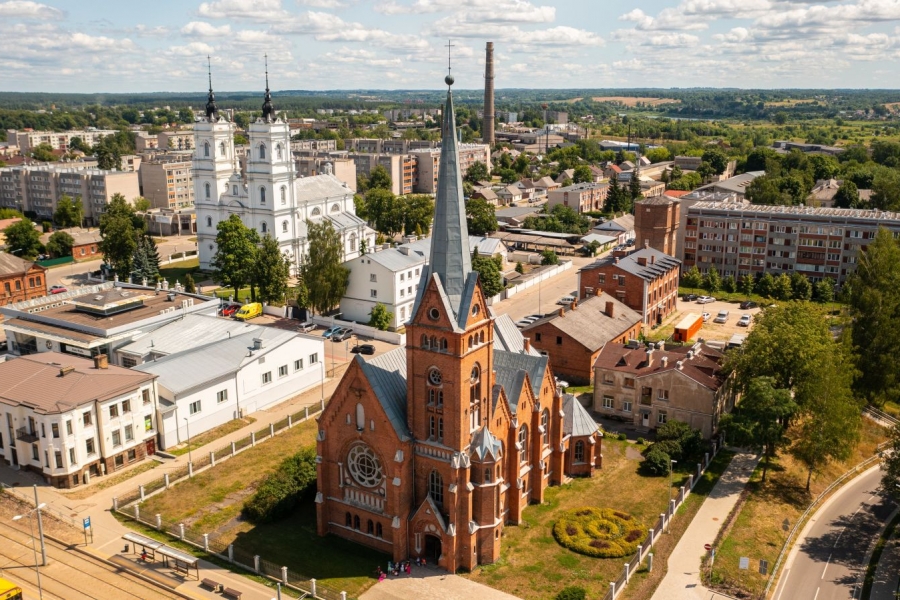
Daugavpils, Latvia’s second-largest city, is particularly vulnerable to such broadcasting intrusions due to its demographic makeup and proximity to the Belarusian border. According to Latvia’s 2021 population census, only 20.7% of Daugavpils residents identify as ethnic Latvians, with a significant portion of the population being Russian-speaking.
Media experts note that this situation underscores the complex challenge of balancing media freedom with national security concerns in the Baltic region. While Latvia has moved to consolidate and digitize its foreign-language media offerings, this has potentially created openings for neighboring states to fill the analog radio void with their own messaging.
Latvian authorities have not yet announced any technical countermeasures to block the broadcasts, though neighboring Lithuania has taken strong measures against similar incursions in the past, including signal jamming.
This incident occurs against the backdrop of heightened tensions in the region, with Belarus remaining a close ally of Russia and continuing to host Russian military assets near NATO’s eastern borders. The cross-border radio situation exemplifies how information space remains a contested domain even as physical borders between the European Union and Belarus are increasingly fortified.
Fact Checker
Verify the accuracy of this article using The Disinformation Commission analysis and real-time sources.

11 Comments
While the details are still emerging, the reported Belarusian radio intrusion into Latvia is a worrying development. Latvia must take decisive action to protect its media sovereignty and prevent further erosion of its information landscape.
This incident speaks to the broader geopolitical tensions in the region and the use of information warfare tactics. Latvia will need to carefully balance its response to protect its citizens while avoiding further escalation.
It’s troubling to see Belarus reportedly seizing radio frequencies to spread its propaganda agenda. This highlights the need for stronger regional cooperation on media security and frequency management.
You’re right, this is a concerning development that undermines media freedom in the region. Latvia should coordinate with allies to mount a robust response and prevent further interference.
The reported takeover of Latvian radio frequencies by Belarus is a brazen attempt to circumvent border restrictions and disseminate state propaganda. Latvia must act quickly to regain control of its airwaves.
Absolutely, Belarus is clearly exploiting gaps in broadcast regulations to project influence across the border. Latvia needs to work with international bodies to establish clearer rules and enforcement mechanisms.
This incident highlights the importance of frequency coordination and media security, especially in border regions. Latvia should consider upgrading its radio monitoring capabilities to quickly detect and counter any unauthorized broadcasts.
This is a concerning development along the Latvia-Belarus border. Using radio frequencies to broadcast propaganda is a worrying tactic. Latvia should work with international partners to address this issue and protect its airwaves.
Agreed, unauthorized use of radio frequencies for propaganda is a serious violation of sovereignty. Latvia should pursue all diplomatic and legal options to stop this intrusion.
The ability of Belarus to seize Latvian radio frequencies for propaganda purposes is a concerning breach of media sovereignty. Latvia should work with international partners to develop more robust mechanisms to secure its airwaves.
While the specific technical details are unclear, the reported Belarusian radio intrusion into Latvia is a clear violation of media sovereignty. Latvia must act swiftly to regain control of its airwaves and prevent further incursions.