


Listen to the article
In Russia’s War-Weary Fourth Year, Cultural Events Replace Overt Propaganda
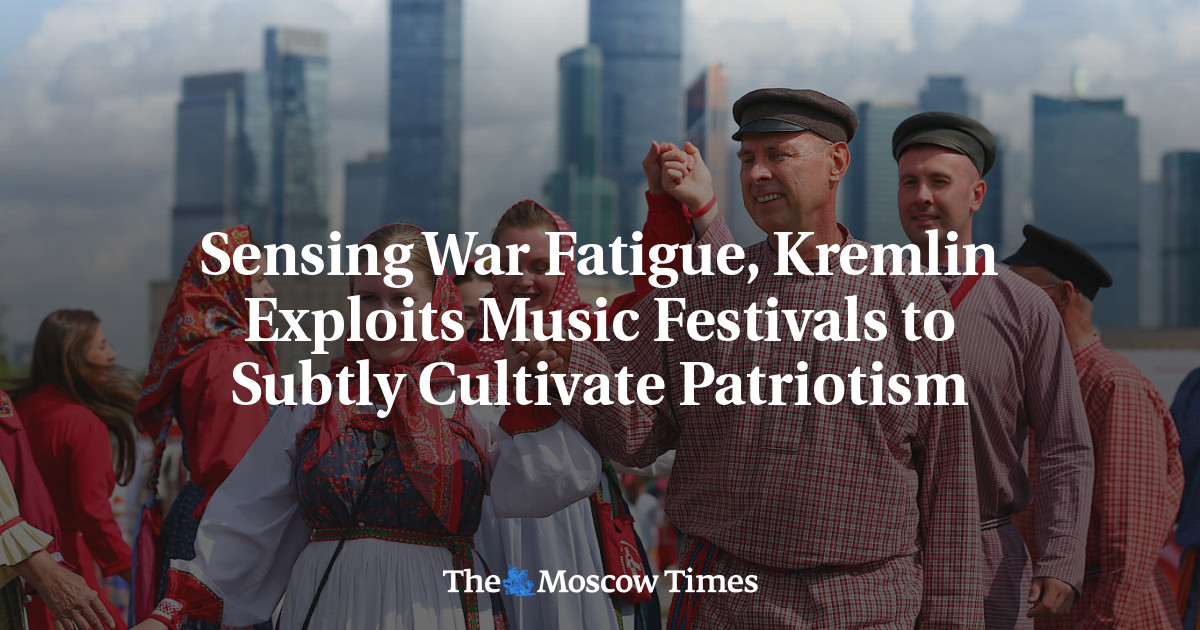
“Mother Land, white birch-tree / For me, it’s Holy Rus, for others a splinter,” sang Tatyana Kurtukova to thousands at Moscow’s Poklonnaya Gora, home to a museum commemorating the Soviet victory in World War II.
The crowd enthusiastically joined in the a cappella folk-inspired hit “Matushka” during a festival celebrating Moscow’s birthday. Among the co-headliners was Lyube, the rock band widely believed to be President Vladimir Putin’s favorite.
“People don’t listen to this ironically anymore — they genuinely enjoy it. Everyone is starting to look back at our roots, at Russia’s cultural values,” said one concertgoer who requested anonymity. “Mostly the younger generation — they’ve begun to identify themselves with Russia and its culture. They’re paying more attention to traditional Russian songs.”
Now deep into the fourth year of the Ukraine war, Russian authorities appear to be shifting tactics in their effort to maintain public support. Rather than relying on the overtly militaristic messaging that dominated the war’s early phase, officials are increasingly turning to entertainment and cultural events that appeal to Russians’ sense of national identity.
“People are tired of this endless, dead-end war and militaristic patriotism has given way to escapism,” music critic Artemy Troitsky told The Moscow Times. “Most people, especially the young, are fed up with war propaganda. Instead, entertainment and nostalgic themes are taking center stage.”
The government has significantly increased cultural programming across the country, with summer festivals alone increasing by more than a third nationwide compared to last year.
In Moscow, city officials launched “Summer in Moscow,” billed as “the largest urban program” featuring cultural, charitable, and sporting events—most free of charge. Attendees described elaborate setups with DJs, activity zones, basketball courts, painting workshops, and trendy cafés.
“Everything was free, the crowd was a decent size, but not too packed,” said one Muscovite, noting that current musical trends lean toward folk-inspired tunes while overtly pro-war songs were generally avoided at large public gatherings.
Nevertheless, the war’s shadow still looms over Russia’s cultural landscape. Anti-war artists remain banned from performing, and numerous military-patriotic festivals were held this summer in both Moscow and the regions. These included the “Rifle and Guitar” festival in Omsk, grenade-throwing competitions in St. Petersburg, and patriotic song contests organized by the United Russia party in various regions.
Even at seemingly apolitical events, the state’s influence is evident. At the VK Festival organized by Russian tech giant VK in several major cities, banners promoted fast-track entry for visitors who downloaded the state-backed MAX messenger—a domestic alternative to WhatsApp and Telegram that has faced criticism for sharing user data with authorities.
“Before the final performance, everyone sang the Russian national anthem,” noted one festival attendee.
The Kremlin appears to be collaborating strategically with cultural figures to channel collective emotions generated by the war, according to researcher Oshank Hashemi.
“In times of war, people often express support for the state and display identity markers more prominently,” Hashemi explained. “These are also moments when people cling more strongly to what makes them proud and unites. The Kremlin clearly invests in and supports artists who express these feelings.”
While the total expenditure on cultural propaganda since the war began remains unclear, the Kremlin has reportedly allocated around 161 billion rubles ($1.7 billion) to patriotic and pro-war projects since 2022. Official data shows that patriotic events, contests, and festivals nearly doubled from 514 in 2023 to 905 in 2024.
One prominent example of Russia’s cultural diplomacy efforts was the revival of Intervision, a Cold War-era song contest positioned as an alternative to Eurovision. Putin stated the event’s aim was to “promote cultural dialogue and strengthen friendship between peoples,” though critics viewed it as politically motivated, with reports of paid extras brought in to fill the audience.
The contest appeared tightly managed by the Kremlin, with Putin’s domestic policy chief Sergei Kiriyenko chairing its supervisory board. Russia’s representative was the country’s most prominent patriotic singer, Shaman, who asked judges from the 23 participating countries not to score his performance—a move some interpreted as preventing him from either winning or losing.
According to Troitsky, Shaman represents “the only relatively successful” project in terms of pro-war musical propaganda, calling it “a modest achievement at best, especially given the vast amounts of state funding poured into pop propaganda.”
Yet for some Russians, these patriotic themes appear to resonate. “I didn’t use to like patriotic songs, but this time I was moved,” said a woman who attended Kurtukova’s concert. “I like this trend of loving your country—not the state or the authorities, but the country itself: its nature, culture, education and people. Let the people love what they have—without getting involved in politics, but by paying attention to the good and positive aspects.”
Fact Checker
Verify the accuracy of this article using The Disinformation Commission analysis and real-time sources.

13 Comments
This shift in tactics by the Kremlin, from overt militaristic messaging to a focus on cultural events and traditional values, is intriguing. It suggests an acknowledgment of the war’s impact on public sentiment and a desire to find new ways to maintain support. However, the true test will be whether this approach resonates with the Russian people.
This shift in the Kremlin’s propaganda tactics, from overt militarism to a focus on cultural events and traditional values, is an interesting development. It suggests an acknowledgment of the war’s impact on public sentiment and a desire to find new ways to rally support. However, the success of this approach will depend on how it resonates with the Russian people, especially the younger generation.
The Kremlin’s use of music festivals to boost patriotism is a fascinating strategy. It speaks to the challenges they face in maintaining public support as the war drags on. While tapping into cultural identity may resonate with some, it remains to be seen if this approach can effectively counter the growing war fatigue.
You make a good point. The Kremlin’s shift in tactics suggests they recognize the need to find new ways to rally the public, but it’s unclear whether cultural events will be enough to overcome the realities of the conflict.
The shift from overt militaristic messaging to cultural events seems like a strategic move by the Kremlin. It will be telling to see if this approach resonates with the public, especially the younger demographic, or if it’s seen as an attempt to distract from the realities of the conflict.
You raise a good point. The Kremlin may be hoping that a focus on cultural identity and traditional values will help offset war weariness, but it could backfire if people see it as transparent propaganda.
The Kremlin’s use of music festivals to boost patriotism is a thought-provoking strategy. It indicates a recognition of the need to adapt their messaging as the war’s impact on public sentiment becomes more apparent. However, the true test will be whether this cultural approach can effectively counter the growing war fatigue among the Russian people.
The Kremlin’s pivot to cultural festivals as a means of bolstering patriotism is a curious move. While it may tap into a sense of national identity, it remains to be seen whether this will be effective in the face of growing war fatigue, particularly among younger Russians.
I’m curious to see how effective these music festivals will be in boosting patriotism. While the Kremlin may be hoping to tap into a sense of cultural pride, the younger generation may be less receptive to this approach compared to the overt militarism of the war’s earlier phase.
The Kremlin’s decision to rely more on cultural events and entertainment to boost patriotism is a curious one. While it may tap into a sense of national identity, it could also be seen as a diversionary tactic to distract from the ongoing war and its impacts. Time will tell if this approach is effective in maintaining public support.
It’s interesting to see the Kremlin shift their propaganda tactics from overt militarism to a focus on cultural events and traditional values. This suggests an acknowledgment of the war’s toll on public sentiment and a desire to find new ways to maintain support. However, the success of this approach will depend on how it resonates with the Russian people, particularly the younger generation who may be less receptive to this type of messaging.
It’s interesting to see how the Kremlin is trying to boost patriotism through cultural events as war fatigue sets in. Music festivals could be an effective way to rally support, but it remains to be seen if the younger generation will genuinely connect with the traditional Russian themes or view it as propaganda.
It’s an interesting strategic shift by the Kremlin to rely more on cultural events and entertainment rather than overt propaganda. However, I wonder if this will truly resonate with the public, especially as the war continues to grind on. Time will tell if this approach can maintain support.