


Listen to the article
Propaganda and Politics: How Jane McCrea’s Death Became a Revolutionary Symbol
In the tumultuous days of 1777, as the American Revolution raged across the colonies, a single death in upstate New York would become one of the war’s most potent propaganda tools. For nearly a century afterward, virtually every American knew the name Jane McCrea, though few knew the actual circumstances of her demise.
McCrea, killed by Native Americans allied with the British on the eve of the patriots’ victory at Saratoga, was swiftly transformed into a revolutionary martyr. Her story became a cautionary tale of wartime atrocities allegedly sanctioned by the British, despite being just one civilian casualty among many during the conflict.
“She became a useful tool. She became a saint, you might say, of the Revolution,” explains Paul Staiti, art historian at Mount Holyoke College and author of “The Killing of Jane McCrea: An American Tragedy on the Revolutionary Frontier.” “People felt as though they could feel her fear, feel her death, feel her love for her fiancé.”
The actual Jane McCrea remains largely unknown to historians. Born around 1752 in New Jersey to a Presbyterian minister, she relocated to New York in the early 1770s to live with her older brother. At the time of her death, McCrea was reportedly romantically involved with David Jones, a colonist who had enlisted in the British Army. Her brother, meanwhile, fought for the patriots. Among her ten other siblings, allegiances were similarly divided between loyalist and patriot causes.
McCrea’s own political views remain unrecorded. Like many women of her era, none of her writings survive, leaving propagandists with “unimpeded license to make her into whatever they wanted—or needed—her to be,” as Staiti writes.
Multiple accounts document her killing on July 27, 1777. Most agree that disaster struck while she was visiting a friend, Sarah McNeil, at her home in Fort Edward, New York. McNeil was preparing to flee advancing British forces when Native warriors arrived. The soldiers took both women prisoner but failed to find Eve, a Black woman likely enslaved by McNeil, who had hidden in the house with her infant son.
The prevailing narrative suggests that McCrea’s captors—usually identified as Wyandot or Mohawk—shot and scalped her after quarreling over whose prisoner she was. However, other accounts attribute her death to patriot soldiers, suggesting she was caught in crossfire as rebels pursued British-allied warriors.
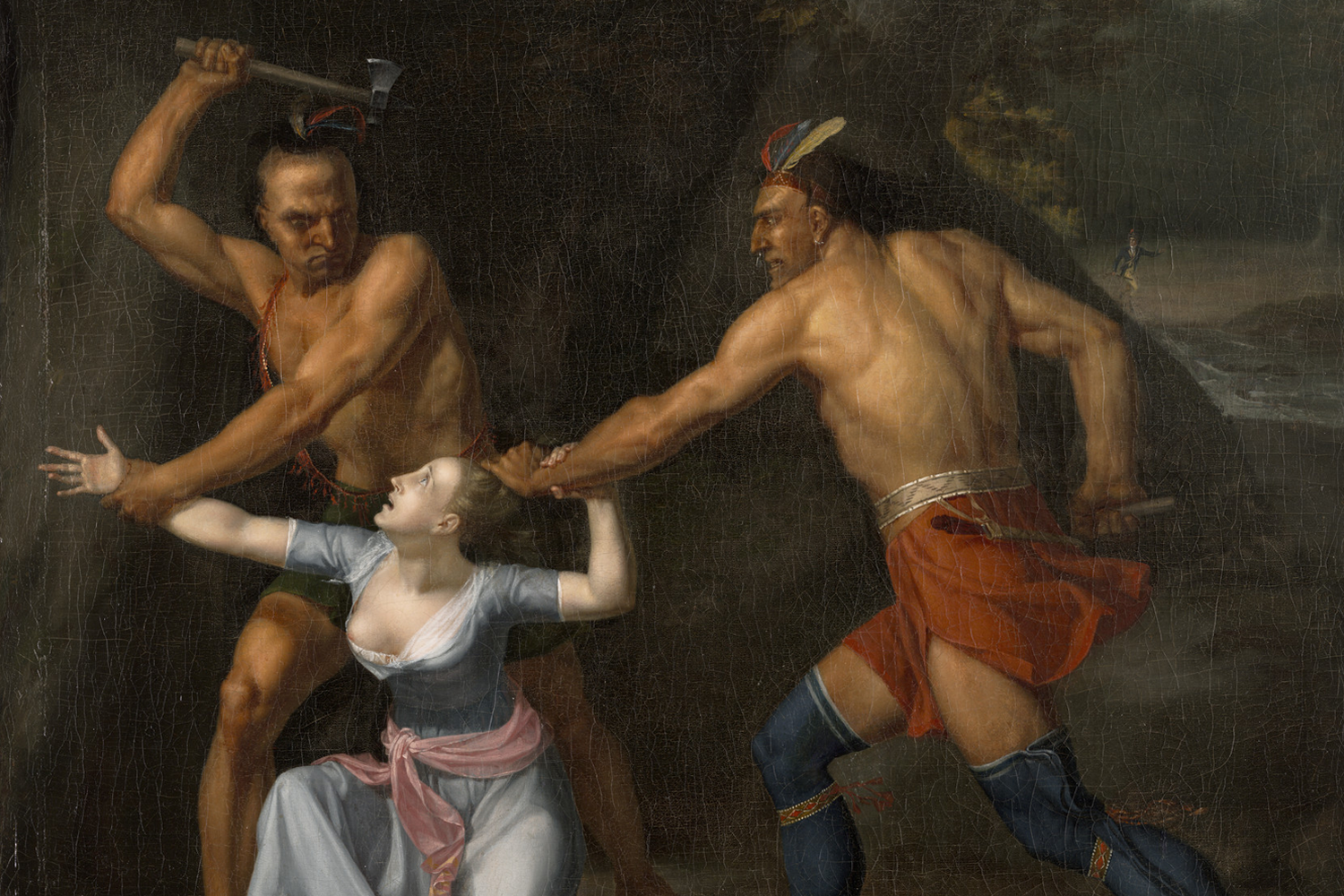
American newspapers first reported McCrea’s death in mid-August 1777. Initially mentioned alongside other casualties during a military clash, her story was quickly embellished to exemplify enemy atrocities. The Boston Independent Chronicle described the Native warriors as “devils” who were “disposed to murder, merely for the sake of murdering,” while portraying McCrea as a “harmless, helpless female, by nature too feeble to make defense.”
American Major General Horatio Gates amplified the incident in a letter to British Lieutenant General John Burgoyne, accusing him of “hir[ing] the savages of America to scalp Europeans.” Gates claimed the killing occurred on McCrea’s wedding day, writing that she was “dressed to receive her promised husband, but met her murderer employed by you.”
Burgoyne vehemently denied these accusations, describing McCrea’s killing as “no premeditated barbarity” and Gates’ account as false. His protests came too late, however, as the story had already spread through every major American newspaper.
In England, members of the opposition Whig Party seized on the story as a powerful antiwar argument. The London Annual Register reported that McCrea’s killing “struck every breast with horror,” fixating on her “innocence of youth and bloom of beauty.” British press framed the tragedy as an example of loyalist lives sacrificed in an unnecessary war.
Both sides simplified the narrative to serve their political interests, ignoring the complex factors at play. The Indigenous Haudenosaunee Confederacy had a history of broken treaties with Europeans, and while most Native tribes in New York sided with Britain, two of the Six Nations allied with the Americans. The territory where McCrea died was already highly disputed before the Revolutionary War began.
Patriot propaganda portrayed scalping as evidence of Native American “savagery,” despite the fact that American colonists and Europeans practiced scalping too. During the French and Indian War, Massachusetts had offered bounties for the scalps of Native men, women and children. Throughout the Revolution, patriots and British regularly accused each other of scalping to terrorize opponents.
McCrea’s story spurred patriotic fervor and reportedly drove enlistment in the Continental Army. As the Battle of Saratoga became legendary in American history, her martyrdom was increasingly cited as a turning point enabling the landmark victory, though this connection was largely invented after the fact.
Poets, painters, and authors perpetuated the propaganda long after her death. John Vanderlyn’s 1804 painting “The Murder of Jane McCrea” inspired countless woodcut prints that immortalized McCrea as a brave yet doomed beauty. Washington Irving and prominent 19th-century historians like Benson Lossing ensured her story remained in the public consciousness. Different iterations emphasized her whiteness, femininity and beauty to heighten moral outrage.
After the Revolution, McCrea’s killing came to signify more than a single act of wartime brutality. It provided “a convenient rationale for racism, violence and abuse” against Native Americans, as historians Jeremy Engels and Greg Goodale noted. Her story proved particularly useful as the U.S. military increased campaigns to seize Native lands in the mid-19th century.
“Her story becomes a way that people in the Northeast can connect to and claim this grander American narrative of westward expansion and of an idea of civilization triumphing over supposed barbarity,” explains historian Blake Grindon.
Today, McCrea has largely faded from public memory. Eric Schnitzer, a National Park Service ranger at Saratoga National Historical Park, notes that while visitors frequently mentioned McCrea in the 1990s, “these days, rather few people are even aware of her having existed.”
The propaganda that once made Jane McCrea a household name has lost its utility in modern American storytelling, yet her story remains a powerful reminder of how deaths in wartime can be weaponized for political purposes long after the conflict ends.
Fact Checker
Verify the accuracy of this article using The Disinformation Commission analysis and real-time sources.

13 Comments
As someone interested in the history of the Revolutionary War, I’m curious to learn more about the real Jane McCrea and the true circumstances of her death. Separating fact from fiction in these cases is vital for understanding the past.
Absolutely, digging deeper into the nuances and complexities of historical events is so important. It’s easy for simplified narratives to take hold, but the real story is often more layered and ambiguous.
The transformation of Jane McCrea’s story into revolutionary propaganda is a sobering reminder of the malleability of historical accounts. It speaks to the need for a balanced, multifaceted approach to understanding the past.
This is a great example of how propaganda can distort and overshadow the actual human experiences of war. It’s a sobering reminder that we must always approach historical accounts with a critical eye.
The transformation of Jane McCrea’s story into a revolutionary symbol is a fascinating case study in the power of narrative. It speaks to how easily personal tragedies can be co-opted for political ends, even centuries later.
This article highlights the power of narrative in shaping collective memory and national identity. The McCrea case study is a thought-provoking example of how personal tragedies can be appropriated for larger political ends.
As someone interested in the Revolutionary War, I’m eager to learn more about the real Jane McCrea and the complexities of her story. Separating myth from reality is crucial for gaining a deeper understanding of this pivotal period in American history.
It’s intriguing to see how a single civilian death became such a potent rallying cry during the Revolutionary War. The article highlights the complex interplay between individual tragedy and larger political/military objectives.
This piece highlights the importance of understanding the nuanced and often messy realities behind the simplified narratives of historical events. Unpacking the true story of Jane McCrea is a valuable exercise in critical thinking.
Separating myth from reality is crucial when examining the history of the Revolutionary War. Studying how the McCrea story was used as propaganda underscores the need for rigorous, evidence-based historical analysis.
Jane McCrea’s story is a poignant one, and it’s interesting to see how it was used to vilify the British and rally support for the American cause. It’s a complex tale that shows the blurry line between myth and reality during wartime.
Agreed, the weaponization of personal tragedies for propaganda purposes is a common tactic throughout history. It’s important to always critically examine the underlying motives and agendas at play.
This is a fascinating look at how a single tragic death during the Revolutionary War became a powerful propaganda tool. It’s a sobering reminder of how narratives can be twisted, even around personal tragedies, to serve political agendas.