


Listen to the article
Milan Art Students Explore the Hidden Power of Propaganda in Exhibition
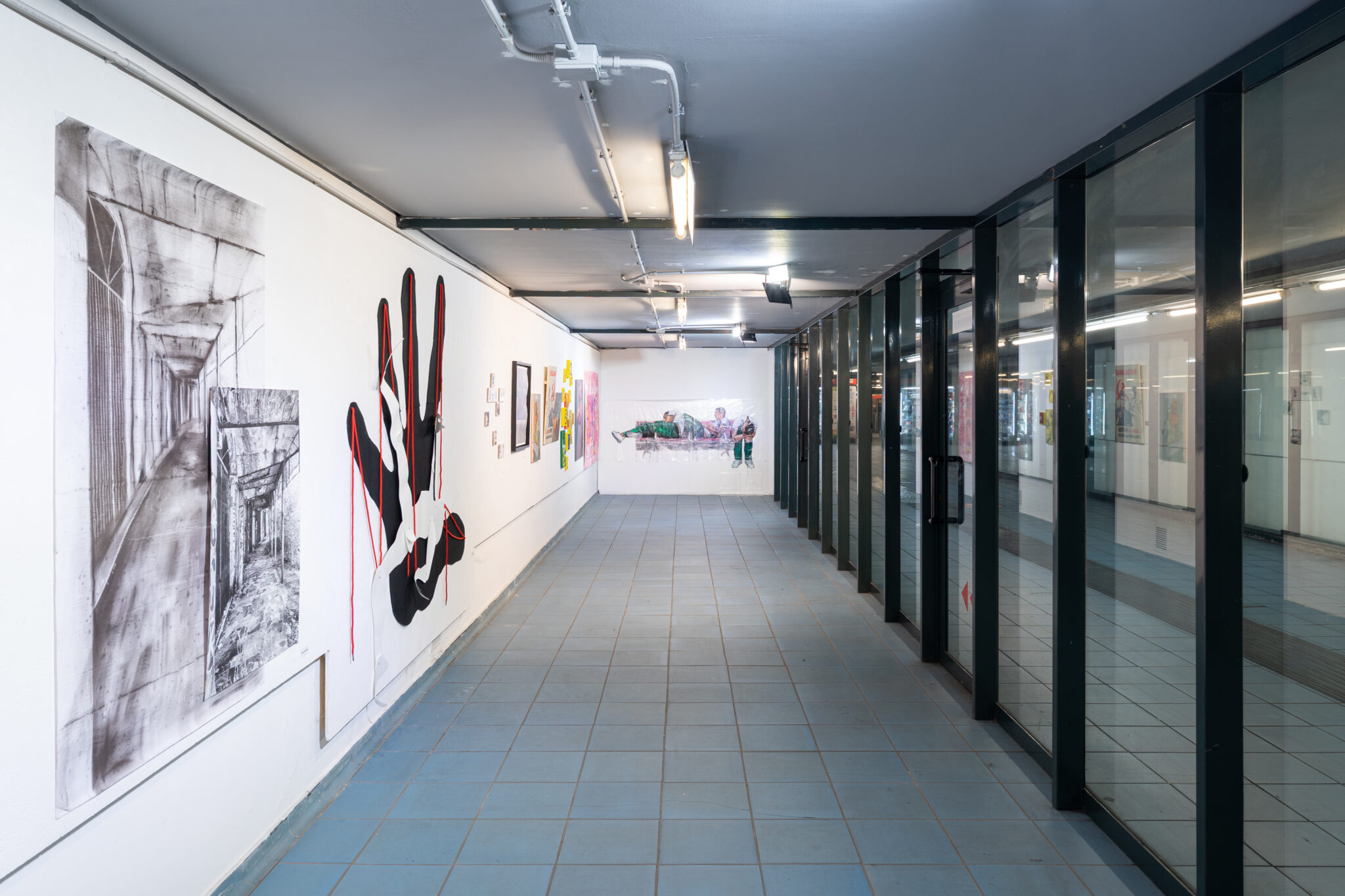
Propaganda, a weapon that affects not just its direct targets but society as a whole, has become the focus of a thought-provoking exhibition in Milan. The show, simply titled “Propaganda,” opened on Holocaust Remembrance Day in the Porta Venezia railway underpass, created through a collaboration between the Accademia di Belle Arti di Brera and the Artepassante Foundation.
“Propaganda guides and directs without you realizing you are being led,” explained Barbara Nahmad, a professor of Techniques and Technologies of Painting at the prestigious Brera Academy and curator of the exhibition. Nahmad challenged her students to move beyond abstract concepts and examine propaganda as a daily experience—often invisible yet fundamental to contemporary history.
The exhibition features works in diverse formats and artistic languages, deliberately avoiding a linear narrative. Instead, visitors encounter a sequence of pieces born from individual reflection on how propaganda functions in society.
One striking installation features a rifle constructed entirely from Lego bricks, creating an unsettling juxtaposition between childlike innocence and deadly weaponry. This contrast highlights how propaganda often disguises itself as entertainment, consumption, or lighthearted content rather than appearing overtly threatening.
Another work places an apple beside a hand grenade in a still life composition, eliminating any possibility of neutrality in the viewer’s interpretation. The pairing forces confrontation with the propagandistic technique of binary thinking.
A particularly powerful piece displays a large black hand on a wall with red threads extending from its fingertips to manipulate a puppet—a vivid representation of behind-the-scenes control mechanisms that govern movements while remaining hidden from view.
The exhibition is accompanied by critical analysis from Riccardo Notte, a cultural anthropology professor at Brera Academy. Notte’s text examines the thought and legacy of Edward L. Bernays, author of the influential 1928 essay “Propaganda.” According to Notte, Bernays not only observed manipulation techniques but taught how to employ them effectively through simplified language and emotional triggers.
“A simple, direct, and well-packaged idea—better if summarized in a slogan or effective phrase—can guide desires, expectations, and hostility,” Notte writes. This encapsulates propaganda’s power: offering seemingly clear interpretations of a complex world while dividing reality into simplistic categories of “good” and “evil.”
One of the more nuanced works depicts two young women with blurred faces standing before Milan Cathedral. One leans in to whisper to the other—an intimate gesture that takes on new meaning in the exhibition’s context. Here, propaganda becomes a whispered suggestion passed through trusted relationships in public spaces.
Throughout the collection, visitors encounter recurring themes of powerlessness, disorientation, and the desire to escape external manipulation. “I did not ask the students to provide answers, but rather to recognize that the problem exists,” Nahmad explained of her curatorial approach.
The timing of the exhibition—coinciding with Holocaust Remembrance Day—adds another dimension to the works, implicitly connecting historical propaganda’s role in one of humanity’s darkest chapters to its continued influence in contemporary society.
For Nahmad, the ultimate goal extends beyond the exhibition itself. Her hope is that her students maintain “the awareness of having developed critical thinking about the information they receive every day”—a skill increasingly vital in navigating today’s information-saturated world.
The exhibition serves as both artistic expression and educational tool, inviting viewers to recognize propaganda’s subtle mechanisms in their daily lives and develop the critical faculties needed to resist manipulation.
Fact Checker
Verify the accuracy of this article using The Disinformation Commission analysis and real-time sources.

9 Comments
Fascinating exploration of propaganda as an ‘invisible weapon’ by these art students. Subverting expectations by using everyday objects like Lego bricks to create striking, thought-provoking installations.
Curious to see how these young artists interpret and visualize the hidden power of propaganda in contemporary society. Looks like a thought-provoking exhibition.
Examining propaganda through an artistic lens is a unique approach. Eager to see how these students interpret and convey the complexities of this topic in their work.
The juxtaposition of a Lego rifle is a striking and unsettling choice. Blending childlike materials with such a potent symbol really drives home the exhibition’s message.
That’s a brilliant use of contrast to get the audience to question their assumptions about propaganda. Effective way to make the ‘invisible’ more tangible.
I appreciate how the exhibition challenges visitors to examine propaganda as a daily experience, not just abstract theory. Moving beyond linear narratives to create a more immersive, reflective experience.
Agreed, a refreshing approach that encourages deeper engagement with this complex topic.
Very intrigued by this exhibition and the students’ exploration of propaganda as an ‘invisible weapon.’ Looking forward to seeing more of their creative, unconventional takes on this crucial topic.
Kudos to the Brera Academy for taking on this challenging subject matter. Propaganda is a vital issue, and I’m glad to see it being explored in a thought-provoking, multidimensional way.