


Listen to the article
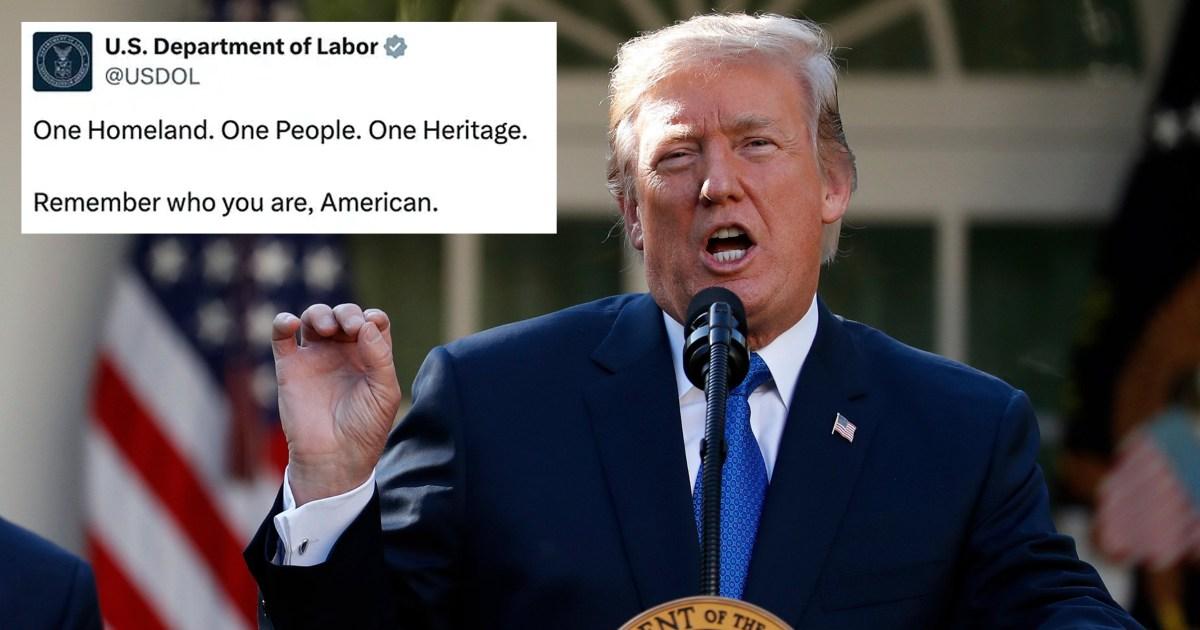
U.S. Government Agencies Under Fire for Nazi-Reminiscent Social Media Posts
Americans are raising concerns over disturbing social media content from federal government agencies that appears to echo slogans from Nazi Germany, raising questions about the messaging strategy of the current administration.
This weekend, the Department of Labour shared a post on social media featuring a statue of President George Washington with the caption: “One Homeland. One People. One Heritage. Remember who you are, American.” While seemingly innocuous, the phrasing bears a striking resemblance to the infamous Nazi slogan “Ein Volk, ein Reich, ein Führer” (One people, One Nation, One Leader), which was widely displayed on propaganda posters featuring Adolf Hitler during the Third Reich.
This isn’t an isolated incident. An investigation by the Southern Poverty Law Center uncovered white nationalist rhetoric in recruitment advertisements for Immigration and Customs Enforcement (ICE), which falls under the Department of Homeland Security (DHS). One particularly troubling advertisement featured the phrase “We’ll have our home again” over an image of a cowboy—language directly linked to a song performed by a neo-Nazi group in North America.
When contacted about these concerns, a DHS spokesperson dismissed the criticism, telling Metro: “Calling everything you dislike ‘Nazi propaganda’ is tiresome. DHS will continue to use all tools to communicate with the American people and keep them informed on our historic effort to Make America Safe Again.”
The apparent infiltration of far-right messaging into official government communications has alarmed historians and political observers. Ian Garner, a historian and propaganda expert, suggested to Metro that these posts reflect a deliberate strategy by the White House to be provocative.
“We see this time and again with the way the White House communicates. It tends to choose the most controversial images and messaging,” Garner explained. “Of course, this stems from Trump himself, who posts content designed to be inflammatory and as outrageous as possible.”
According to Garner, this approach serves a dual purpose: it angers political opponents while simultaneously energizing the president’s base, who take satisfaction in provoking outrage from their political adversaries. “They take delight in the destruction, the chaos, and the provocation, regardless of where the ideas actually originate—whether they come from a childish internet message board like 4chan or from 1930s Nazi Germany,” he noted.
The trend represents a concerning shift in official government communication norms. Historically, federal agencies have maintained politically neutral messaging focused on their institutional missions rather than partisan rhetoric or controversial cultural references.
Garner warns that the normalization of such language in official government channels could have serious consequences for American politics and society. “By using fascist or Nazi-coded language, you normalize it. You make it acceptable,” he said. “We know there are neo-fascist groups, voters, and violent actors in the United States; when they see this language, they only become more enthusiastic.”
This normalization process can shift the boundaries of acceptable discourse, potentially leading to increasingly extreme rhetoric. “Once something becomes acceptable in political discourse, it becomes thinkable. Once it is thinkable, it becomes possible—and ultimately, it becomes much more likely to actually happen,” Garner cautioned.
The controversy unfolds against a backdrop of increasing polarization in American politics, with heated debates about the rise of extremist ideologies and their influence on mainstream institutions. Critics argue that official government channels should remain free of language that could be interpreted as endorsing or normalizing extremist viewpoints.
Neither the White House nor the Department of Labor has issued formal responses to the specific concerns about Nazi-reminiscent language in their communications. The Department of Homeland Security has not removed the controversial recruitment advertisement despite the criticism.
As the administration continues to face scrutiny over its communication strategies, political analysts suggest that the blurring of lines between provocative political messaging and official government communications may represent a significant shift in how federal agencies interact with the public they serve.
Fact Checker
Verify the accuracy of this article using The Disinformation Commission analysis and real-time sources.

10 Comments
This is certainly concerning if government agencies are using slogans that evoke disturbing historical parallels. We should be vigilant about any potential misuse of propaganda tactics, regardless of the administration in power.
I agree, it’s crucial that the government maintains high ethical standards and avoids any appearance of totalitarian or authoritarian messaging.
If these reports are accurate, it’s deeply concerning that government agencies would use language that evokes such a dark and dangerous period in history. Maintaining public trust should be a top priority for any administration.
Agreed. Any appearance of co-opting extremist rhetoric, even unintentionally, is a serious breach of the public’s trust and must be addressed transparently.
As an American citizen, I’m troubled by the idea that federal agencies could be engaging in propaganda tactics reminiscent of authoritarian regimes. We must hold our government accountable and demand a full investigation into these allegations.
Absolutely. Maintaining a free and open society requires vigilance against any encroachment on democratic principles, no matter the source.
While the similarities to Nazi slogans are unsettling, I think it’s important to approach this issue with nuance and objectivity. We should seek a thorough, nonpartisan analysis before rushing to judgment.
Well said. Knee-jerk reactions often generate more heat than light. A calm, fact-based assessment is the best way forward on a sensitive topic like this.
While the similarities to Nazi-era slogans are troubling, I hesitate to jump to conclusions without a deeper understanding of the context and intent behind these social media posts. We should scrutinize the facts carefully before drawing any firm conclusions.
That’s a fair point. It’s important to avoid knee-jerk reactions and instead seek a balanced, evidence-based assessment of the situation.