


Listen to the article
Iran’s Information War: Battling for Narratives Amid Nationwide Protests
As Iran’s protests reach a critical phase, the conflict has expanded beyond street demonstrations into a sophisticated information war, where control over narratives and communication channels has become as crucial as physical suppression tactics.
At the core of this battle is a coordinated state propaganda system operating under cover of one of the most extensive internet shutdowns in Iran’s history. Meanwhile, protesters, opposition media, and ordinary citizens attempt—often risking severe punishment—to circumvent these restrictions and document events on the ground.
According to Hadi Zonouzi, a news editor for Los Angeles-based Lotus Communications Corp with contacts inside Iran, the regime’s messaging apparatus functions with remarkable synchronization.
“The regime’s propaganda isn’t just coming from official news channels; it’s a full-spectrum operation,” Zonouzi told The Media Line. “It’s a coordinated ecosystem that includes state and semi-official media outlets that work in perfect sync. Then you have the so-called ‘experts’ and officials who appear on TV panels, all reinforcing the exact same talking points.”
This sophisticated system deploys clerics delivering political sermons, semi-official Telegram channels, and English-language content targeting diaspora communities and international audiences. The orchestration is evident in the timing of messaging across platforms.
“When a new term or narrative frame is introduced, it appears across all these channels simultaneously. The timing is too perfect to be a coincidence,” Zonouzi noted.
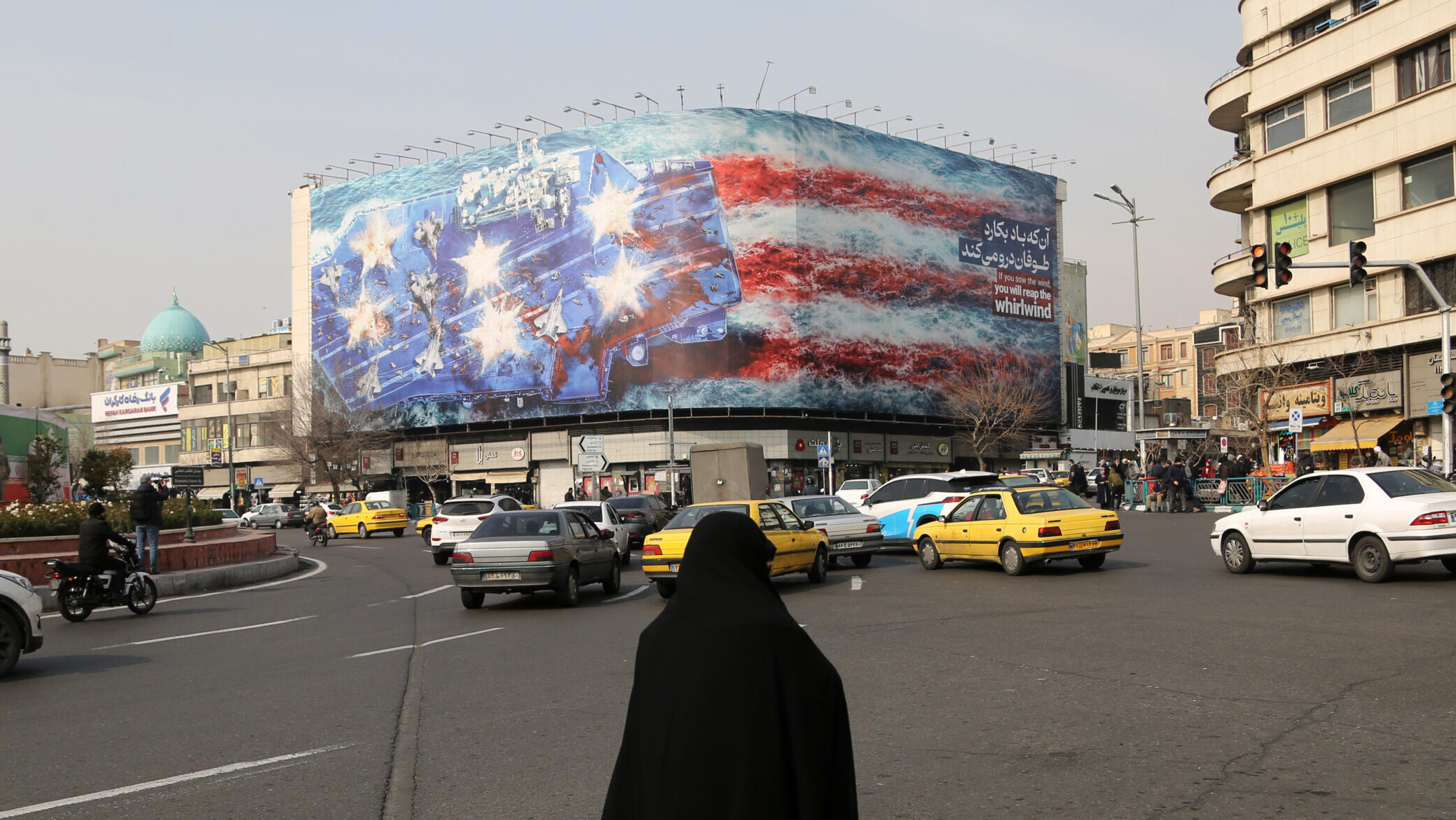
Recent propaganda efforts have intensified, including new political visuals such as a mural in Enqelab Square targeting the United States with the message: “If you sow the wind, you will reap the whirlwind” in both English and Farsi—which Zonouzi interprets as a sign of vulnerability rather than strength.
“They are bluffing a lot. That’s their strategy. They want to show that they are strong. But this level of propaganda, this intensity, is because they feel the pressure—especially from the United States and Israel,” he explained.
Underpinning the propaganda campaign is what Zonouzi describes as an unprecedented internet blackout, effectively creating a “digital iron curtain” around Iran. This shutdown serves multiple strategic purposes: preventing protesters from organizing, controlling information flow, and concealing the scale of government actions.
“This blackout is designed to stop the flow of information, prevent protesters from organizing, and, most importantly, hide the scale of their atrocities from the world, which now are reported as 36,500 in just 48 hours between January 8-9,” he said.
The internet restrictions make independent verification of arrests, injuries, and deaths nearly impossible, as access to hospitals, morgues, and affected neighborhoods becomes severely limited.
Notably, the blackout is selectively applied. State-aligned media maintain connectivity while ordinary citizens are cut off. “Most of the Iranian broadcasting and media connected to the IRGC are active on Telegram and manage to keep publishing. They have different kinds of VPNs and tunnels that they are using to spread their propaganda,” Zonouzi explained.
The Media Line independently verified that several state-aligned outlets, including the Tehran Times and Mehr, are currently inaccessible in many Western countries.
Despite these severe restrictions, protesters and opposition networks continue attempting to break through the regime’s information monopoly using clandestine tools like Starlink satellite terminals, VPNs, mesh networks, and encrypted messaging platforms—although these methods come with significant risks.
“The very tools you would use to access independent information—VPNs, satellite internet like Starlink—are now illegal. Possession alone can lead to prison,” Zonouzi emphasized. The regime treats connectivity itself as evidence of dissent, and people face punishment not only for posting content but for following, reposting, liking, or being interviewed by foreign media.
In the absence of access for international reporters, opposition and diaspora-based media have become crucial in documenting events, aggregating smuggled videos and compiling casualty information—a role made more important as the regime disputes death tolls and promotes lower official figures.
“When bodies are taken, when families are intimidated, when you have to pay to receive a body or risk never seeing it again, counting becomes part of the repression,” Zonouzi noted.
A significant concern highlighted by Zonouzi is how regime framing can influence international coverage, especially when access is limited and official statements dominate information channels. Terms like “riots,” “foreign-backed,” “terrorists,” and “national sovereignty” are strategically deployed by the regime and sometimes inadvertently amplified by global media.
“When foreign media gives equal weight to regime statements and to the voices of victims, it creates a false balance. It ends up amplifying the regime’s lies,” he warned.
For Iranians inside the country, international attention represents both protection and potential danger. “Knowing that the world is watching provides a morale boost. The worst-case scenario is not being watched, but being forgotten,” Zonouzi said. Yet this visibility is weaponized by the regime to reinforce narratives of foreign conspiracy.
As Iran’s crisis continues, information itself remains a critical battlefield. The persistence of leaked videos, satellite connections, and testimony from those willing to take enormous personal risks reflects a society that refuses to be silenced, even as the costs of being heard continue to rise.
Fact Checker
Verify the accuracy of this article using The Disinformation Commission analysis and real-time sources.

32 Comments
If AISC keeps dropping, this becomes investable for me.
Good point. Watching costs and grades closely.
Good point. Watching costs and grades closely.
Exploration results look promising, but permitting will be the key risk.
Good point. Watching costs and grades closely.
Interesting update on Iran’s Strategic Use of Media in Psychological Warfare Operations. Curious how the grades will trend next quarter.
I like the balance sheet here—less leverage than peers.
I like the balance sheet here—less leverage than peers.
Good point. Watching costs and grades closely.
Exploration results look promising, but permitting will be the key risk.
Good point. Watching costs and grades closely.
Good point. Watching costs and grades closely.
If AISC keeps dropping, this becomes investable for me.
Good point. Watching costs and grades closely.
Good point. Watching costs and grades closely.
I like the balance sheet here—less leverage than peers.
The cost guidance is better than expected. If they deliver, the stock could rerate.
Good point. Watching costs and grades closely.
Nice to see insider buying—usually a good signal in this space.
Good point. Watching costs and grades closely.
Good point. Watching costs and grades closely.
I like the balance sheet here—less leverage than peers.
Good point. Watching costs and grades closely.
Good point. Watching costs and grades closely.
Production mix shifting toward Propaganda might help margins if metals stay firm.
I like the balance sheet here—less leverage than peers.
Good point. Watching costs and grades closely.
Good point. Watching costs and grades closely.
Uranium names keep pushing higher—supply still tight into 2026.
Good point. Watching costs and grades closely.
Interesting update on Iran’s Strategic Use of Media in Psychological Warfare Operations. Curious how the grades will trend next quarter.
Good point. Watching costs and grades closely.