


Listen to the article
Iran Intensifies Campaign Against Opposition Following January Protests
The Iranian government has launched a multi-pronged propaganda campaign to delegitimize recent popular protests, framing them as foreign-orchestrated plots rather than genuine expressions of public discontent. State officials and media have labeled the January demonstrations using terms like “adversarial wave-riding” and the “Syrianization project” in an effort to undermine their legitimacy.
Hamidreza Haji-Babayi, Deputy Speaker of Parliament, revealed the regime’s strategic thinking when he stated in an interview: “We should thank God that our enemies are among the most ignorant. Sometimes we should even thank the enemy for certain actions, because these very decisions significantly increase our national cohesion.”
This rhetoric represents just one aspect of a comprehensive strategy that quickly pivoted to securitization and judicial confrontation following the January protests, in which multiple demonstrators were killed. The government’s approach aims to portray opponents not as legitimate protesters but as “servants of foreigners,” while categorizing certain political movements and media outlets as “terrorists.”
The ultimate objective appears to be convincing Iranians that no viable political alternative exists, creating what analysts describe as a sense of deadlock where citizens must choose between “collapse” and the “status quo,” with the Islamic Republic positioned as the only stable option.
Monarchists have become a primary target in this campaign, with officials focusing particularly on Reza Pahlavi, son of Iran’s former Shah. The Judiciary has officially designated the “Pahlavi organization” as a terrorist group and announced plans to seek an Interpol Red Notice for Pahlavi himself. Meanwhile, security forces arrested Nazanin Baradaran, described by authorities as Pahlavi’s “kingpin” inside Iran, claiming she was directed by Pentagon officials.
Academic figures aligned with the regime have joined the offensive. University professor Bijan Abdolkarimi criticized Pahlavi in public statements, describing him as part of “thuggish forces” and expressing frustration that “an undistinguished individual like Reza Pahlavi has been able to create a wave.” Such academics often represent a segment of Iranian intellectuals who criticize specific government policies while remaining philosophically loyal to the principles of the 1979 Revolution.
State-affiliated sources have increasingly employed historical analogies, comparing the Pahlavi movement to the Mongol invasions. Journalist Mohammad Mehdi Abdollahzadeh claimed protesters had “put Hulagu Khan to shame,” while the Daneshjoo News Agency shared imagery juxtaposing Genghis Khan with Reza Pahlavi. These comparisons frame opposition as barbaric and uncivilized, positioning the current regime as a defender of Iranian culture.
Religious symbolism features prominently in official narratives, with authorities highlighting alleged incidents of Quran burning during protests. Though no evidence has been presented linking specific actors to these incidents, state media has attempted to connect such acts to the pre-revolution Pahlavi era.
Notably, the regime has acknowledged its failure to shape younger generations’ perceptions of the Pahlavi period. Officials have explicitly called for increased efforts to “recount the dark era of the Pahlavi regime for today’s generation,” as stated by Esmail Dehestani, a provincial government official in Yazd.
The propaganda campaign has created complicated dynamics within Iran’s political spectrum. Reformists, while disagreeing with hardliners on the root causes of unrest, have largely aligned themselves with the regime’s effort to discredit overseas opposition. Reformist figures like Ali Bagheri and Mohammad Atrianfar have labeled exiled opponents as “non-national, dependent, miserable, and stateless” and questioned their qualifications.
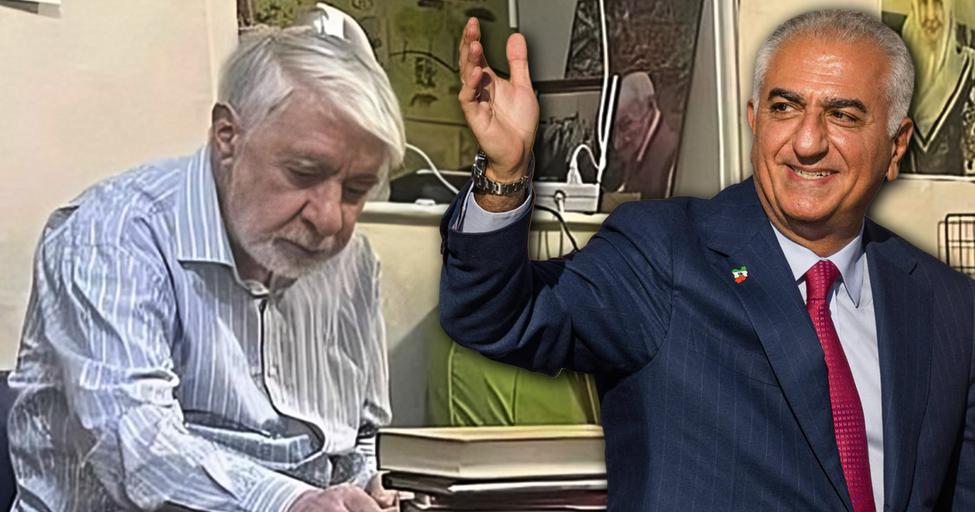
Despite this apparent common cause, hardliners continue to target reformists, accusing them of “justifying violence” and “purifying armed elements.” Even more striking is the treatment of former insiders like Mir-Hossein Mousavi and Mehdi Karroubi, who have been under house arrest since 2011. Their recent calls for constitutional reform have been portrayed as alignment with “a US-Zionist coup project.”
Media outlets critical of the regime face particularly severe measures. The television network Iran International has been designated a terrorist organization, with Iran’s General Prosecutor declaring any cooperation with the channel a “criminal act punishable by law.” Government supporters characterize such media as weapons of “psychological operations,” with journalist Kobra Asupari claiming that “the foundation of Iran International and other Persian-language Western media is the ignorance of the audience.”
Through this comprehensive campaign of delegitimization, Iran’s leadership appears determined to maintain control of the narrative surrounding recent protests, even as underlying economic and social grievances remain unaddressed.
Fact Checker
Verify the accuracy of this article using The Disinformation Commission analysis and real-time sources.

12 Comments
This propaganda campaign is a concerning escalation of the government’s efforts to suppress dissent. Portraying protesters as ‘servants of foreigners’ is a worrying sign that the regime is willing to go to great lengths to cling to power.
Absolutely. The regime’s willingness to resort to such heavy-handed tactics and outright falsehoods is a troubling indication of its desperation to maintain control. It will be interesting to see how this plays out in the long run.
It’s worrying to see the Iranian government clamping down so harshly on dissent. Labeling protests as ‘foreign-orchestrated plots’ is a transparent attempt to discredit the legitimate grievances of the Iranian people.
Absolutely. Resorting to such blatant propaganda and repression is a sign of weakness, not strength, on the government’s part. Curious to see if this heavy-handed approach will backfire in the long run.
The regime’s rhetoric about ‘national cohesion’ and ‘thanking the enemy’ for their actions is quite cynical. It’s clear they’re more concerned with maintaining power than addressing the root causes of the protests.
Agreed. Trying to spin protests as beneficial to national unity is a transparent attempt to deflect attention from the regime’s own failures and lack of legitimacy in the eyes of many Iranians.
The regime’s strategy of portraying opponents as ‘servants of foreigners’ is a classic authoritarian playbook move. Curious to see if this narrative will resonate with the Iranian public or if it will further erode trust in the government.
That’s a good point. Scapegoating external forces may rally some nationalist sentiment, but could also undermine the regime’s credibility if people see through the propaganda.
The government’s ‘securitization and judicial confrontation’ approach to the protests is concerning, especially given reports of demonstrators being killed. Cracking down on dissent rarely ends well for authoritarian regimes in the long run.
Agreed. Suppressing legitimate grievances often backfires and fuels further resentment. Interested to see how the international community responds to Iran’s heavy-handed tactics against its own citizens.
Interesting to see how Iran’s state media is trying to frame the recent protests as foreign-backed rather than genuine expressions of public discontent. Their rhetoric of ‘national cohesion’ and labeling opponents as ‘servants of foreigners’ is quite telling.
It’s a common tactic for authoritarian regimes to delegitimize protests by blaming external actors. Curious to see if this propaganda campaign will be effective in quelling further unrest.