


Listen to the article
Iran’s Jewish Community Navigates Delicate Balance Amid Tensions and Purim Protests
At the center of Hamadan, Iran, one of the world’s oldest continuously inhabited cities, stands a small brick mausoleum traditionally believed to house the tombs of biblical figures Esther and Mordechai. For Iran’s Jewish community, it’s their holiest site. For anti-Israel protesters, it has become a recurring focal point for demonstrations.
Over the past 15 years, the tomb has transformed into a flashpoint where protesters gather during Purim, sometimes throwing Molotov cocktails or burning Israeli flags. These demonstrations stem from regime-promoted narratives recasting the Book of Esther not as a story of Jewish survival but as a historical account of Jews perpetrating genocide against 75,000 Iranians.
The Jewish community’s response has been carefully calibrated: respectful appeals to the Interior Ministry emphasizing their loyalty while requesting protection for their sacred site. As U.S.-led military intervention remains a possibility, Iranian Jews prepare to celebrate Purim discreetly, adapting their traditions to the current political climate.
“Jews in Iran celebrate Purim with a very low profile because of all this antisemitic propaganda,” explains Thamar E. Gindin, author of “The Book of Esther Unmasked” and a research fellow at Haifa University’s Ezri Center for Iran and Persian Gulf Research.
Before the 1979 Islamic Revolution, approximately 100,000 Jews lived in Iran with significant religious freedoms under the Shah, who maintained ties with both the United States and Israel. The country even served as a haven for Jews fleeing hostile conditions in neighboring Arab nations.
The revolution marked a dramatic shift as Sharia law was imposed and religious minorities faced new constraints. Several Jewish community members were imprisoned on false accusations of being Zionist spies, triggering a mass exodus to the United States and Israel.
Today, Iran hosts approximately 9,000-10,000 Jews—the largest Jewish community in the Middle East outside Israel. While they can practice their religion, they face substantial discrimination, including being barred from senior government positions. The Jewish community is allocated one parliamentary seat, filled by what Beni Sabti, an Iran expert at the Institute for National Security Studies, describes as a “puppet” representative.
“He praises the regime all the time, and calls Israel ‘the Zionist entity’ and says it must be erased,” Sabti noted. Jews also face legal inequalities, including diminished weight of their testimony compared to Muslims in court proceedings.
The situation for Iran’s Jewish community deteriorated following the Twelve-Day War in June 2025. Since then, over 30 Jewish Iranians have been detained on accusations of collaborating with Israeli intelligence.
To protect community members, Jewish leaders publicly demonstrate allegiance to the regime and distance themselves from Israel. In January, Rabbi Younes Hamami Lalehzar, a prominent Jewish community leader, participated in a memorial service for Islamic Revolutionary Guard Corps commander Qassem Soleimani, even appearing alongside Hezbollah and Hamas representatives.
During recent waves of unrest, the community has maintained a deliberately low profile. “They didn’t come out from their houses,” Sabti explained, noting they only leave “to buy very basic products.” This cautious approach stems from lessons learned during the 2022 Women, Life, Freedom protests, when Jews attending synagogue services were mistaken for protesters and arrested.
Despite these precautions, the regime has used the Jewish community as “propaganda hostages,” according to Gindin. Jewish leaders have been compelled to participate in pro-regime events, including revolutionary parades. “If they tell you to gather your people to protest against Israel, you don’t have the prerogative to say no when the lives of thousands of people are dependent on your collaboration with the regime,” she explained.
The regime’s rewriting of the Purim story has become an annual tradition in Iranian media, schools, and academic circles. While the Book of Esther is widely considered non-historical by scholars, Iranian commentators present it as a distortion of actual events, claiming that Jews killed 77,000 Iranians with royal approval.
Some even connect Purim to Sizdah Bedar, an Iranian spring festival, suggesting that Persians commemorate fleeing their homes to escape a Jewish massacre by gathering outdoors.
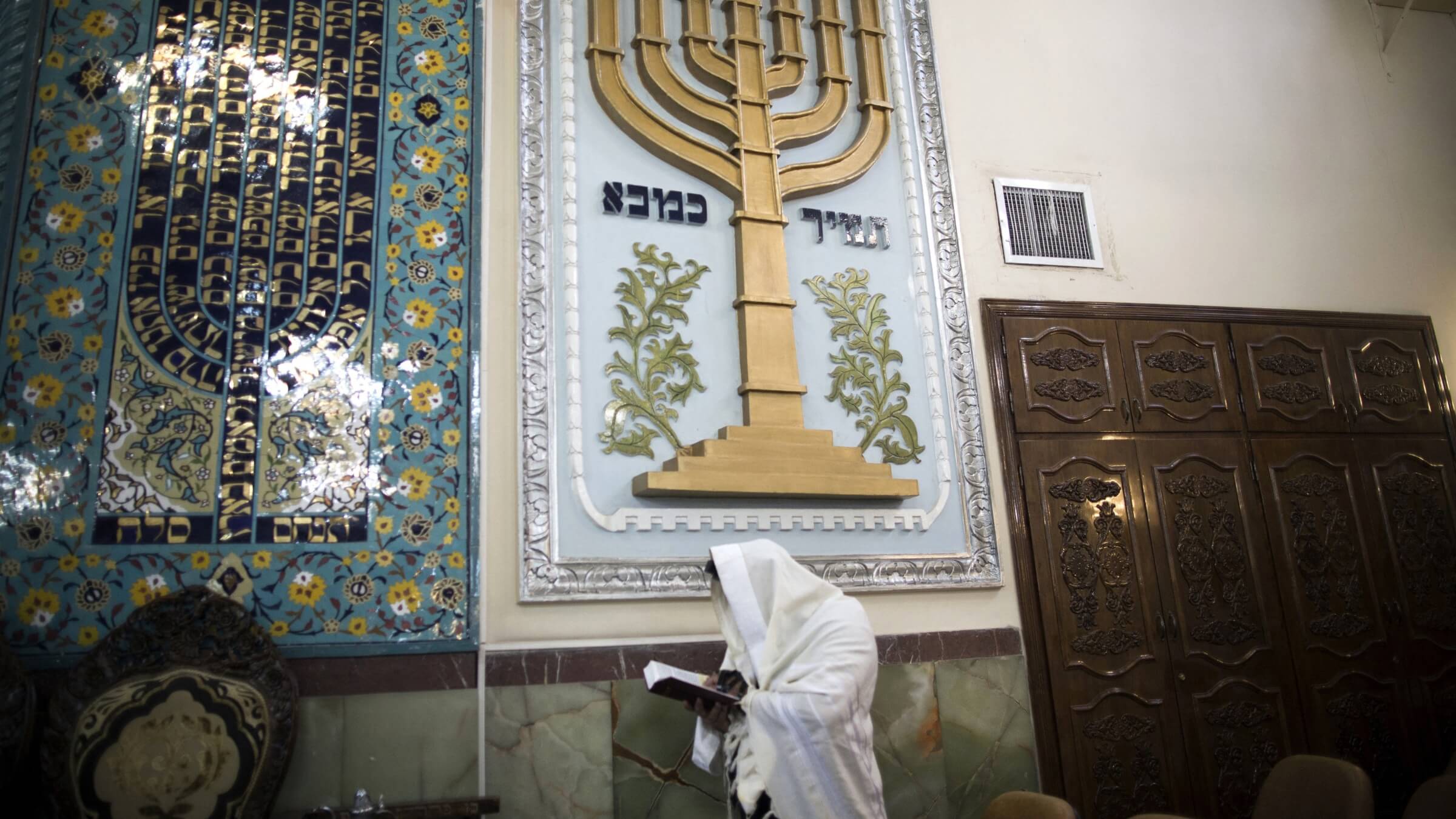
Despite ongoing tensions, Iranian Jews maintain their Purim traditions with cultural adaptations. The megillah reading proceeds in synagogues with minimal booing of Haman’s name out of respect for decorum. Costumes are omitted in keeping with Iranian modesty norms, and some prepare halva instead of traditional mishloach manot (gift baskets). Although Iran officially prohibits alcohol, Jews receive special dispensation to consume it at home for religious purposes.
Throughout these celebrations, Iran’s Jewish community continues its precarious balancing act—preserving ancient traditions while demonstrating loyalty to a regime that often portrays their heritage as a threat to national identity.
Fact Checker
Verify the accuracy of this article using The Disinformation Commission analysis and real-time sources.

11 Comments
As the U.S.-Iran tensions remain high, it’s understandable that Iran’s Jewish community would need to adapt their Purim celebrations to the current political climate. Preserving their traditions in the face of government pressure is commendable.
The government’s claims linking the Purim holiday to genocide are highly problematic and appear to be a thinly veiled attempt at propaganda. Protecting the religious freedom and cultural heritage of minority groups should be a priority.
I agree. The Jewish community’s measured response, emphasizing their loyalty while requesting protection, is a thoughtful approach in these circumstances.
It’s disheartening to see the regime’s attempts to rewrite the Purim story for political purposes. The Jewish community’s efforts to celebrate their traditions while navigating the delicate situation deserve recognition.
Fascinating to see how Iran’s Jewish community navigates the delicate balance between celebrating their traditions and the government’s anti-Israel rhetoric during Purim. It’s a complex situation that highlights the broader tensions in the region.
The government’s attempts to recast the Purim story as a historical account of Jewish genocide against Iranians is a concerning example of propaganda. It’s important to protect religious freedom and cultural heritage, even in politically charged environments.
I agree. The Jewish community’s response of appealing for protection while emphasizing their loyalty seems like a prudent approach in these circumstances.
The transformation of the tomb of Esther and Mordechai into a flashpoint for anti-Israel protests is a concerning development. Protecting sacred sites and religious freedom should be a priority, even in the midst of political conflicts.
This article highlights the challenges faced by minority communities in Iran, where religious and cultural expression can become politicized. The resilience of Iran’s Jewish community is admirable.
The tensions surrounding the tomb of Esther and Mordechai demonstrate the complex and often precarious position of minority communities in Iran. It’s important to find ways to preserve cultural heritage and religious freedom, even in politically charged environments.
This article highlights the delicate balance that Iran’s Jewish community must strike as they celebrate their traditions. Navigating government pressure and anti-Israel rhetoric requires remarkable resilience and diplomacy.