


Listen to the article
Media’s Role in Shaping Iran’s Opposition Movements Raises Concerns
Fresh waves of protests have erupted across Iran, fueled by longstanding tensions under the Islamic Republic and unresolved grievances from the “Jin, Jiyan, Azadi” uprising. These demonstrations stem from deep-seated sociopolitical, economic, ethnonational, and gender-based pressures that continue to plague Iranian society.
As protesters take to the streets, a parallel battle is unfolding in the media landscape, particularly among Iranian opposition outlets abroad. These platforms are not merely reporting on events but actively shaping narratives about political meaning, leadership, and legitimacy within the opposition movement.
Media coverage has become increasingly problematic, with certain outlets disproportionately amplifying select voices while marginalizing others. This selective amplification doesn’t necessarily involve spreading misinformation but rather cherry-picking facts that favor particular narratives and figures—a subtle yet powerful form of propaganda that legitimizes and amplifies certain perspectives over others.
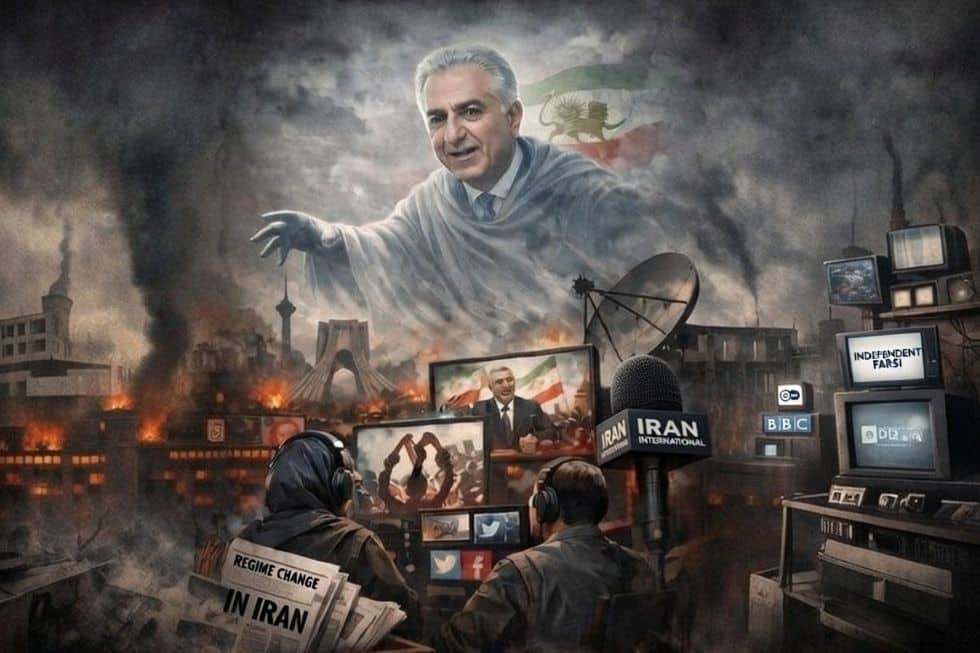
The current media dynamic bears troubling similarities to historical precedents in Iran. In 1979, a rumor circulated that Ayatollah Khomeini’s image had appeared on the moon—a story that gained credibility when mentioned on BBC Persian radio, helping elevate Khomeini’s quasi-messianic status during the Islamic Revolution.
Today, Persian-language media outlets appear to be constructing a similar narrative around Reza Pahlavi, the exiled son of Iran’s last monarch. Major platforms including BBC Persian, Iran International, Independent Farsi, and Manoto have given outsized coverage to Pahlavi, portraying him as the central figure of the opposition movement despite the complex reality on the ground.
This media framing has occurred even as protests in several Kurdish cities—including Sine (Sanandaj) and Seqqiz, where the Jin, Jiyan, Azadi protests began in 2022—have faced declining coverage. This disparity is particularly significant given the Pahlavi dynasty’s historical record of suppressing ethnonational rights in non-Persian regions of Iran.
The pattern became so pronounced that in 2023, several non-Persian and non-monarchist journalists working for opposition Persian-language media outlets resigned in protest. Their departures coincided with a social media campaign under the hashtag #MediaCoup, which criticized what users saw as media bias favoring Pahlavi, boycotting alternative voices, and focusing primarily on Persian-inhabited areas.
The situation has continued into 2026, with media outlets primarily circulating videos of Pahlavi supporters while giving little attention to footage showing other perspectives or incidents where Pahlavi supporters reportedly harassed non-monarchists.
This pattern of elevating a single strongman while marginalizing other voices mirrors previous episodes in Iran’s history. During the Green Movement of 2009, Persian diaspora media portrayed Mir Hossein Mousavi and Mehdi Karroubi as the sole legitimate leaders of the struggle for freedom, despite their controversial records and criticisms from non-Persian communities. Consequently, non-Persian regions largely abstained from those uprisings.
Pahlavi’s “Emergency Period Pamphlet,” released in July 2025, has received inadequate critical scrutiny from these media outlets. The document outlines his vision for post-Islamic Republic Iran, claiming leadership of the “national uprising” while presenting political options that may exclude significant constituencies, particularly ethnonational groups seeking federalism rather than the binary choice between monarchy and unitary republic that Pahlavi proposes.
The pamphlet’s structure also raises concerns about power concentration, with provisions that would grant the self-proclaimed leader significant control over the proposed National Uprising Institution through appointment powers and final decision-making authority.
The risk of repeating history looms large. In 1979, Kurdistan was the only region to vote against the Islamic Republic in a nationwide referendum. The response was brutal—Khomeini issued a fatwa calling for jihad, resulting in military suppression and massacres in Kurdish areas.
As media outlets continue to amplify Pahlavi’s voice while sidelining other perspectives, particularly those from non-Persian communities, they may inadvertently be undermining the prospects for a truly democratic and pluralistic future in Iran. Critics argue that if another Persian strongman dominates the opposition movement, future uprisings may face the same limitations as previous ones.
For Iran to achieve genuine democratic transformation, media platforms must represent the full diversity of voices across the country’s multinational landscape rather than recreating historical patterns that have previously led to authoritarian outcomes.
Fact Checker
Verify the accuracy of this article using The Disinformation Commission analysis and real-time sources.

18 Comments
This article highlights the need for nuanced and impartial coverage of Iran’s opposition movements. While the former crown prince may be a prominent figure, the media should strive to represent the full spectrum of voices and perspectives.
This is a complex and nuanced situation. While the former crown prince may be a prominent media figure, it’s important to consider the broader context and diverse perspectives within Iran’s opposition movement.
Agreed, the media coverage seems to be selectively amplifying certain voices while marginalizing others. A balanced and inclusive approach is crucial to understand the full picture.
The media’s selective amplification of certain voices within the Iranian opposition movement is a concerning trend that deserves further scrutiny. A more balanced and inclusive approach is needed to accurately reflect the diverse perspectives.
Agreed. The media’s role in shaping political narratives is a delicate issue that requires careful consideration of potential biases and agendas.
The article’s focus on the media’s role in shaping the narratives around Iran’s opposition movements is a critical issue. It’s essential to maintain a balanced and inclusive approach to ensure a full understanding of the diverse perspectives within the opposition.
Well said. The media’s influence in this context is a double-edged sword, and we must be vigilant in recognizing potential biases and agendas.
While the former crown prince’s prominence is noteworthy, the real story seems to be the complex, multifaceted nature of the opposition within Iran. The media’s role in amplifying certain voices deserves close scrutiny.
Agreed, the opposition movement is not monolithic, and the media’s selective focus risks oversimplifying a nuanced situation. A more holistic approach is needed.
The media’s role in shaping the opposition narrative is a concerning trend. While the former crown prince may be a prominent figure, the article rightly points out the need to consider the broader context and range of voices within Iran.
Well said. Media coverage should aim to inform, not amplify specific agendas. A more nuanced and inclusive approach is crucial in this complex situation.
The concerns raised in this article about the media’s role in shaping the opposition narrative in Iran are valid and worth further examination. A more inclusive and balanced approach is necessary to truly understand the complexities of the situation.
Absolutely. The media’s influence can be a powerful tool, but it must be wielded responsibly to avoid amplifying certain perspectives at the expense of others.
This article raises important questions about the media’s responsibility in covering complex political movements like the opposition in Iran. While the former crown prince’s prominence is noteworthy, the broader landscape of the opposition deserves equal attention and representation.
This article highlights the delicate balance between media coverage and political narratives. It’s important to keep an open mind and seek out diverse perspectives on the ongoing developments in Iran.
The article raises valid concerns about the media’s role in shaping the narratives around Iran’s opposition movements. It’s crucial to be aware of potential biases and to seek out a range of perspectives.
Absolutely, the media’s influence in this context is a double-edged sword. We must be vigilant in parsing fact from narrative.
This article raises important questions about the media’s responsibility in covering complex political movements. While the former crown prince’s prominence is noteworthy, the broader opposition landscape deserves equal attention.