


Listen to the article
Iran’s Naval Arsenal Spotlighted as Regional Tensions Escalate
Footage showcasing Iran’s naval drone capabilities has resurfaced amid intensifying hostilities between Iran, the United States, and Israel. The propaganda video, originally from 2025, reveals an extensive underground arsenal of naval drones, anti-ship missiles, and sea mines that Iran has positioned near the strategically vital Strait of Hormuz.
The conflict escalated following U.S. and Israeli strikes on Iran on February 28, which resulted in the death of Iran’s Supreme Leader Ayatollah Ali Khamenei. His son has since assumed leadership as the region descends further into violence.
Iran has responded with missile strikes targeting Israel and U.S. military bases throughout the Middle East. The situation has deteriorated to the point where Gulf nations closed their airspaces, stranding thousands of travelers, while U.S. embassies and prominent hotels have become targets of drone attacks.
Despite U.S. President Donald Trump’s claim that the war with Iran is “very complete” following a conversation with Russian President Vladimir Putin, Iranian military actions suggest otherwise. Trump asserted that Iranian drones are “being blown up all over the place,” but evidence indicates Iran has established numerous mine-laying vessels near the Strait of Hormuz.
This narrow waterway, spanning just 50 kilometers, serves as a critical global shipping lane through which approximately one-fifth of the world’s oil supply passes. Iran’s blockade of this channel has already had profound consequences for the global economy, with oil prices surging to $120 per barrel on Monday, March 9.
Iranian military officials have made alarming threats about their capabilities and intentions. Senior Islamic Revolutionary Guard Corps (IRGC) General Fadavi claimed, “We have missiles that are fired from underwater and their speed is one hundred meters per second, and we may use them in the coming days.” Iran has boasted that only they and Russia possess such advanced underwater missile technology.
Iran has threatened to drive oil prices to an unprecedented $200 per barrel, which would trigger severe global economic repercussions. Iranian Parliament Speaker Mohammad Bagher Ghalibaf issued a stern warning: “Any aggression against soil of Iranian islands will shatter all restraint. We will abandon all restraint and make the Persian Gulf run with the blood of invaders.”
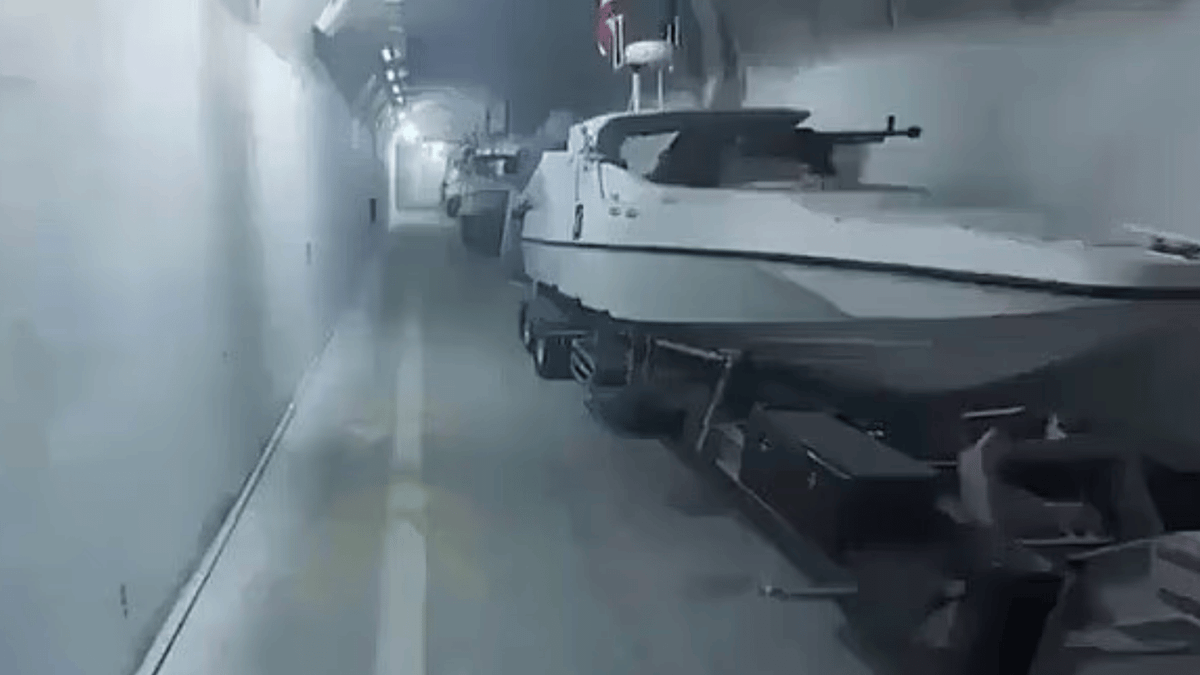
The resurfaced propaganda video reveals extensive underground facilities housing naval attack boats, which Iran has been using to launch drones at vessels navigating the strait. The footage shows rows of naval drones and other maritime weapons systems stored in tunnel complexes, highlighting Iran’s significant investment in asymmetric naval warfare capabilities.
The situation has already turned deadly. Reports emerged this week that Iranian strikes on oil tankers in the Persian Gulf have resulted in at least one crew fatality. Iraq’s director general of the General Company for Ports, Farhan al-Fartousi, confirmed that “two foreign tankers carrying Iraqi fuel oil were subjected to unidentified attacks inside territorial waters, causing them to catch fire.”
On Tuesday, the U.S. military announced it had destroyed 16 Iranian vessels and removed “a few dozen mines” from the region, according to CNN. However, the Iranian military appears to be continuing its strategy of disrupting maritime traffic through the strait.
Energy security analysts warn that prolonged disruption to the Strait of Hormuz could lead to global fuel shortages and price instability, with implications far beyond the immediate region. The conflict’s impact on global shipping routes is already forcing vessels to take longer, costlier alternate routes, adding pressure to global supply chains still recovering from pandemic-related disruptions.
As tensions continue to mount, international diplomatic efforts to de-escalate the situation have yet to yield significant results, leaving global markets bracing for further volatility in the energy sector.
Fact Checker
Verify the accuracy of this article using The Disinformation Commission analysis and real-time sources.

24 Comments
Interesting update on Iranian Propaganda Video Showcases Concerning Military Strategy with Global Economic Implications. Curious how the grades will trend next quarter.
If AISC keeps dropping, this becomes investable for me.
Good point. Watching costs and grades closely.
Uranium names keep pushing higher—supply still tight into 2026.
Good point. Watching costs and grades closely.
Good point. Watching costs and grades closely.
The cost guidance is better than expected. If they deliver, the stock could rerate.
Good point. Watching costs and grades closely.
Uranium names keep pushing higher—supply still tight into 2026.
Good point. Watching costs and grades closely.
Good point. Watching costs and grades closely.
Uranium names keep pushing higher—supply still tight into 2026.
I like the balance sheet here—less leverage than peers.
Good point. Watching costs and grades closely.
Nice to see insider buying—usually a good signal in this space.
Good point. Watching costs and grades closely.
Interesting update on Iranian Propaganda Video Showcases Concerning Military Strategy with Global Economic Implications. Curious how the grades will trend next quarter.
Good point. Watching costs and grades closely.
Uranium names keep pushing higher—supply still tight into 2026.
Good point. Watching costs and grades closely.
Interesting update on Iranian Propaganda Video Showcases Concerning Military Strategy with Global Economic Implications. Curious how the grades will trend next quarter.
Good point. Watching costs and grades closely.
Good point. Watching costs and grades closely.
Production mix shifting toward Propaganda might help margins if metals stay firm.