


Listen to the article
Tehran’s Propaganda Battleground: The Strategic Billboards of Enqelab Square
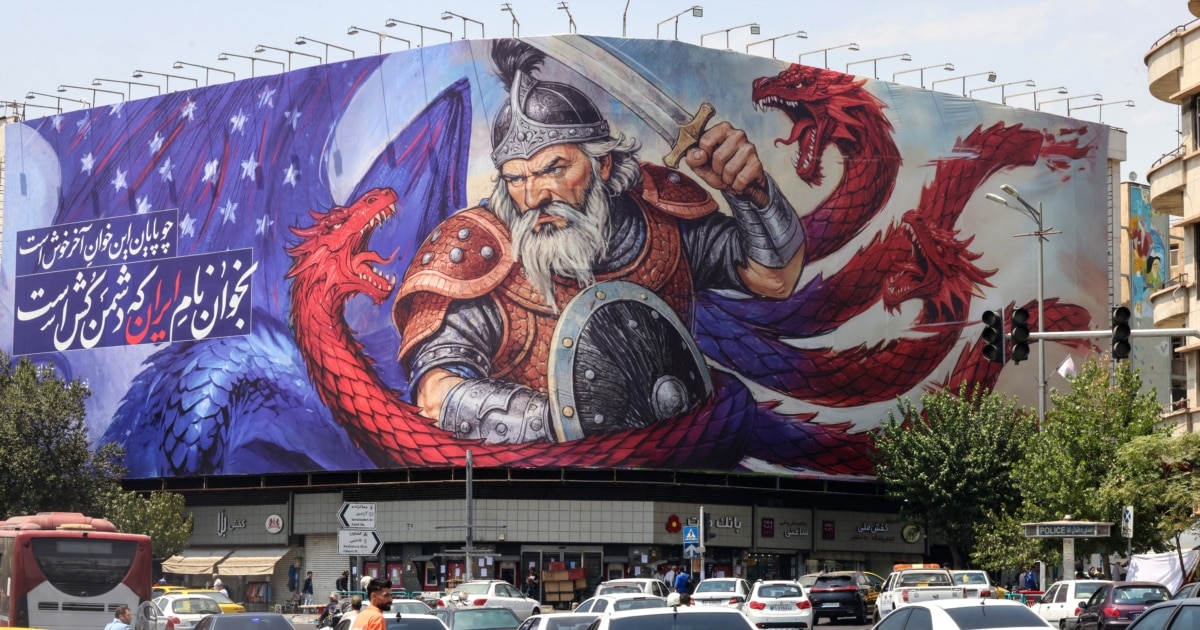
A massive billboard depicting a battered American aircraft carrier trailing blood now looms over Tehran’s busy Enqelab (Islamic Revolution) Square, marking the latest in a series of provocative visual propaganda displays that have become a hallmark of Iran’s public messaging strategy.
Positioned strategically on a main thoroughfare from Tehran’s international airport, this high-traffic intersection has hosted at least five different large-scale propaganda posters over the past two months alone, each crafted to project Iranian strength while threatening perceived enemies.
The current display appears timed to coincide with the approach of a US naval flotilla near Iranian waters, accompanied by the biblical warning: “If you sow the wind, you will reap the whirlwind.” This direct threat represents the latest escalation in Iran’s visual rhetoric campaign.
According to Darren Linvill, a professor with the Media Forensics hub at Clemson University, these striking visual displays serve a dual purpose. “They create these images so that they will be shared by Western media outlets and then from there to social media,” Linvill told reporters. Despite the considerable expense of frequently updating building-sized posters, he noted that “in the grand scheme of things, billboards are cheap” considering their propaganda value.
The psychological impact on Iranian citizens remains a primary objective, according to Janatan Sayeh, a research analyst with the Washington-based Foundation for Defense of Democracies. “It’s constant exposure, ensuring citizens encounter propaganda everywhere, from the metro to public parks,” Sayeh explained. “It’s a psychological tactic meant to remind Iranians there is no escape from the regime.”
While anti-American and anti-Israeli murals have been fixtures in Tehran since the 1979 Islamic Revolution, the use of rapidly changeable massive billboards represents a more recent tactical evolution in Iran’s propaganda arsenal. The Enqelab Square billboard first appeared in Iranian news agencies in early 2023, while a smaller billboard in nearby Vali Asr Square has been projecting regime messaging since 2015.
The themes displayed above Enqelab Square reflect Iran’s shifting priorities and current tensions. Recent displays have included images celebrating Iran’s nuclear program with the slogan “science is power,” depictions of missiles raining down on Israel with the declaration “If you want war, we are the master of war,” and a banner showing American naval personnel kneeling before Iranian forces—referencing a 2016 incident when US sailors were temporarily detained after a navigational error.
Some displays incorporate cultural elements, including characters from the epic Persian poem Shahnameh battling creatures adorned with American flag colors, blending nationalist pride with anti-Western sentiment.
These propaganda efforts have not gone unchallenged by Iranian citizens. During recent anti-government protests, similar billboards elsewhere in Tehran were reportedly set ablaze, though there is no evidence the Enqelab Square billboard itself was targeted. Some Iranians have expressed frustration with the confrontational messaging, with one woman telling journalists that banners threatening Israel are “just provoking more tension.”
The aggressive posturing displayed on these billboards often contradicts Iran’s behind-the-scenes diplomatic approach, according to analysts. “Image is everything for the regime, and it cannot afford to appear weak to its support base,” said Sayeh. “This is why there are moments when it issues public threats while it seeks to de-escalate in private.”
As tensions continue to simmer in the region, Tehran’s strategic deployment of visual propaganda at Enqelab Square remains a powerful tool for both domestic control and international messaging—a physical manifestation of Iran’s complex political stance in a contested region.
Fact Checker
Verify the accuracy of this article using The Disinformation Commission analysis and real-time sources.

14 Comments
While Iran may view these propaganda displays as a way to project strength, they seem more likely to heighten regional tensions than achieve any meaningful strategic goals. De-escalation and open communication would be a wiser path forward.
I agree. Ramping up the rhetoric and aggressive posturing is unlikely to lead to positive outcomes. Iran would be better served by pursuing diplomatic solutions to ease regional conflicts.
The use of public spaces for such overt propaganda is concerning. While Iran may view these displays as a way to project strength, they seem more likely to heighten regional tensions than achieve any meaningful strategic goals. Diplomacy and de-escalation should be the priority.
These propaganda billboards appear to be more about stoking nationalist sentiment at home than achieving any real strategic objectives. While the messaging may resonate with some Iranians, it’s unlikely to sway the international community. A more measured, diplomatic approach would be far more constructive.
I agree. Ramping up the rhetoric and aggressive posturing through these public displays is a risky strategy that could backfire. Iran would be better served by pursuing de-escalation and open communication to address the underlying issues.
These propaganda billboards seem more like chest-thumping than a serious strategic move. Iran may score some nationalist points at home, but the international community is unlikely to be swayed. A more measured, diplomatic approach would be far more constructive.
These public displays of propaganda seem aimed at whipping up nationalist sentiment and projecting an image of Iranian strength. While the messaging may play well domestically, it’s unlikely to achieve much beyond escalating regional tensions.
You’re right, these types of provocative visual displays are unlikely to de-escalate the situation. Iran may be trying to rally its citizens, but it risks further inflaming conflicts with the US and its allies.
It’s troubling to see Iran using public spaces for such aggressive propaganda. While the messaging may resonate domestically, it’s unlikely to achieve any meaningful strategic goals beyond heightening regional tensions. Diplomacy and de-escalation should be the priority.
It’s concerning to see Iran using public spaces for such aggressive propaganda. Stoking nationalism and threatening perceived enemies is a dangerous game that could have serious repercussions. Diplomacy and de-escalation should be the priority here.
The use of public spaces for such overt propaganda is concerning. While Iran may intend to rally its citizens, these displays risk further escalating regional tensions. A more nuanced, diplomatic approach would be better suited to addressing the underlying issues.
Absolutely. Ratcheting up the rhetoric and threats through these propaganda displays is unlikely to lead to positive outcomes. Iran should focus its efforts on de-escalating the situation through constructive dialogue.
These propaganda displays seem more like political theater than a serious strategic move. While Iran may intend to rally its citizens, the international community is unlikely to be swayed. A more measured, diplomatic approach would be far more constructive in addressing the underlying issues.
I agree. Ramping up the rhetoric and posturing through these public propaganda displays is a risky strategy that could backfire. Iran would be better served by pursuing de-escalation and open communication with its neighbors and the international community.