


Listen to the article
The International Olympic Committee (IOC) has sparked outrage among Holocaust remembrance organizations for marketing T-shirts commemorating the 1936 Berlin Olympic Games, an event held more than three years after Adolf Hitler’s Nazi regime seized power in Germany.
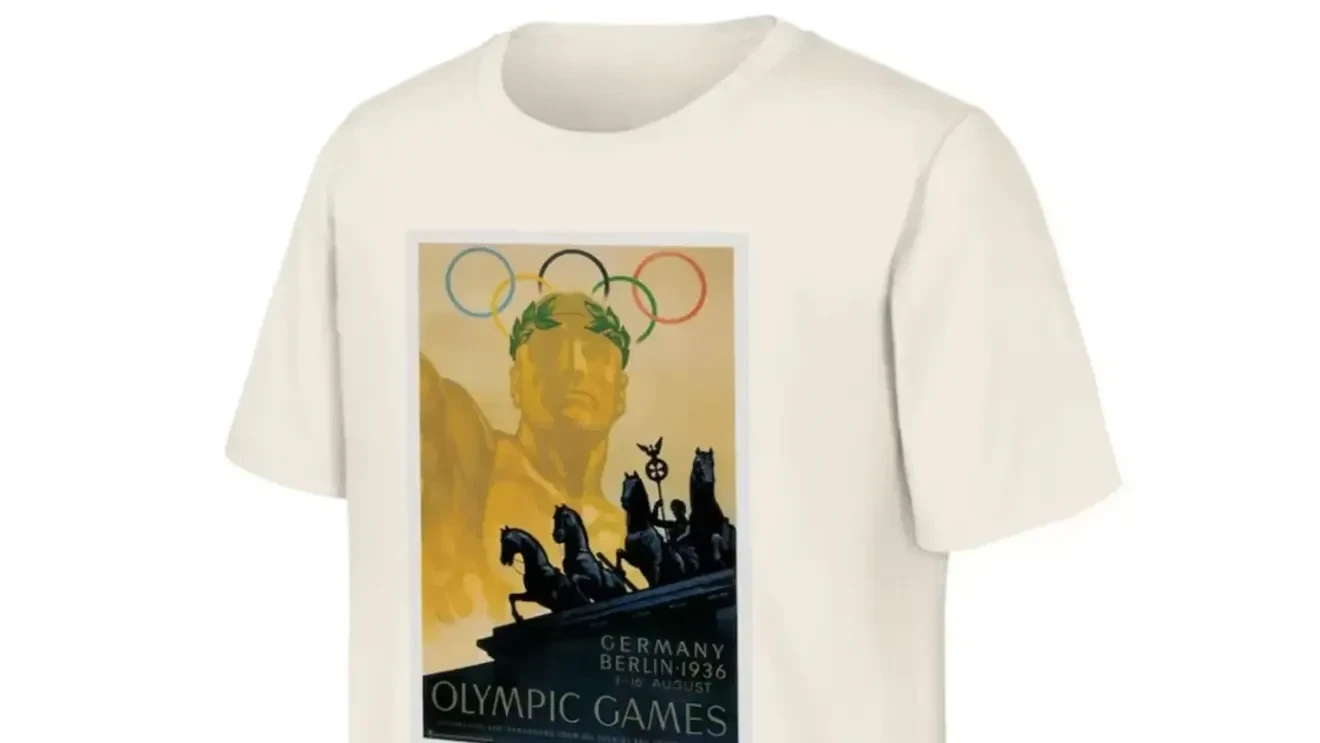
The controversial merchandise, which quickly sold out before being removed from the IOC’s “Heritage Collection,” featured Franz Würbel’s original 1936 Olympic poster design. The image depicted a muscular, wreath-wearing statue alongside Berlin’s Brandenburg Gate with the inscription “Germany Berlin 1936 Olympic Games.”
Holocaust advocacy groups have strongly condemned the IOC’s decision to commercialize memorabilia from what many historians consider a propaganda showcase for Hitler’s regime. The 1936 Games are widely recognized as an event manipulated by the Nazis to promote their ideology of Aryan racial superiority on the world stage.
“The Nazis used the 1936 Olympics to showcase their oppressive regime to the world,” explained Christine Schmidt, co-director of the Wiener Holocaust Library, in comments to CNN. “They aimed to smooth over international relations while simultaneously preventing almost all German-Jewish athletes from competing, rounding up the 800 Roma who lived in Berlin, and concealing signs of virulent antisemitic violence and propaganda from the world’s visitors.”
Schmidt further questioned the IOC’s judgment, noting that “The IOC would be minded to consider whether any aesthetic appreciation of these games can be comfortably separated from the horror that followed.”
The controversy highlights the complex intersection of sports, politics, and historical memory. While the IOC presented its Heritage Collection with the tagline “Each edition of the Games reflects a unique time and place in history when the world came together to celebrate humanity,” critics argue this sanitized description glosses over the darker realities of the 1936 Olympics.
Scott Saunders, CEO of International March of the Living, an organization that arranges educational visits to the former Auschwitz concentration camp, emphasized how the Berlin Games revealed societal complicity with antisemitism.
“Sport has the power to unite, to inspire, and to elevate the very best of humanity. But history reminds us that it can also be manipulated to sanitize hatred and normalize exclusion,” Saunders told CNN. “The lesson of Berlin is urgent. When antisemitism resurfaces in public life, whether in stadiums, streets, or online, silence is not neutrality. It is complicity.”
Despite the backlash, the IOC defended its decision to sell the merchandise. In a statement to CNN, an IOC spokesperson acknowledged the “historical issues of ‘Nazi propaganda'” but suggested these elements didn’t taint the Games themselves.
“We must also remember that the Games in Berlin saw 4,483 athletes from 49 countries compete in 149 medal events. Many of them stunned the world with their athletic achievements, including Jesse Owens,” the spokesperson said.
Owens, an African American athlete who won four gold medals at the 1936 Games, has often been cited as a counterpoint to Nazi ideology. His victories on German soil contradicted Hitler’s notions of racial superiority, though historians note that the propaganda machine still managed to portray the Games as a Nazi triumph to domestic audiences.
The IOC spokesperson added that “The historical context of these Games is further explained at the Olympic Museum in Lausanne,” and mentioned that “the number of T-shirts produced and sold by the IOC is limited, which is why they are currently sold out.”
The controversy emerges amid growing concerns about rising antisemitism globally and debates about how sporting organizations should address complicated historical legacies. Critics argue that commercializing memorabilia from the 1936 Games trivializes the historical context in which they occurred – a period when the Nazi regime was already implementing discriminatory policies that would eventually lead to the Holocaust.
The incident raises questions about the responsibility of international sporting bodies when balancing commercial interests against ethical considerations and historical sensitivity, particularly regarding events closely associated with regimes responsible for genocide and widespread human rights abuses.
Fact Checker
Verify the accuracy of this article using The Disinformation Commission analysis and real-time sources.

18 Comments
I like the balance sheet here—less leverage than peers.
Exploration results look promising, but permitting will be the key risk.
Good point. Watching costs and grades closely.
Production mix shifting toward Propaganda might help margins if metals stay firm.
If AISC keeps dropping, this becomes investable for me.
Good point. Watching costs and grades closely.
Good point. Watching costs and grades closely.
Silver leverage is strong here; beta cuts both ways though.
Good point. Watching costs and grades closely.
Good point. Watching costs and grades closely.
I like the balance sheet here—less leverage than peers.
Good point. Watching costs and grades closely.
Interesting update on IOC Faces Criticism Over Sale of T-shirt Linked to 1936 Nazi Olympics. Curious how the grades will trend next quarter.
Good point. Watching costs and grades closely.
Good point. Watching costs and grades closely.
Nice to see insider buying—usually a good signal in this space.
The cost guidance is better than expected. If they deliver, the stock could rerate.
Good point. Watching costs and grades closely.