


Listen to the article
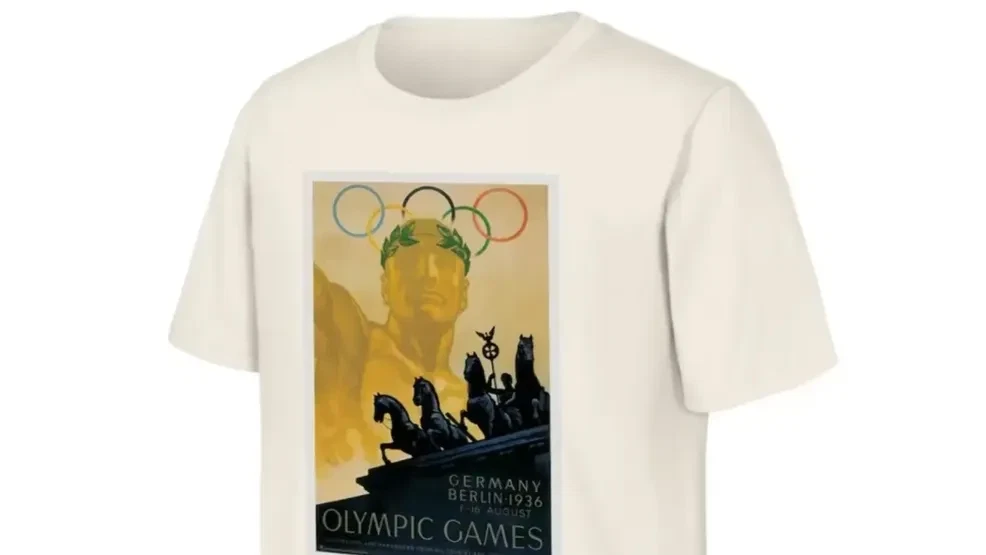
The International Olympic Committee (IOC) has faced sharp criticism from Holocaust remembrance organizations for selling T-shirts commemorating the 1936 Olympic Games held in Nazi Germany under Adolf Hitler’s regime.
The controversial merchandise, which was part of the IOC’s “Heritage Collection,” has since sold out and been removed from availability. The shirts featured Franz Würbel’s original 1936 Olympic poster depicting a muscular statue wearing a wreath, with Berlin’s Brandenburg Gate and the text “Germany Berlin 1936 Olympic Games.”
Holocaust advocacy groups have condemned the IOC for seemingly glorifying an event that historians widely recognize as a propaganda platform for Hitler’s Nazi regime. The 1936 Games took place more than three years after Hitler rose to power, during a period when Nazi persecution of Jews and other minorities was already well underway.
Christine Schmidt, co-director of the Wiener Holocaust Library, told CNN that the historical context cannot be ignored. “The Nazis used the 1936 Olympics to showcase their oppressive regime to the world, aiming to smooth over international relations while at the same time preventing almost all German-Jewish athletes from competing, rounding up the 800 Roma who lived in Berlin, and concealing signs of virulent antisemitic violence and propaganda from the world’s visitors,” Schmidt explained.
She emphasized that Nazi ideology permeated every aspect of the Games, adding that “the IOC would be minded to consider whether any aesthetic appreciation of these games can be comfortably separated from the horror that followed.”
Scott Saunders, CEO of International March of the Living, an organization that conducts educational trips to the former Auschwitz concentration camp, highlighted the broader implications. “Sport has the power to unite, to inspire, and to elevate the very best of humanity. But history reminds us that it can also be manipulated to sanitize hatred and normalize exclusion,” he told CNN.
Saunders drew parallels to contemporary issues, adding that “when antisemitism resurfaces in public life, whether in stadiums, streets, or online, silence is not neutrality. It is complicity.”
The 1936 Olympics are particularly notorious in sporting history as Hitler attempted to use them to demonstrate what he called “Aryan racial superiority.” The Nazi regime barred German-Jewish athletes from participation and openly referred to Black athletes as “non-humans.”
Despite these well-documented facts, the IOC defended the merchandise. In a statement to CNN, an IOC spokesperson acknowledged the “historical issues of ‘Nazi propaganda'” but countered that the Games themselves weren’t tainted by the political context. “We must also remember that the Games in Berlin saw 4,483 athletes from 49 countries compete in 149 medal events. Many of them stunned the world with their athletic achievements, including Jesse Owens,” the spokesperson said.
Owens, an African American athlete who won four gold medals at the Berlin Games, famously challenged Hitler’s racial ideology with his dominance on the track. While those around him performed the Nazi salute, Owens maintained the traditional Olympic salute on the podium.
The IOC spokesperson noted that the “historical context of these Games is further explained at the Olympic Museum in Lausanne” and added that only a limited number of the T-shirts were produced, explaining why they are currently sold out.
The controversy highlights the ongoing tension between commemorating sporting history and acknowledging the darker political contexts in which some Olympic Games have taken place. As preparations continue for future Olympics, the incident raises questions about how sporting bodies should handle the more problematic chapters of their past.
Fact Checker
Verify the accuracy of this article using The Disinformation Commission analysis and real-time sources.

10 Comments
This is a complex issue, as the 1936 Olympics were a pivotal historical event. However, the IOC should carefully consider the messaging and impact of selling merchandise tied to the Nazi regime’s propaganda efforts.
Definitely a valid concern. The IOC needs to strike a balance between preserving history and avoiding the appearance of glorifying a repressive ideology. Sensitivity to the victims of Nazism should be the top priority.
I’m curious to hear more about the IOC’s rationale for including this merchandise in their ‘Heritage Collection.’ While historical context is important, the Nazi ties make this a highly controversial move that deserves scrutiny.
Agreed, the IOC should provide a clear explanation for why they decided to feature this particular item. Transparency around their decision-making process would help address the valid concerns raised by Holocaust remembrance groups.
The IOC’s decision to sell these Nazi-era Olympics shirts is troubling. Even if the intent was to preserve history, the optics of profiting from such a morally repugnant regime is highly problematic.
I share your view. The IOC should reconsider this move and explore alternative ways to educate the public about the 1936 Olympics that don’t involve commercially exploiting such a dark chapter in history.
Selling merchandise linked to the Nazi Olympics is a concerning move by the IOC. While the historical context shouldn’t be ignored, the optics of profiting off such a dark period are questionable at best.
I agree, the IOC should be more mindful of the implications and symbolism behind their product offerings. Promoting items from the 1936 Games risks normalizing or downplaying the Nazis’ abuses.
While I appreciate the IOC’s efforts to showcase Olympic history, selling merchandise linked to the Nazi regime seems like a misstep that fails to fully acknowledge the horrors and human rights abuses of that era.
Absolutely. The IOC should prioritize sensitivity and thoughtful commemoration over commercial interests when it comes to such a politically and ethically fraught historical event. A more nuanced approach is needed.