


Listen to the article
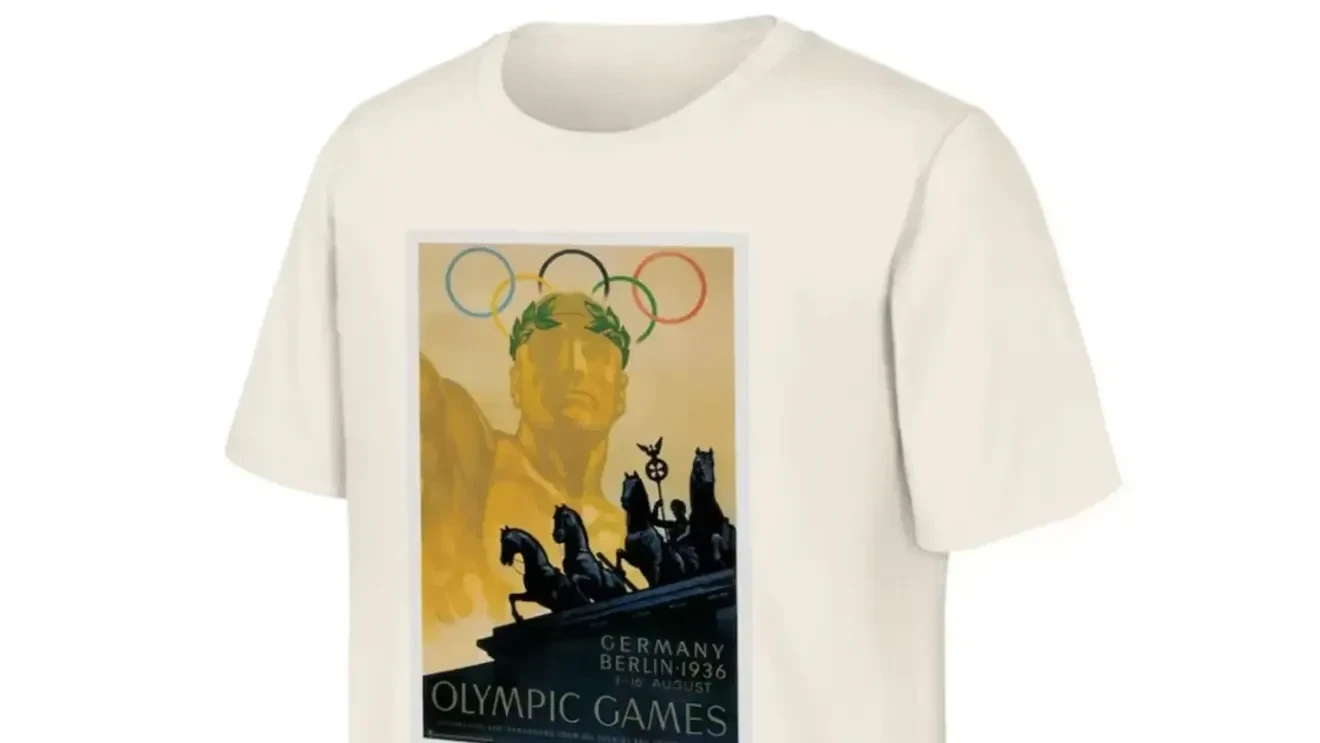
The International Olympic Committee (IOC) has drawn sharp criticism from Holocaust remembrance organizations for marketing T-shirts commemorating the 1936 Olympic Games held in Nazi Germany. The controversial merchandise, which has since sold out, featured the original 1936 Olympic poster created by Franz Würbel.
The shirt displayed a muscular statue of a man wearing a laurel wreath with Berlin’s Brandenburg Gate in the background and the text “Germany Berlin 1936 Olympic Games” prominently featured. It was part of the IOC’s “Heritage Collection,” which the organization described as celebrating how “each edition of the Games reflects a unique time and place in history when the world came together to celebrate humanity.”
Holocaust advocacy groups have condemned the merchandise, emphasizing that the 1936 Olympics were deliberately exploited by Adolf Hitler’s regime to promote Nazi propaganda and Aryan supremacy ideology. The Games took place more than three years after Hitler’s rise to power, during a period when the Nazi government was implementing increasingly severe anti-Jewish policies.
Christine Schmidt, co-director of the Wiener Holocaust Library, told CNN that “the Nazis used the 1936 Olympics to showcase their oppressive regime to the world.” She explained that the Nazi government prevented nearly all German-Jewish athletes from competing and rounded up approximately 800 Roma living in Berlin. Officials also worked to conceal evidence of antisemitic violence and propaganda from international visitors.
“The Nazis’ fascist and antisemitic propaganda infiltrated their promotion of the games, and many international Jewish athletes chose not to compete,” Schmidt added. She suggested that the IOC should consider whether “any aesthetic appreciation of these games can be comfortably separated from the horror that followed.”
Scott Saunders, CEO of International March of the Living, an organization that conducts educational trips to the former Auschwitz concentration camp, emphasized the broader implications of celebrating the 1936 Olympics. “Sport has the power to unite, to inspire, and to elevate the very best of humanity. But history reminds us that it can also be manipulated to sanitize hatred and normalize exclusion,” Saunders told CNN.
He stressed that the Berlin Olympics demonstrated how society can become complicit in antisemitism, adding: “When antisemitism resurfaces in public life, whether in stadiums, streets, or online, silence is not neutrality. It is complicity.”
Despite the widespread criticism, the IOC defended its decision to sell the merchandise. A spokesperson acknowledged the “historical issues of ‘Nazi propaganda'” associated with the Berlin Games but argued that this did not tarnish the athletic competition itself.
“We must also remember that the Games in Berlin saw 4,483 athletes from 49 countries compete in 149 medal events. Many of them stunned the world with their athletic achievements, including Jesse Owens,” the IOC spokesperson told CNN. Owens, an African American athlete who won four gold medals at the 1936 Games, became a powerful symbol against Nazi ideology of racial superiority when he saluted from the first-place podium while others performed the Nazi salute.
The IOC stated that “the historical context of these Games is further explained at the Olympic Museum in Lausanne” and noted that “the number of T-shirts produced and sold by the IOC is limited, which is why they are currently sold out.”
Historians widely recognize that the 1936 Olympics represented a significant propaganda opportunity for Hitler’s regime. The Nazi government had already begun implementing discriminatory policies against Jews, and during the Games, they openly referred to Black athletes as “non-humans.” These Games occurred at a critical moment in history, just three years before the outbreak of World War II and the beginning of the Holocaust.
Fact Checker
Verify the accuracy of this article using The Disinformation Commission analysis and real-time sources.

11 Comments
The IOC’s ‘Heritage Collection’ should steer clear of items that could be seen as glorifying the Nazis’ exploitation of the 1936 Olympics. They need to be more mindful of the impact their choices have, especially around such a sensitive historical event.
Holocaust remembrance groups are right to speak out against this decision. The IOC should engage with them to ensure their commemorations are done in a thoughtful, ethical manner.
Celebrating the Olympic ideal is admirable, but the IOC’s choice to sell merchandise linked to the Nazi regime’s propaganda is concerning. They should reconsider this line and find ways to honor history that don’t risk normalizing or trivializing atrocities.
While the IOC may have intended to celebrate the Olympic spirit, selling shirts linked to the Nazi regime’s propaganda is an insensitive move. They need to be more thoughtful about how they commemorate history, especially events used to promote hateful ideologies.
Holocaust advocacy groups are right to condemn this decision. The IOC should engage with them to ensure their heritage collections are curated in a more ethical and inclusive way.
The IOC’s decision to sell a shirt commemorating the 1936 Nazi Olympics is troubling and insensitive. While historical context is important, this merchandise risks sanitizing the regime’s exploitation of the Games to promote hateful ideologies.
The IOC should be more thoughtful when selecting items for its ‘Heritage Collection’ to avoid glorifying such a dark chapter in history.
I understand the desire to commemorate historical events, but the IOC’s choice to sell merchandise tied to the Nazi-era Olympics is misguided. They should be more sensitive to how this could be perceived and find a better way to honor the past.
While historical context is important, the IOC’s decision to sell a shirt tied to the 1936 Nazi Olympics is misguided. They should be more thoughtful about how they commemorate the past, especially events used for hateful propaganda.
Profiting off merchandise linked to the Nazi regime’s propaganda is a poor choice by the IOC. They should reconsider this line and focus on celebrating the Olympic spirit in a more inclusive and ethical way.
Holocaust remembrance groups are right to condemn this decision. The IOC needs to be more sensitive to the impact of their actions, especially around such a sensitive historical event.