


Listen to the article
IOC Faces Criticism Over 1936 Berlin Olympic Games Commemorative T-shirts
The International Olympic Committee (IOC) has drawn sharp criticism from Holocaust remembrance organizations for selling T-shirts commemorating the 1936 Olympic Games held in Nazi Germany, a period when Adolf Hitler had already been in power for over three years.
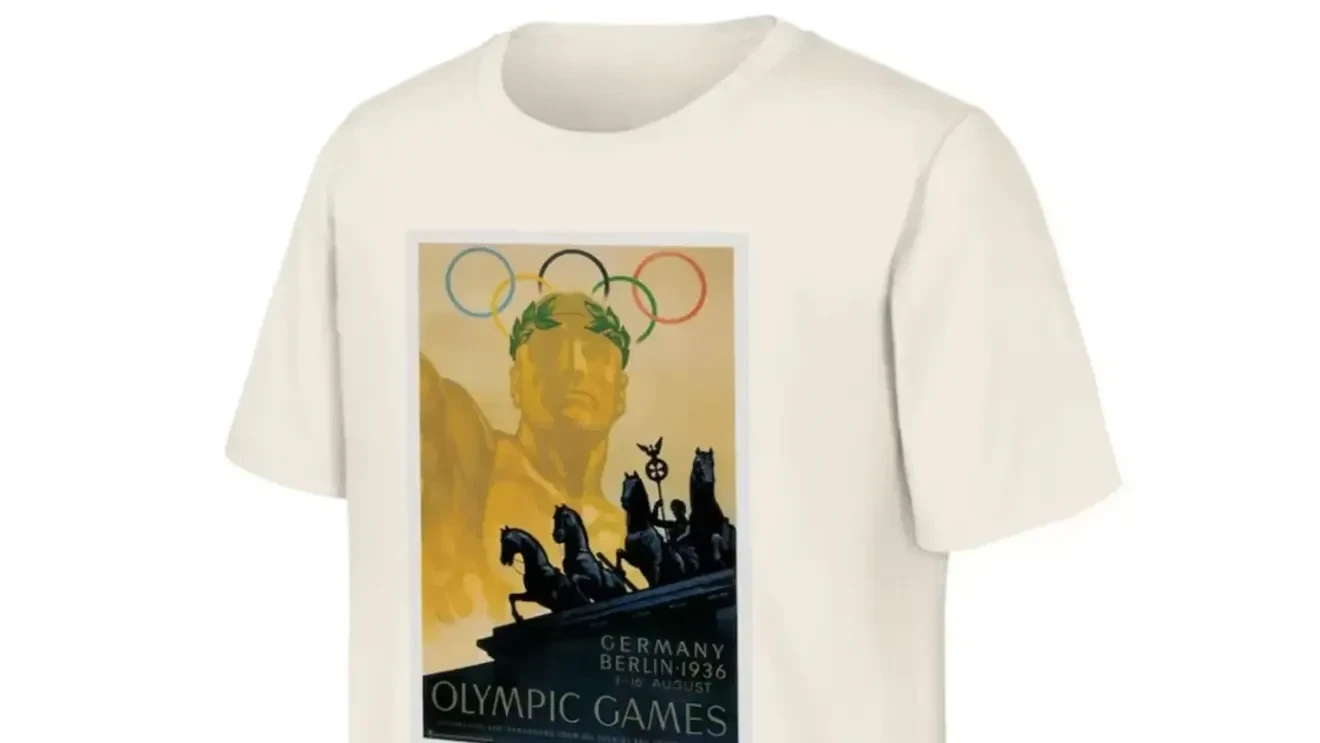
Holocaust advocacy groups have condemned the merchandise, which was part of the IOC’s “Heritage Collection” but has since sold out. The controversial T-shirt featured Franz Würbel’s original 1936 Olympic poster design showing a muscular statue adorned with an Olympic wreath and Berlin’s Brandenburg Gate, along with the text “Germany Berlin 1936 Olympic Games.”
“The Nazis used the 1936 Olympics to showcase their oppressive regime to the world,” explained Christine Schmidt, co-director of the Wiener Holocaust Library, in comments to CNN. “They aimed to smooth over international relations while simultaneously preventing almost all German-Jewish athletes from competing, rounding up the 800 Roma who lived in Berlin, and concealing signs of virulent antisemitic violence and propaganda from the world’s visitors.”
Historians widely acknowledge that Hitler exploited the international sporting event as a propaganda platform to promote his ideology of Aryan racial superiority. The Nazi regime systematically excluded German-Jewish athletes from participation and openly referred to Black athletes as “non-humans.”
Scott Saunders, CEO of International March of the Living, which organizes educational trips to the former Auschwitz concentration camp, emphasized the broader implications of commemorating such an event without proper context. “Sport has the power to unite, to inspire, and to elevate the very best of humanity. But history reminds us that it can also be manipulated to sanitize hatred and normalize exclusion,” Saunders told CNN.
The controversy highlights the complex relationship between sports, politics, and historical memory. The Berlin Olympics, while ostensibly celebrating international athletic competition, took place against the backdrop of the Nazi regime’s escalating persecution of Jews and other minorities, which would ultimately lead to the Holocaust.
Despite the backlash, the IOC defended its decision to sell the merchandise. An IOC spokesperson told CNN that while they “acknowledge the historical issues of ‘Nazi propaganda’ related to the Berlin 1936 Olympic Games,” they believe this did not diminish the athletic accomplishments of the 4,483 athletes from 49 countries who competed in 149 medal events.
The spokesperson specifically highlighted Jesse Owens, the African American athlete who won four gold medals at the Berlin Games, directly challenging Hitler’s notions of Aryan supremacy. Images of Owens giving a traditional salute on the podium while surrounded by others performing the Nazi salute became powerful symbols of resistance to fascism through athletic excellence.
“The historical context of these Games is further explained at the Olympic Museum in Lausanne,” the spokesperson added, noting that only a limited number of T-shirts were produced and sold, which is why they are currently sold out.
The incident raises important questions about how sporting organizations should navigate complex historical events. While the IOC’s Heritage Collection aims to celebrate the legacy of past Olympic Games, critics argue that commemorating the 1936 Berlin Olympics without adequately acknowledging its exploitation by the Nazi regime risks sanitizing a dark chapter in both Olympic and world history.
For Holocaust education organizations, the controversy serves as a reminder of how easily historical memory can be commodified without proper context, potentially undermining efforts to ensure that lessons from one of history’s darkest periods are not forgotten or diminished through commercial memorabilia.
Fact Checker
Verify the accuracy of this article using The Disinformation Commission analysis and real-time sources.

16 Comments
While I appreciate the IOC’s aim to document Olympic history, selling merchandise tied to the 1936 Berlin Games is highly problematic. The Nazis exploited that event to showcase their hateful ideology – the IOC should not be profiting off that shameful legacy.
Exactly. The IOC has a responsibility to be more discerning and sensitive when it comes to products that evoke such a painful and dark chapter. This merchandise is a misstep that they need to promptly rectify.
I’m troubled by the IOC’s move to sell ’36 Berlin Olympics t-shirts. While preserving Olympic history is understandable, this specific event was shamefully exploited by the Nazis for propaganda. Profiting off that legacy is highly insensitive and disrespectful to Holocaust survivors and their families.
I agree completely. The IOC should know better than to commercialize something so deeply tied to the atrocities of the Nazi regime. This is a major misstep that erodes public trust and undermines their role as a global organization. They need to urgently reconsider this decision.
This is a complex issue with valid arguments on both sides. On one hand, the IOC may view the merchandise as a historical commemoration. But given the Nazis’ abhorrent use of the ’36 Olympics for propaganda, I can understand why many find it highly insensitive and inappropriate.
I share your nuanced perspective. There are merits to preserving Olympic history, but not at the expense of ignoring the atrocities committed by the Nazi regime. The IOC should carefully reconsider this merchandise.
I’m quite troubled by the IOC’s decision to sell merchandise tied to the 1936 Berlin Olympics. While the Games themselves hold historical significance, the event was shamelessly exploited by the Nazi regime for their own propaganda purposes. Profiting off that legacy is highly insensitive.
Agreed. The IOC should have known better than to commercialize something with such a dark and painful history. This move is a major misstep that undermines their credibility as a global organization. They need to engage in serious self-reflection on this issue.
I’m very concerned by the IOC’s decision to sell ’36 Berlin Olympics merchandise. While preserving Olympic history is important, this specific event was cynically used by the Nazis for their hateful agenda. Profiting off that legacy is highly disrespectful to Holocaust victims and their families.
Absolutely. The IOC has a moral obligation to be extremely discerning when it comes to commemorating events so inextricably linked to the horrors of Nazi Germany. This merchandise is a clear lapse in judgment that they need to rectify through sincere dialogue and action.
Commemorating the 1936 Berlin Olympics is a sensitive topic given the Nazi regime’s exploitation of the games for propaganda purposes. While the IOC may have historical reasons for including such merchandise, they should carefully consider the ethical implications and impact on Holocaust survivors and their families.
I agree, the IOC needs to be extremely cautious when dealing with this dark chapter of Olympic history. Profiting off merchandise that evokes such a painful legacy is tone-deaf at best, and potentially hurtful to many.
The IOC’s decision to sell ’36 Berlin Olympics merchandise is quite concerning. While preserving Olympic history is important, this specific event was cynically used by the Nazis for propaganda. The IOC should rethink this move out of respect for Holocaust victims and their families.
I agree completely. The IOC needs to show more thoughtfulness and care when commemorating events that were so clearly abused by authoritarian regimes for their own malicious ends. This is a lapse in judgment that requires a swift and sincere response.
The IOC’s decision to sell these ’36 Berlin Olympics t-shirts is highly questionable. While the Olympics themselves hold historical significance, this event was egregiously exploited by the Nazi regime. Profiting off such a legacy is extremely tone-deaf and disrespectful to Holocaust survivors.
Absolutely. The IOC should know better than to commercialize something so inextricably linked to the horrors of Nazi Germany. This is a major misstep that they need to swiftly rectify through sincere dialogue with Holocaust remembrance groups.