


Listen to the article
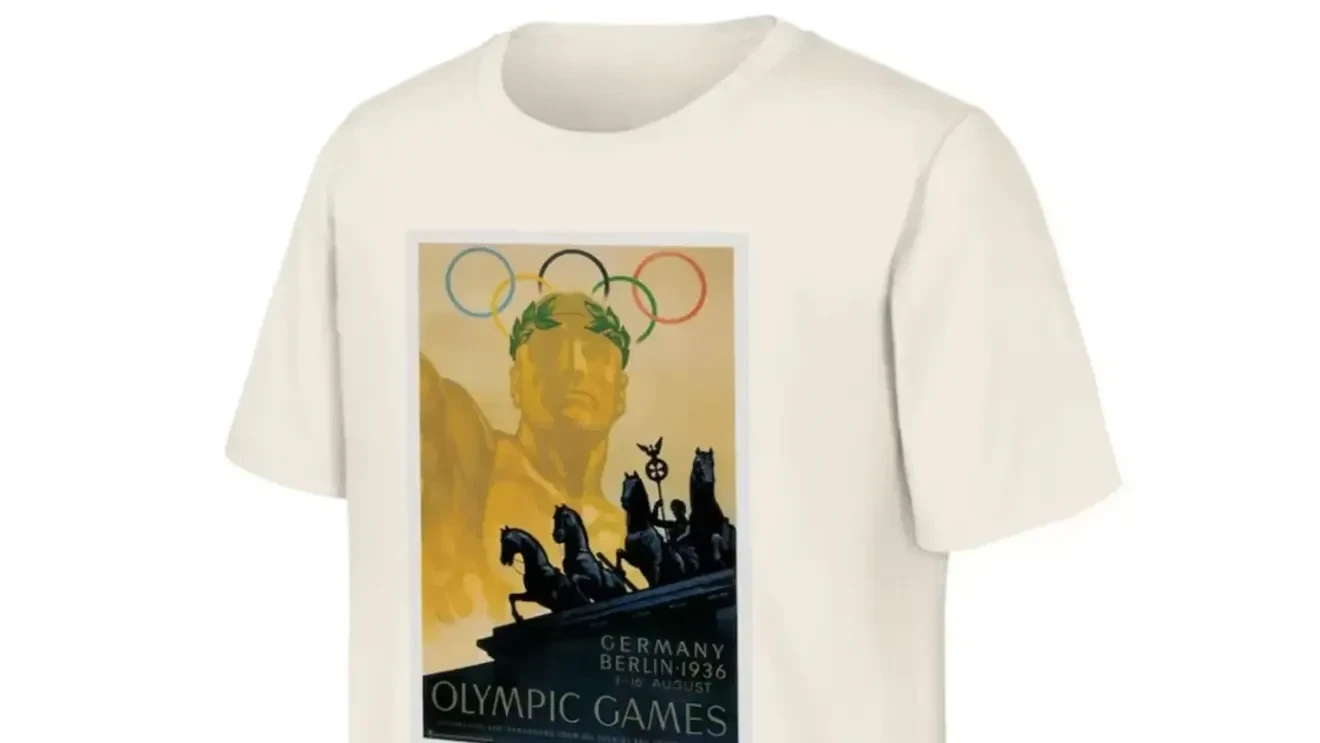
The International Olympic Committee (IOC) has drawn sharp criticism from Holocaust remembrance organizations for selling T-shirts commemorating the 1936 Olympic Games held in Nazi Germany. The controversial merchandise, which recently sold out, has reignited discussions about the ethics of memorializing an event widely regarded as a propaganda platform for Adolf Hitler’s regime.
The shirts, part of the IOC’s “Heritage Collection,” featured Franz Würbel’s original 1936 Olympic poster design showing a muscular statue wearing a wreath, with Berlin’s Brandenburg Gate prominently displayed and the text “Germany Berlin 1936 Olympic Games.”
Holocaust advocacy groups immediately condemned the merchandise, highlighting the historical context that made these particular Games uniquely problematic. The 1936 Olympics took place more than three years after Hitler’s rise to power, during a period when the Nazi regime was systematically implementing discriminatory policies against Jews and other minority groups.
“The Nazis used the 1936 Olympics to showcase their oppressive regime to the world,” explained Christine Schmidt, co-director of the Wiener Holocaust Library, in comments to CNN. “They aimed to smooth over international relations while simultaneously preventing almost all German-Jewish athletes from competing, rounding up the 800 Roma who lived in Berlin, and concealing signs of virulent antisemitic violence and propaganda from the world’s visitors.”
Schmidt further questioned whether “any aesthetic appreciation of these games can be comfortably separated from the horror that followed” – referring to the Holocaust that would begin just a few years later.
Historians widely document how the Berlin Olympics served as a carefully orchestrated international public relations event for Hitler’s government. The regime temporarily removed anti-Jewish signs from public spaces and toned down overt antisemitic rhetoric during the two weeks of competition to present a sanitized image to foreign visitors and media.
Scott Saunders, CEO of International March of the Living, an organization that conducts educational trips to former concentration camps, emphasized the broader implications of commemorating such an event. “Sport has the power to unite, to inspire, and to elevate the very best of humanity. But history reminds us that it can also be manipulated to sanitize hatred and normalize exclusion,” Saunders told CNN.
Despite mounting criticism, the IOC defended its decision to sell the merchandise. An IOC spokesperson acknowledged the “historical issues of ‘Nazi propaganda'” but insisted this didn’t taint the athletic achievements at the Games, particularly highlighting Jesse Owens, the African American athlete who won four gold medals in a powerful rebuke to Nazi racial theories.
“We must also remember that the Games in Berlin saw 4,483 athletes from 49 countries compete in 149 medal events. Many of them stunned the world with their athletic achievements,” the spokesperson stated, adding that “the historical context of these Games is further explained at the Olympic Museum in Lausanne.”
The IOC noted that only a limited number of shirts were produced and sold, which explains why they are currently sold out. The organization has since removed the item from its online store.
The controversy underscores the ongoing challenges faced by sports organizations in navigating the complex historical contexts of past events. While the Olympic Games are celebrated for bringing nations together in peaceful competition, the 1936 Berlin Olympics remain deeply entangled with one of history’s darkest chapters.
This incident comes at a time of rising global antisemitism and growing concerns about historical revisionism, making the IOC’s merchandising decision particularly sensitive. For Holocaust remembrance organizations, the commercialization of an Olympics that excluded Jewish athletes and served as a propaganda platform represents a troubling oversight of historical context and moral responsibility.
Fact Checker
Verify the accuracy of this article using The Disinformation Commission analysis and real-time sources.

10 Comments
I’m curious to hear more about the ethical considerations around commemorating the 1936 Berlin Olympics. What are some ways the IOC could approach this history more sensitively?
While artistic and historical artifacts shouldn’t be erased, the IOC needs to weigh the ethical implications of profiting off the 1936 Berlin Olympics given its Nazi associations.
I appreciate the IOC’s efforts to preserve Olympic history, but selling merchandise linked to the Nazi propaganda machine at the 1936 Games is highly problematic. More thoughtful curation is needed.
The 1936 Berlin Olympics were undoubtedly a propaganda platform for the Nazi regime. I’m surprised the IOC would choose to sell merchandise so closely tied to that dark history.
Agreed, the IOC should be more mindful of the messaging and symbolism it promotes, especially when it comes to events so heavily associated with oppression and human rights abuses.
This is a complex issue without easy answers. On one hand, the 1936 Olympics have historical significance. But the Nazi regime’s exploitation of the event makes it understandably controversial to commemorate.
While the 1936 Olympics posters have artistic merit, the historical context of Nazi Germany makes them inappropriate for casual merchandising. The IOC should reconsider this product line.
Excellent point. Profiting from Nazi imagery, even inadvertently, is highly problematic and disrespectful to Holocaust victims and survivors.
Memorializing the 1936 Berlin Olympics is a sensitive issue given the Nazi propaganda surrounding the event. The IOC should be more thoughtful about how it portrays that history.
I agree, the IOC needs to carefully consider the context and messaging when marketing merchandise related to that Olympics.